

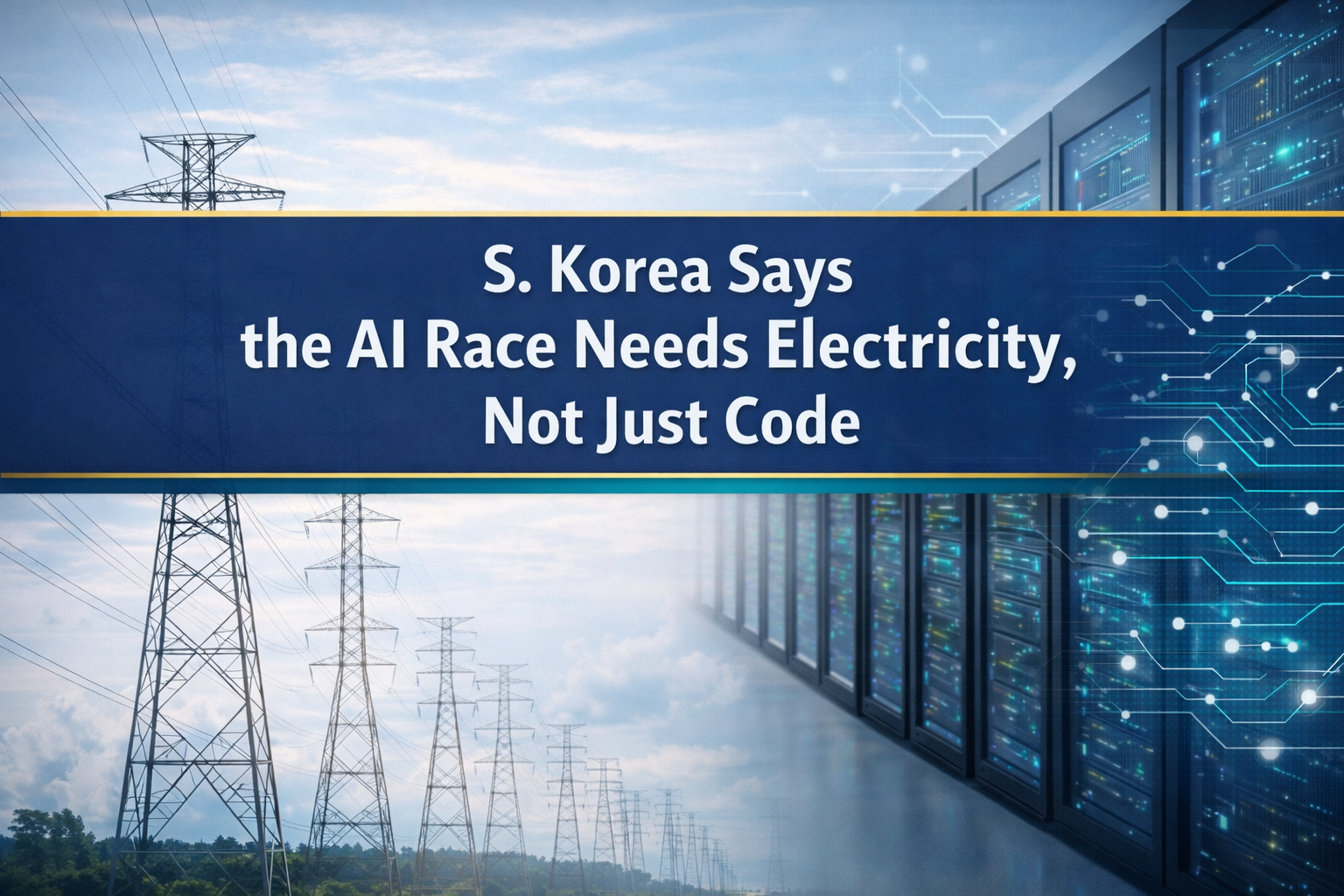
S. Korea Says the AI Race Needs Electricity, Not Just Code
Intermediate | February 18, 2026
✨ Read the article aloud on your own or repeat each paragraph after your tutor.
Why the AI Race Needs Electricity
South Korea’s top presidential policy aide is sending a very practical message: the AI race needs electricity—and a lot of it. He argues that AI is no longer mainly a competition about clever algorithms. Instead, it’s becoming a competition about physical infrastructure like power plants, transmission lines, and chip factories. (AJU Press)
“Code Proliferates, But Power Plants Don’t”
In a Facebook post, presidential policy chief Kim Yong-beom said that AI has evolved into a capital-intensive hardware industry, where scarce resources—such as GPUs, memory chips, transmission lines, and electricity—matter more than software code. He put it bluntly: models and code spread fast, but power plants, transmission networks, and semiconductor fabs cannot be copied overnight. (AJU Press)
The “Paradox” for Korea’s Chip Champions
Kim highlighted what he called a looming paradox: SK hynix and Samsung Electronics produce the world’s most advanced high-bandwidth memory (HBM) used with Nvidia GPUs in overseas data centers, but South Korea itself lacks enough large-scale AI computing clusters to fully benefit from that technology at home. In other words: Korea is helping fuel the AI boom abroad—but may not have enough “AI horsepower” domestically. (AJU Press)
It’s Not a Shortage… It’s Speed and Scale
Interestingly, Kim said South Korea doesn’t face an outright electricity shortage. The deeper problem is delivering power at the scale and speed that AI data centers demand. He also supported the idea of local production and local consumption of electricity—meaning regions that generate power should share the industrial benefits that come from that energy. (AJU Press)
Korea’s Energy Planning Meets the AI Boom
These comments land at an important moment: South Korea is preparing its 12th basic plan for electricity supply and demand, a 15-year blueprint (2026–2040) that will shape the country’s energy mix as AI data-center demand grows. The government previously committed to building two large-scale nuclear reactors under the 11th electricity supply plan finalized in February 2025, signaling that energy policy is being aligned with next-generation industry needs. (AJU Press)
To zoom out: the International Energy Agency says global electricity use by data centres is projected to double to around 945 TWh by 2030, with AI a major driver of the increase. That’s why “electricity-first thinking” is showing up in more and more AI discussions worldwide. (IEA)
Vocabulary
- Policy aide (noun) – a high-level advisor who helps shape government decisions.
Example: “The policy aide warned that energy infrastructure will shape the AI race.” - Power grid (noun) – the network that delivers electricity from producers to users.
Example: “Upgrading the power grid can take years of planning and investment.” - Strategic infrastructure (noun) – essential systems a country treats as critical for national success.
Example: “Kim wants the grid treated as strategic infrastructure.” - Capital-intensive (adjective) – requiring a lot of money to build and operate.
Example: “AI data centers are capital-intensive because they require expensive hardware and energy.” - Commodity (noun) – a basic resource that can be bought and sold.
Example: “Electricity is becoming a key commodity in the AI economy.” - Transmission line (noun) – a high-voltage line that carries electricity long distances.
Example: “Data center hubs need new transmission lines to move power. ” - Semiconductor fab (noun) – a factory where computer chips are manufactured.
Example: “Building a semiconductor fab is a multi-year project.” - Computing cluster (noun) – a group of computers working together as a powerful system.
Example: “Large computing clusters are essential for training advanced AI models.” - Blueprint (noun) – a detailed long-term plan.
Example: “The 12th electricity plan is a blueprint for 2026 to 2040.” - Scale (noun) – the size or capacity needed to handle big demand.
Example: “AI growth requires power at massive scale.”
Discussion Questions (About the Article)
- Why did Kim Yong-beom say the AI race needs electricity, not just code?
- What did he mean by “code spreads fast, but power plants don’t”?
- What is the “paradox” he described for SK hynix and Samsung Electronics?
- Why is the issue about speed and scale, not only about shortages?
- Which part of Korea’s plan (grid upgrades, nuclear, regional benefits) seems most important to you? Why?
Discussion Questions (About the Topic)
- Do you think electricity access will become a competitive advantage for countries? Why?
- If you were a tech CEO, how would you choose where to build an AI data center?
- Should regions that produce electricity receive special benefits? What kind?
- What are the pros and cons of using nuclear power to support AI growth?
- How can countries balance fast growth with stable, affordable energy?
Related Idiom
“No power, no play” – if you don’t have the resources, you can’t compete.
Example: “In the AI boom, it’s almost ‘no power, no play’—without electricity and grid capacity, progress slows down.”
📢 Want more practical English with real-world topics? 👉 Sign up for the All About English Mastery Newsletter! Click here to join us.
Want to finally Master English but don’t have the time? Mastering English for Busy Professionals is the course for you.
Follow our YouTube Channel @All_About_English for more great insights and tips.
This article was inspired by:
- (AJU Press: S.Korea’s top policy aide says AI race hinges on electricity, not code)
- (IEA: Energy and AI — Energy demand from AI)

 English
  한국어
한국어