

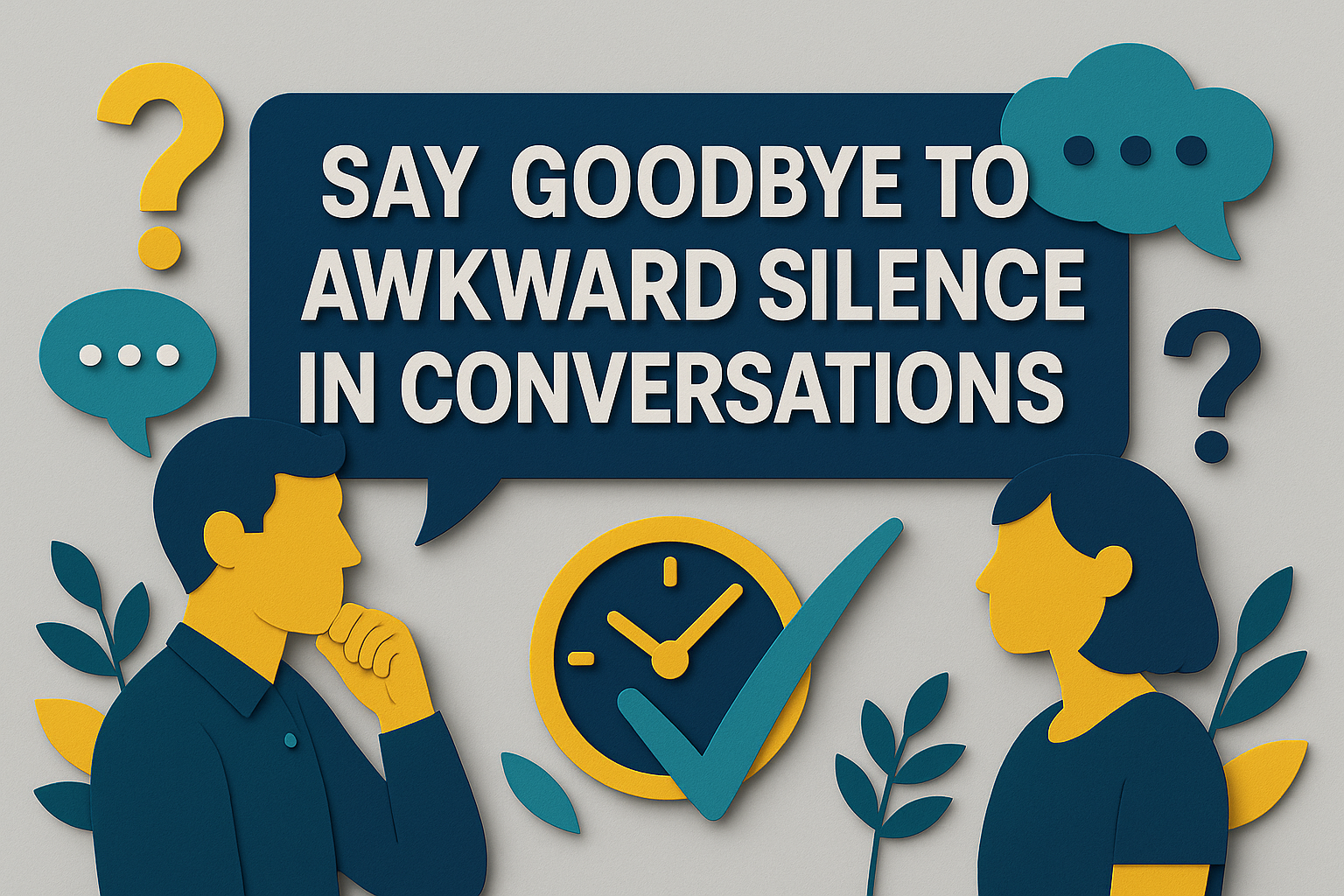
Say Goodbye to Awkward Silence in Conversations 🤝
Advanced Level | October 19, 2025
Read the article aloud on your own or repeat each paragraph after your tutor.
Silence can be golden—except when it isn’t. We’ve all experienced that uncomfortable pause when a conversation suddenly stops and no one knows what to say next. Whether it’s in a meeting, at a networking event, or during small talk with a new colleague, those quiet seconds can feel like hours. But here’s the good news: avoid awkward silence with a few simple strategies that make conversations flow naturally.
Learning how to manage silence in conversation is one of the most powerful communication skills a professional can develop. When you know what to do in those moments, you can transform tension into connection. Let’s look at how you can avoid awkward silence once and for all.
Why Awkward Silence Happens
Silence often appears when we run out of “safe” topics or when our brain needs a moment to process what’s been said. In English, this pause can feel especially stressful for non-native speakers. You might start worrying about grammar, pronunciation, or whether your next idea will sound natural. Ironically, the more you think, the quieter you become.
Instead of fearing silence, recognize it as part of natural conversation. Even native speakers pause. The trick is knowing how to move forward confidently instead of freezing.
Strategy 1: Prepare Simple Follow-Ups
Be Ready Before You Speak
Preparation doesn’t make you sound robotic—it makes you sound confident. Before entering a meeting or chat, think of a few follow-up questions that keep the flow going. For example:
- “That’s interesting—what led you to that idea?”
- “How do you usually handle that situation?”
- “What’s been your biggest challenge with this project?”
These short, open-ended questions give the other person something to build on and show that you’re listening.
Strategy 2: Share Small Details
Use Personal Moments to Spark Connection
When the silence hits, try sharing a small piece of information about yourself or your work. You don’t have to tell a long story—just a sentence or two is enough to spark connection.
For example:
“This week has been busy—I’ve been finalizing a client report.”
That tiny statement invites a natural response like,
“Oh, really? What kind of report?”
Suddenly, the silence is gone.
Strategy 3: Use the “Answer, Add, Ask” Technique
Keep the Flow Going Naturally
This approach comes from the Hidden Conversation Hacks method. It’s called the AAA Rule: Answer, Add, and Ask.
Let’s say someone asks, “How was your weekend?”
You might respond:
“It was great—I went hiking with some friends. What about you?”
You answered, added a little context, and asked a similar question back. It’s natural, balanced, and keeps the energy alive.
Strategy 4: Embrace Short Pauses
Confidence in the Quiet
Not every silence is awkward. Some are necessary for reflection. After asking a meaningful question, give the other person time to think. Avoid jumping in too quickly. A calm, confident pause shows that you’re patient and comfortable. This is especially effective in professional discussions, where thoughtful responses matter more than speed.
Strategy 5: Practice “Soft Landings” to Avoid Awkward Silence
Transition Smoothly Between Topics
When a topic starts to fade, don’t let it crash—guide it gently to the next one. You can do this with phrases like:
- “That reminds me of…”
- “Speaking of that…”
- “On a similar note…”
These transitions make you sound fluent and in control, helping the conversation flow naturally from one idea to another.
Final Thoughts on How to Avoid Awkward Silence
Avoiding awkward silence isn’t about speaking nonstop—it’s about keeping energy and curiosity alive. When you practice open-ended questions, share short insights, and use smooth transitions, you’ll notice your English conversations feel easier and more natural.
Confidence grows from connection—and the best way to build that is by staying engaged, not perfect.
Vocabulary List
- Awkward (adjective) — Uncomfortable or uneasy.
Example: There was an awkward pause during the meeting. - Strategy (noun) — A plan or method for success.
Example: She used a smart strategy to keep the conversation going. - Tension (noun) — A feeling of nervousness or stress.
Example: Small talk helps break the tension in meetings. - Follow-up (noun) — A question or comment that continues a topic.
Example: He asked a good follow-up to show interest. - Engaged (adjective) — Actively involved or interested.
Example: Staying engaged helps you avoid silence. - Flow (noun) — Smooth and continuous movement.
Example: The conversation had a nice flow after they relaxed. - Reflect (verb) — To think carefully about something.
Example: She paused to reflect before answering. - Transition (noun) — A smooth change from one idea to another.
Example: Use transitions like “speaking of” to sound fluent. - Context (noun) — The situation or background information.
Example: Adding context makes your story easier to understand. - Curiosity (noun) — A desire to know or learn more.
Example: Curiosity helps you ask better questions.
5 Questions About the Article
- What are some reasons awkward silence happens in conversation?
- How can preparing follow-up questions help avoid silence?
- What does the AAA Rule stand for?
- Why are short pauses sometimes helpful?
- What are “soft landings,” and how do they help?
5 Open-Ended Discussion Questions
- When was the last time you experienced awkward silence in English?
- Which strategy do you think will help you the most?
- How can you use pauses effectively in your work conversations?
- What types of follow-up questions feel natural to you?
- How do you personally move from one topic to another in conversation?
📢 Want more tips like this? 👉 Sign up for the All About English Mastery Newsletter! Click here to join us!
Want to Master English with confidence and clarity? Check out Mastering English for Busy Professionals — learn the simple 10-minute-a-day method trusted by professionals worldwide.
Follow our YouTube Channel @All_About_English for weekly speaking tips and real-world English practice.

 English
  한국어
한국어