

Outshine Colleagues by Avoiding This Common Mistake ✍️
Advanced Level | February 7, 2026
Read the article aloud on your own or repeat each paragraph after your tutor.
If you want to sound sharp in English at work, you don’t need “fancy” vocabulary—you need clarity. One easy way to outshine others is to avoid vague pronouns at work—especially in emails, chats, and meetings where people read quickly. And one of the most common clarity killers is so small that even advanced learners miss it: vague pronouns.
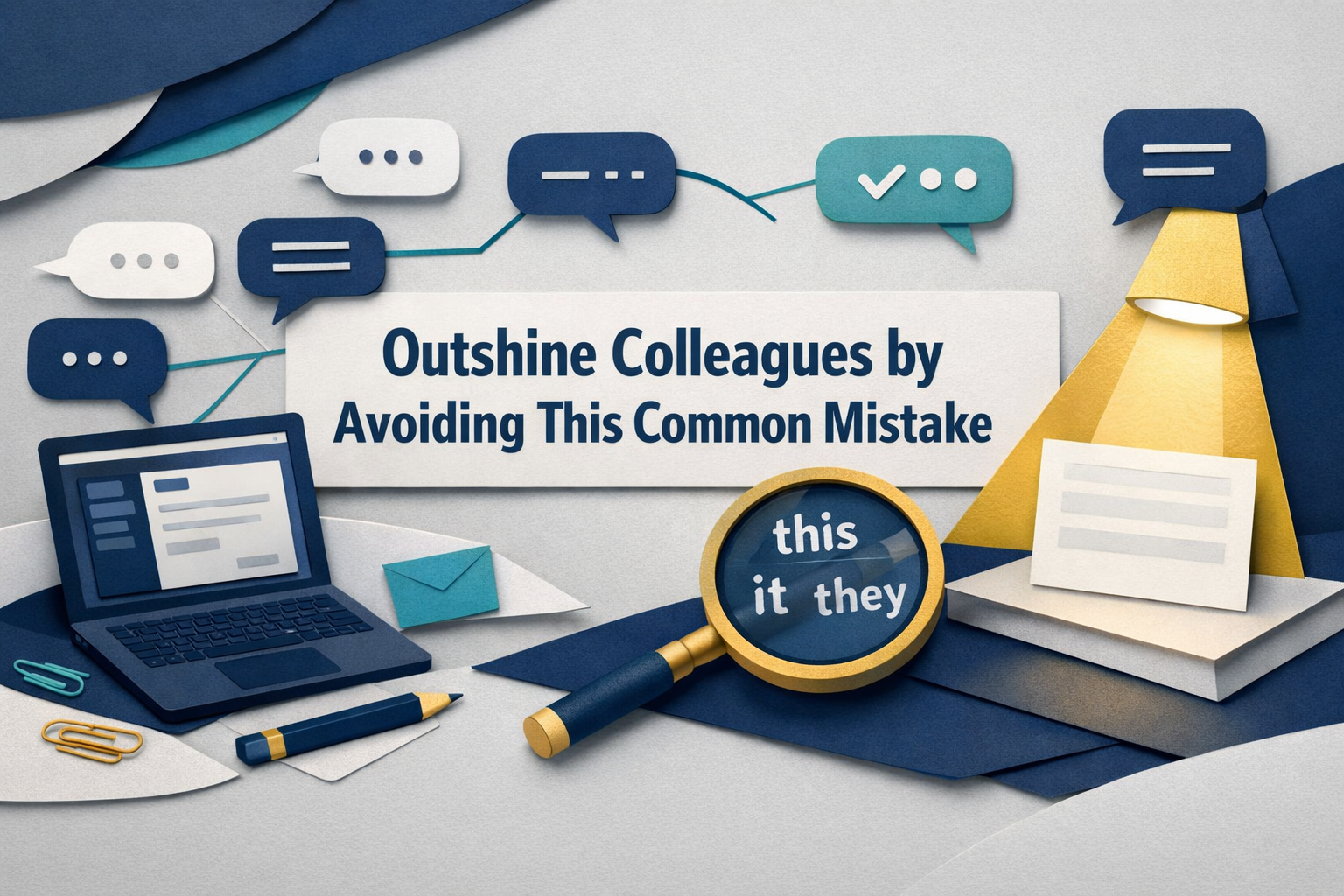
Here’s what I mean. In meetings and emails, people often say this, that, it, they, or he/she… but the listener isn’t 100% sure what those words refer to. The sentence is grammatically correct, but the meaning becomes fuzzy. In business, fuzzy meaning = delays, mistakes, and awkward follow-up questions.
Picture this: you send a message after a meeting. “We need to update it by Friday.” Your coworker replies, “Update what by Friday?” Now you’re forced to backtrack, explain, and (worst of all) you look unprepared—when the real problem is just one unclear word.
Avoid Vague Pronouns at Work: The Common Mistake (“This/It/They” With No Clear Noun)
Vague pronouns happen when the pronoun points to a general idea instead of a specific noun.
- “This is important.” (What is “this”?)
- “It needs approval.” (What is “it”?)
- “They said no.” (Who is “they”?)
These sentences can work in a casual chat because people can guess the meaning. But at work—especially across teams, time zones, and cultures—guessing creates problems.
The Fix: Name the Thing (Then Use the Pronoun)
A simple upgrade is to name the noun once, then use pronouns after that.
- Weak: “This needs to be reviewed.”
- Strong: “The draft proposal needs to be reviewed. It should be ready by Friday.”
- Weak: “They rejected it.”
- Strong: “The procurement team rejected the vendor request.”
Notice what happens: the stronger version feels confident, specific, and professional. You sound like someone who knows exactly what’s going on.
Three Quick “Clarity Upgrades” You Can Use Today
- Replace “this/that” with a noun
- “This caused delays.” → “The missing test data caused delays.”
- Add a short label after the pronoun
- “It’s risky.” → “It’s risky for the timeline.”
- Use a one-line recap before your request
- “Can you review it?” → “Here’s the updated budget sheet. Can you review it today?”
Why This Makes You Stand Out
Clear English is leadership English. When you remove ambiguity, you reduce friction. People respond faster. Meetings run smoother. You get fewer “Wait—what do you mean?” questions. Over time, that reputation adds up: you become the person who communicates cleanly and gets things done.
So the next time you’re about to write “this” or “it,” pause for one second and ask yourself: If someone reads this quickly, will they know exactly what I mean? If not, name the thing. That one-second habit helps you avoid vague pronouns at work and sound more decisive.
Vocabulary List
- ambiguity (noun) — uncertainty about meaning; something that can be understood in more than one way.
Example: Ambiguity in an email can slow down a project. - clarity (noun) — the quality of being easy to understand.
Example: Clarity helps teams make decisions faster. - pronoun (noun) — a word that replaces a noun (e.g., it, this, they).
Example: A pronoun must clearly point to a specific noun. - refer (verb) — to point to or mean something.
Example: In this sentence, “it” refers to the updated schedule. - specific (adjective) — clear and exact, not general.
Example: Be specific about which file you want reviewed. - misunderstanding (noun) — a situation where people don’t understand each other correctly.
Example: A misunderstanding can happen when a message is too vague. - follow-up (noun) — an additional message or action to continue or clarify something.
Example: She sent a follow-up to clarify the deadline. - backtrack (verb) — to return to an earlier point to correct or explain.
Example: He had to backtrack because the instructions were unclear. - friction (noun) — difficulty or tension that slows progress.
Example: Clear communication reduces friction between teams. - recap (noun/verb) — a short summary of what happened or what was said.
Example: Let’s recap the action items before we end the meeting.
5 Questions About the Article
- What is the “common mistake” described in the article?
- Why can vague pronouns create problems at work?
- What is the main fix for unclear words like “this” and “it”?
- What are the three “clarity upgrades” suggested?
- How can clear communication help you stand out professionally?
5 Open-Ended Discussion Questions
- When do you usually write “this” or “it” in your work messages?
- What is one message you sent recently that could be clearer with a stronger noun?
- In your job, what kinds of misunderstandings happen most often—and why?
- How does clear communication affect trust on a team?
- What’s one communication habit you want to improve this month?
📢 Want more practical English like this (short, useful, and made for busy people)? 👉 Sign up for the All About English Mastery Newsletter! Click here to join us!
Want to finally Master English but don’t have the time? Mastering English for Busy Professionals is the course for you! Check it out now!
Follow our YouTube Channel @All_About_English for more great insights and tips


 English
  한국어
한국어