

US Condemns China Drills Near Taiwan: Why the Wording Matters
Intermediate | January 9, 2026
✨ Read the article aloud on your own or repeat each paragraph after your tutor.
A Tense Week in the Taiwan Strait
This week, the United States publicly criticized China’s latest war games near Taiwan, calling them “highly provocative” and saying they raised tensions unnecessarily. In simple terms, China drills near Taiwan are getting so close and so frequent that even careful diplomatic language is starting to sound like a warning. In a statement reported by multiple outlets, the U.S. urged Beijing to exercise restraint, stop military pressure, and return to meaningful dialogue instead of using force and intimidation. (CBS News)
What Happened: “Justice Mission 2025” and a Blockade Scenario
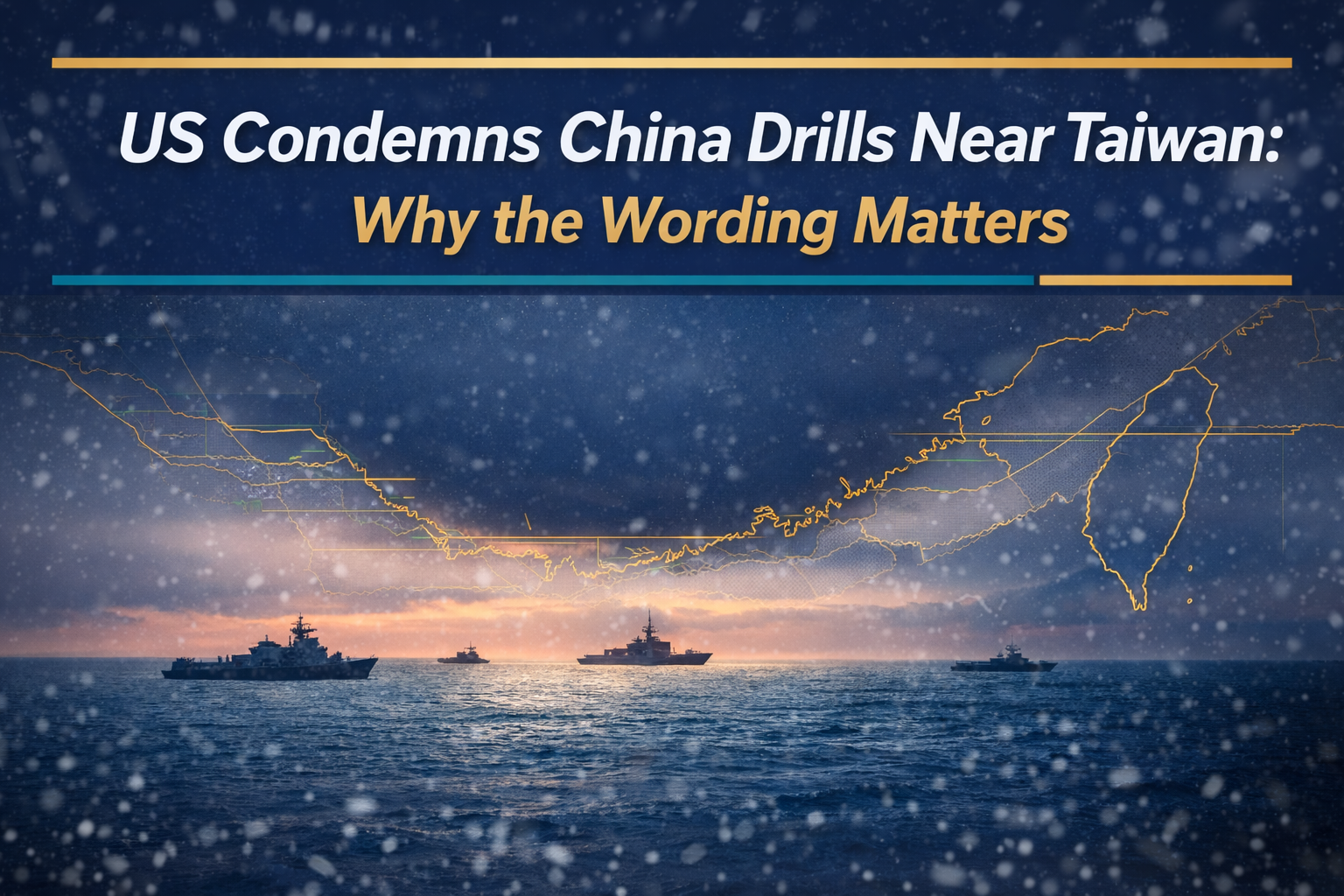
According to reporting from Taipei and international agencies, China’s People’s Liberation Army (PLA) ran two days of live-fire drills on Monday and Tuesday, in exercises code-named “Justice Mission 2025.” The drills were described as simulating a blockade around Taiwan, a route that matters globally because the Taiwan Strait is one of the world’s busiest shipping lanes. (Taipei Times, CBS News)
The Detail That Got Everyone’s Attention: Rockets Landed Very Close
Taiwan’s Ministry of National Defense said the PLA fired 27 rockets on the second day of drills—and 10 of them landed inside Taiwan’s contiguous zone, which reaches 24 nautical miles (44.4 km) from the coast. Taipei called the activity the closest-ever Chinese live-fire to Taiwan. For many observers, that’s not just “training.” It’s a pressure move with real risk. (Taipei Times)
China drills near Taiwan: Why the U.S. Chose Strong Language
In business, wording matters—because wording signals priorities. In this case, U.S. officials said China drills near Taiwan “increase tensions unnecessarily” and warned against unilateral changes to the “status quo,” especially “by force or coercion.” That language is meant to calm allies, deter escalation, and keep the “rules of the game” clear, even when the situation is messy. (Taipei Times, CBS News)
Bigger Picture: Weapons Sales, Global Reactions, and Competing Narratives
The drills also landed in the middle of bigger political friction. Reports noted a recently announced US$11 billion weapons package for Taiwan, which China framed as “external interference.” Meanwhile, several governments—including the EU, UK, France, Germany, Australia, New Zealand, Japan, the Philippines, Canada, and others—voiced concerns in the days before the U.S. statement. China responded by calling Taiwan an “internal affair” and urged others to follow the “one China” principle. (Taipei Times)
What This Could Mean Next
After China said the drills were complete, Taiwan said it would stay on alert because Chinese aircraft and vessels remained active in nearby areas. That’s the stressful part of these situations: even when the “official” drills end, the tension can stay on the table. For students, this is also a great real-world example of how governments use words like restraint, pressure, and coercion—not just as vocabulary, but as strategy. (Reuters, AP News)
Vocabulary
- condemn (verb) — to publicly criticize strongly.
Example: “The U.S. condemned the latest drills as dangerous.” - exercise (noun) — a planned military training event.
Example: “The exercise simulated a blockade around Taiwan.” - provoke (verb) — to cause a reaction, often anger or conflict.
Example: “Many leaders said the drills could provoke a crisis.” - tension (noun) — a stressful situation between groups or countries.
Example: “The drills increased tension in the region.” - restraint (noun) — holding back from extreme action.
Example: “The U.S. urged China to show restraint.” - pressure (noun) — force used to influence someone’s behavior.
Example: “Taipei said China is using military pressure.” - dialogue (noun) — serious conversation aimed at solving problems.
Example: “Officials called for dialogue instead of threats.” - blockade (noun) — stopping ships or traffic from entering or leaving.
Example: “The drills practiced a blockade of major ports.” - contiguous zone (noun) — waters near a country where it can enforce certain laws.
Example: “Some rockets landed in Taiwan’s contiguous zone.” - coercion (noun) — forcing someone to act through threats or pressure.
Example: “The statement opposed changes made through coercion.”
Discussion Questions (About the Article)
- What did the U.S. criticize, and what words did it use to describe the drills?
- Why is the detail about rockets landing in the contiguous zone important?
- What is a blockade, and why would a military drill simulate one?
- How do you think government statements can affect markets and business confidence?
- What do you think is the biggest risk during drills like these: accidents, miscommunication, or political escalation?
Discussion Questions (About the Topic)
- Why do countries conduct military exercises near borders or disputed areas?
- Should public statements be calm and neutral, or strong and direct? Why?
- How can a “misunderstanding” turn into a bigger conflict?
- What role do alliances and international partners play in regional security?
- What actions can reduce tension without making either side “lose face”?
Related Idiom / Phrase
“Turn up the heat” — to increase pressure or intensity.
Example: “By running drills so close to Taiwan, China is turning up the heat to test reactions from Taipei and Washington.”
📢 Want more real news made simple for English practice? 👉 Sign up for the All About English Mastery Newsletter! Join here: Join the newsletter
Want to finally master English but don’t have the time? Mastering English for Busy Professionals is built for you: Explore the course
Follow our YouTube Channel @All_About_English for more: Subscribe on YouTube
This article was inspired by: Taipei Times, CBS News, Reuters, AP News, and Al Jazeera.


 English
  한국어
한국어