

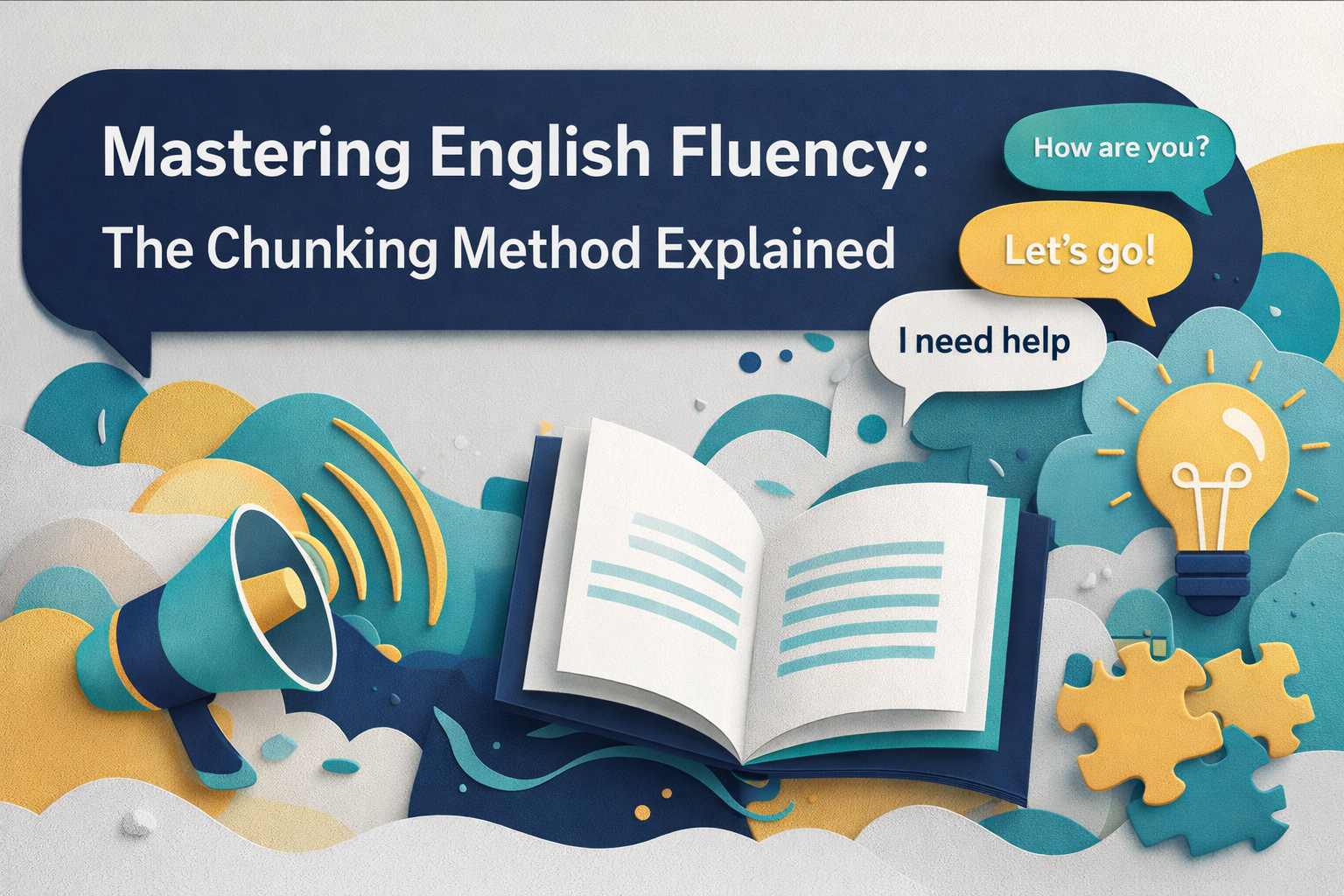
Mastering English Fluency: The “Chunking Method” Explained 🌟
Intermediate Level | February 24, 2026
Read the article aloud on your own or repeat each paragraph after your tutor.
If you’ve ever tried to speak English in a meeting and felt your brain buffering like slow Wi‑Fi… you’re not alone. A lot of busy professionals know the words, but they freeze when they try to build a sentence in real time. That’s usually because they’re trying to speak one word at a time. In this lesson, you’ll learn the chunking method for English fluency so you can speak faster with less stress.
Here’s the good news: fluent speakers don’t build sentences like Lego bricks. They speak in chunks—small groups of words that come out together. Think of chunks like “ready-made phrase packs” your brain can grab quickly.
The Chunking Method for English Fluency
The chunking method for English fluency means learning and using English in natural word groups, not single words. For example, instead of learning the word update, you learn a chunk like “quick update on…” or “just to give you an update…”. These chunks are common in real business English, so they sound natural and save you time when you speak.
Why Chunking Makes You Sound More Fluent
When you speak in chunks, you don’t need to “build” every sentence from scratch. Your brain can focus on the idea instead of the grammar. That reduces hesitation, improves rhythm, and makes your speaking smoother—especially in meetings, phone calls, and presentations.
How to Use Chunking at Work (The 3-Step Routine)
Step 1: Collect Useful Chunks
Pick chunks that match your real life. If you lead meetings, collect chunks like “Let’s kick things off…” or “Before we wrap up…”. If you work in tech, you might use “The main issue is…” or “Here’s what we found…”.
Step 2: Practice Aloud (Short + Daily)
Don’t just read chunks—say them out loud. Choose 5 chunks and repeat each one 10 times. Yes, you’ll feel a little ridiculous. That’s fine. You’re training your mouth, not just your memory.
Step 3: Plug Chunks Into Real Sentences
Chunks are like a sentence “starter kit.” Example:
- Chunk: “Just to clarify…”
- Full sentence: “Just to clarify, are we changing the deadline or the scope?”
When you can do that quickly, your confidence goes up—and your English sounds more professional.
Mini Practice: 6 Powerful Meeting Chunks
Try these today:
- “Let’s take a step back…”
- “From my perspective…”
- “To be honest…”
- “If I understand you correctly…”
- “What I’m hearing is…”
- “Let’s circle back to that…”
Say each one slowly, then say it faster with a natural rhythm.
The Secret: Chunks Beat “Perfect Grammar”
A lot of learners think fluency means knowing every grammar rule. But real fluency is speed + clarity + comfort. Chunking helps you speak faster without sounding messy. You’ll still improve grammar over time—but you won’t be stuck in silence while you wait.
If you want to speak more confidently this week, don’t memorize 50 new words. Memorize 10 useful chunks, practice them out loud, and use them in one real conversation.
Vocabulary List
- Fluency (noun) — The ability to speak smoothly and easily.
Example: Her fluency improved after she practiced speaking every day. - Chunk (noun) — A small group of words learned and used together.
Example: “Just to clarify” is a useful chunk for meetings. - Hesitate (verb) — To pause because you are unsure what to say.
Example: I hesitate less when I use common phrases I already know. - Rhythm (noun) — A natural flow and pattern of speech.
Example: Chunking helps your rhythm sound more natural. - Scope (noun) — The size or limits of a project or task.
Example: We need to confirm the scope before we set the timeline. - Clarify (verb) — To make something clearer or easier to understand.
Example: Can you clarify what you mean by “priority” here? - Natural (adjective) — Sounding normal and not forced.
Example: That phrase sounds natural in business conversations. - Routine (noun) — A regular way of doing something.
Example: A short daily routine is easier to keep than long weekly study sessions. - Plug in (phrasal verb) — To insert something into a place where it fits.
Example: You can plug in a chunk at the start of many sentences. - Confidence (noun) — A strong belief that you can do something well.
Example: My confidence increased after I used English in a real meeting.
5 Questions About the Article
- Why do many professionals freeze when they try to speak English?
- What is the chunking method?
- How does chunking help your speaking speed?
- What are the three steps of the chunking routine?
- Write one full sentence using the chunk “If I understand you correctly…”
5 Open-Ended Discussion Questions
- In what situations do you feel most nervous speaking English at work?
- What are three chunks you would like to use in meetings?
- How could you practice chunks in your daily schedule (morning, commute, lunch, etc.)?
- What’s one phrase you often translate from your native language that sounds unnatural in English?
- If you practiced 10 chunks for one week, what change do you think you would notice?
📢 Want more practical English you can use immediately? 👉 Sign up for the All About English Mastery Newsletter! Click here to join us!
Want to finally Master English but don’t have the time? Mastering English for Busy Professionals is the course for you! Check it out now!
Follow our YouTube Channel @All_About_English for more great insights and tips.


 English
  한국어
한국어