

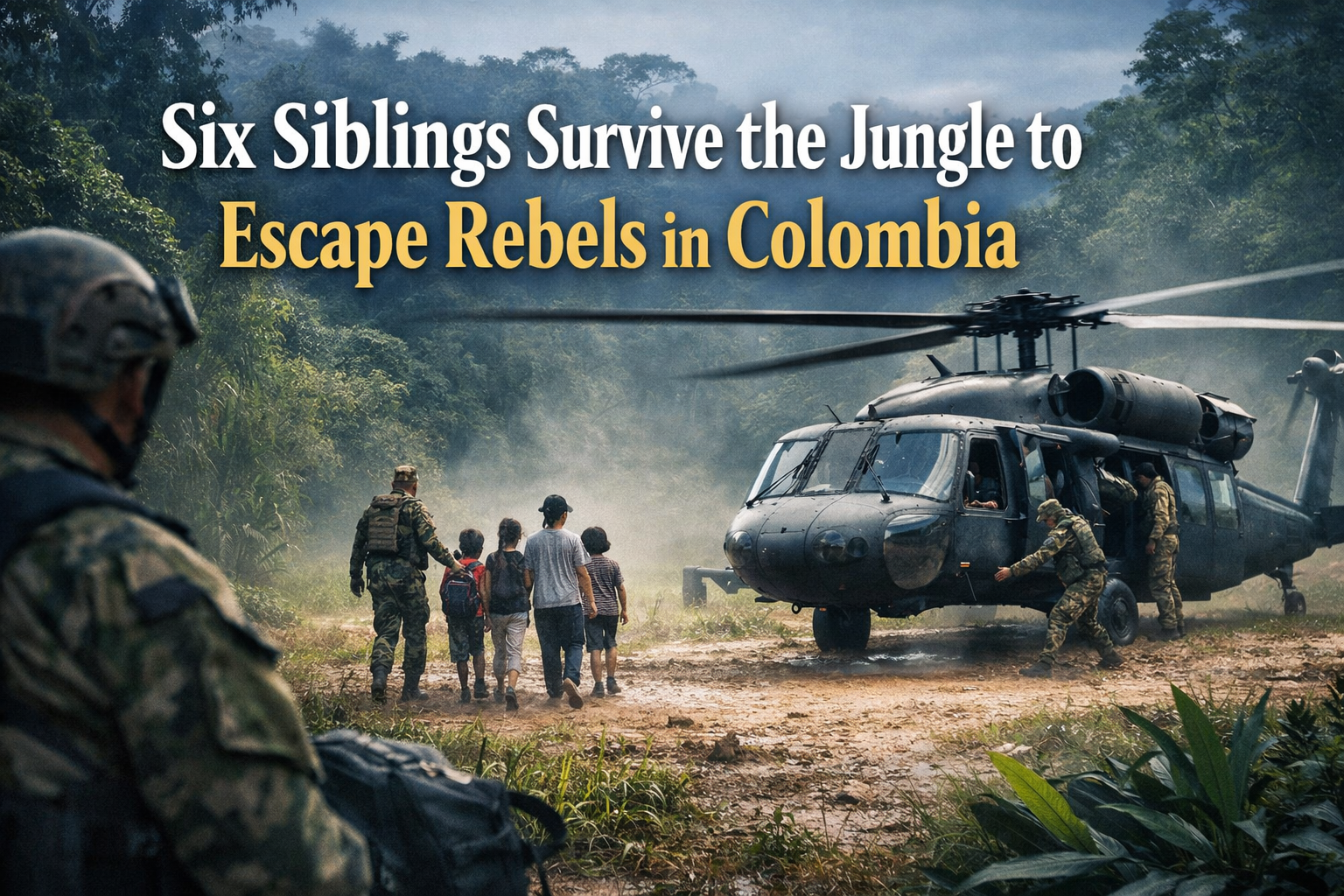
Six Siblings Survive the Jungle to Escape Rebels in Colombia
Advanced | April 10, 2026
✨ Read the article aloud on your own or repeat each paragraph after your tutor.
A Frightening Escape in Rural Colombia
In one of the most dramatic stories out of Colombia this spring, six siblings were rescued after hiding in the rainforest for three days. According to the Associated Press, the children had gone into hiding in the southwestern province of Caquetá because a rebel group was trying to seize them after kidnapping their parents. Five of the siblings were minors, and the oldest was an adult sister. Colombia’s defense minister said the army carried out a helicopter rescue and airlifted them from the remote area. (AP News)
Why the Colombia Siblings Escape Rebels Story Matters
The Colombia siblings escape rebels story is not only about one family. It also shines a light on a much bigger problem in Colombia’s long-running conflict. The children were hidden near the family’s farm in the municipality of Cartagena del Chairá after their parents escaped captivity and ran to a military base for help. Once the parents shared the children’s location, the army moved in and rescued them in the early hours of Tuesday. (The Washington Post)
A Rebel Group Under Scrutiny
Authorities said the group behind the threat was led by Alexander Díaz, also known as Calarcá, a former FARC commander who rejected Colombia’s 2016 peace deal. AP reported that his group, known as the EMBF, is still in peace talks with President Gustavo Petro’s administration, even though it had agreed last year not to recruit minors. (AP News) That detail gives this case an especially bitter edge. On paper, there was an agreement. In real life, one family still had to run for its life.
Child Recruitment Is Still a Major Risk
This is where the bigger picture gets even more serious. UNICEF said in February that the recruitment and use of children by armed groups in Colombia has quadrupled over the past five years. The agency also said that, based on U.N.-verified figures, one child is recruited or used by an armed group in Colombia every 20 hours. (UNICEF) In other words, this was not some isolated jungle nightmare. It fits into a broader trend that continues to put children and families at risk.
Peace Talks, Old Problems
Reuters has reported that Díaz’s faction remains in talks with President Gustavo Petro, while Colombia’s wider peace efforts have struggled to produce strong results. AP also noted that Petro’s “total peace” strategy has shown few results so far. (Reuters) That makes this rescue story feel like more than just a lucky ending. It also raises a tough question: if peace talks are moving forward, why are children still being hunted by armed groups?
A Story of Fear, Courage, and Survival
At a human level, this story is hard to forget. Imagine being a child and spending three days in the rainforest, hiding quietly because armed men may be looking for you. It sounds like a movie plot, but for this family, it was real life. The good news is that the siblings survived and were rescued. Still, the Colombia siblings escape rebels case reminds us that in some parts of the world, childhood can still be shaped by conflict instead of safety.
Vocabulary
- Rescue (noun/verb) – to save someone from danger.
Example: The army carried out a rescue in a remote part of Caquetá. - Sibling (noun) – a brother or sister.
Example: The six siblings stayed together while hiding in the rainforest. - Captivity (noun) – the state of being held by force.
Example: The children’s parents escaped captivity before the rescue took place. - Remote (adjective) – far away from towns or cities.
Example: The family was found in a remote jungle area. - Airlift (verb/noun) – to move people by aircraft, especially in an emergency.
Example: The army airlifted the children out of the dangerous area. - Rebel group (noun) – an armed group fighting against the government.
Example: The rebel group was accused of trying to capture the children. - Province (noun) – a region within a country.
Example: The rescue happened in the province of Caquetá. - Recruitment (noun) – the act of bringing people into an organization or group.
Example: Child recruitment remains a major concern in Colombia. - Ceasefire (noun) – an agreement to stop fighting for a period of time.
Example: Critics say some armed groups have used ceasefires to regroup. - Conflict (noun) – a long period of fighting or serious disagreement.
Example: Colombia’s internal conflict has affected families for decades.
Discussion Questions (About the Article)
- Why did the six siblings hide in the rainforest?
- How were the children finally rescued?
- What role did the parents play in the rescue operation?
- Why is the involvement of the EMBF especially troubling?
- What does this story suggest about the limits of peace talks in Colombia?
Discussion Questions (About the Topic)
- Why do armed groups target children in conflict zones?
- What can governments do to protect children in remote rural areas?
- Do peace talks mean much if civilians are still under threat? Why or why not?
- Why might families be afraid to report child recruitment cases?
- How should the international community respond when children are threatened by armed groups?
Related Idiom or Phrase
“Caught in the crossfire”
This phrase means being harmed by a conflict or fight that you are not really part of.
Example: These children were caught in the crossfire of Colombia’s long-running armed conflict.
📢 Want more practical English practice with real-world stories? Sign up for the All About English Mastery Newsletter! Click here to join us.
Want to finally master English but don’t have the time? Mastering English for Busy Professionals is built for busy people like you.
Follow our YouTube Channel @All_About_English for more useful English tips and real-world practice.
This article was inspired by AP News, The Washington Post, UNICEF, and Reuters.


 English
  한국어
한국어