
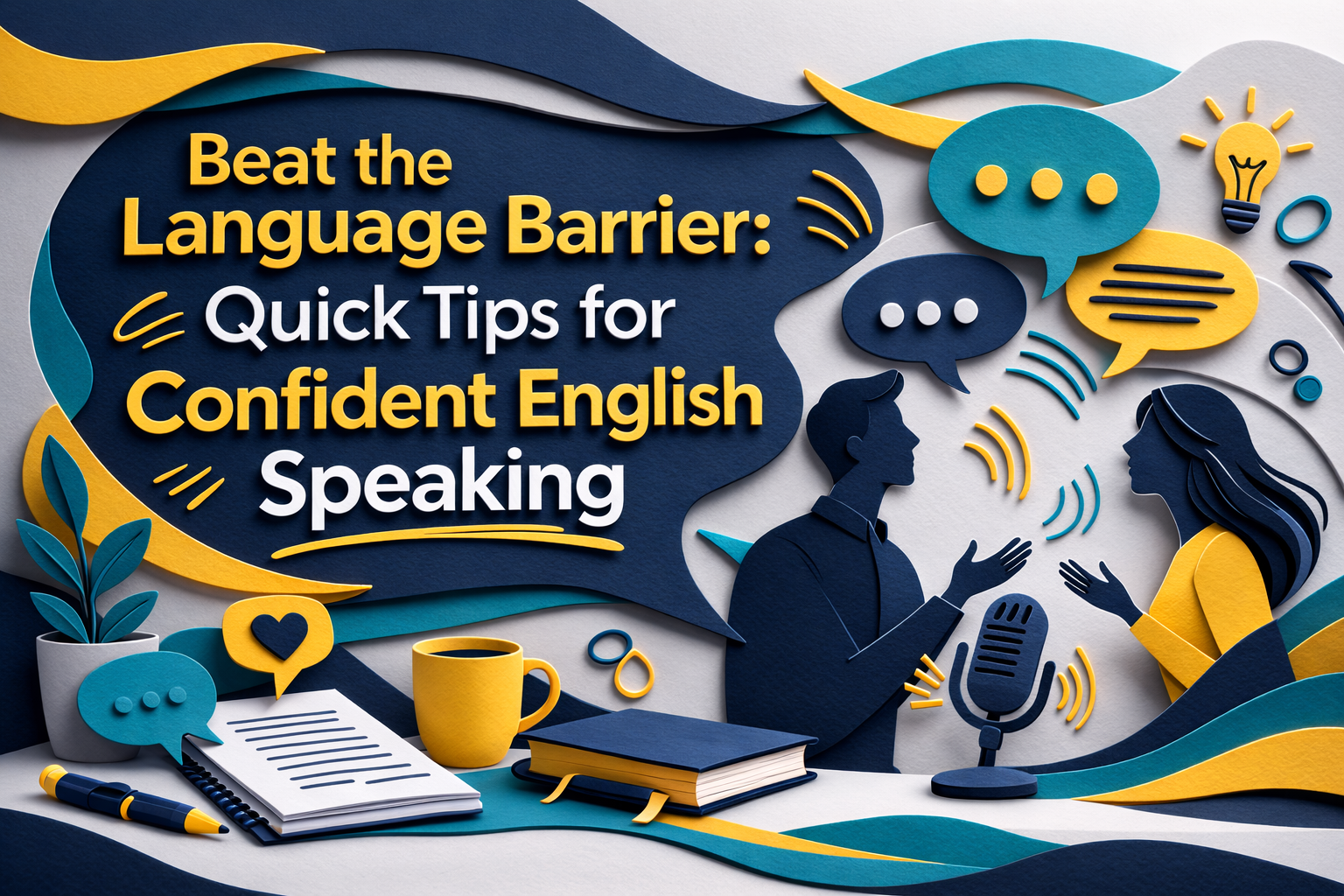
Beat the Language Barrier: Quick Tips for Confident English Speaking 🗣️
Beginner Level | March 5, 2026
Read the article aloud on your own or repeat each paragraph after your tutor.
Why Speaking English Can Feel So Hard
Many professionals can read English emails and understand meetings, but they still feel nervous when they need to speak. You may know the right words, but your voice gets quiet. Your mind goes blank. The good news is: confidence is a skill, and you can build it.
Five Quick Tips for Confident English Speaking
Tip 1: Choose “Clear English,” Not “Perfect English”
First, change your goal. Don’t aim for “perfect English.” Aim for “clear English.” Clear English is simple, direct, and easy to understand. When you focus on clarity, you feel less pressure—and you speak more.
Tip 2: Use Short Sentences
Second, use short sentences. If you try to speak in long sentences, you may get lost in the middle. Short sentences help you stay in control. For example: “I have a question.” “I need help.” “Let me explain.” Simple sentences are powerful.
Tip 3: Use a Simple Conversation Pattern (Answer + Add + Ask)
Third, use a simple conversation tool: Answer + Add + Ask. If someone asks, “How was your weekend?” you can say, “It was good. I rested at home. How about you?” This keeps the conversation moving, even with beginner English.
Tip 4: Prepare Starter Phrases for Work
Fourth, prepare “starter phrases” for common moments at work. Use the same phrases again and again until they feel natural. Try these: “Can you say that again?” “What do you mean by that?” “Let me check and get back to you.” These phrases buy you time and help you speak calmly.
Tip 5: Practice Out Loud Every Day (3–5 Minutes)
Fifth, practice out loud every day for 3–5 minutes. Pick one short paragraph (like one paragraph from this article). Read it aloud. Then record yourself on your phone and listen once. You will notice improvement faster than you expect.
One Final Reminder
Finally, remember this: people don’t need perfect grammar. They need your idea. If your message is clear, you will sound confident—even with a small accent. Speak up. Little by little, you will break the language barrier.
Vocabulary List
- barrier (noun) — something that blocks progress or makes something difficult.
Example: Fear can be a barrier to speaking English at work. - confident (adjective) — feeling sure about yourself.
Example: She sounded confident during the meeting. - clear (adjective) — easy to understand.
Example: Please use clear words when you explain the plan. - pressure (noun) — stress or a strong feeling that you must do well.
Example: He felt pressure to speak perfectly in English. - direct (adjective) — simple and straight to the point.
Example: A direct answer is often best in business. - tool (noun) — something that helps you do a task.
Example: The AAA method is a useful conversation tool. - phrase (noun) — a short group of words used together.
Example: “Can you repeat that?” is a helpful phrase. - repeat (verb) — to say something again.
Example: Could you repeat your last sentence, please? - prepare (verb) — to get ready.
Example: I prepare two questions before every meeting. - improve (verb) — to become better.
Example: You can improve your speaking with daily practice.
5 Questions About the Article
- Why do many professionals feel nervous when they speak English?
- What is a better goal than “perfect English”?
- Why are short sentences helpful?
- What are the three steps in “Answer + Add + Ask”?
- What is one daily practice tip from the article?
5 Open-Ended Discussion Questions
- When do you feel most nervous speaking English (meetings, phone calls, small talk, presentations)? Why?
- What are three “starter phrases” you want to use more often?
- What is one situation this week where you can practice Answer + Add + Ask?
- If you could speak English confidently, what would change in your work life?
- What daily speaking habit feels realistic for you: 3 minutes, 5 minutes, or 10 minutes?
📢 Want more practical English you can actually use at work? 👉 Sign up for the All About English Mastery Newsletter! Click here to join us!
Want to finally Master English but don’t have the time? Mastering English for Busy Professionals is the course for you! Check it out now!
Follow our YouTube Channel @All_About_English for more great insights and tips

 English
  한국어
한국어