

Stop Saying “Give Me Suggestion!”: Correct Usage Explained ✍️
Intermediate Level | April 3, 2026
Read the article aloud on your own or repeat each paragraph after your tutor.
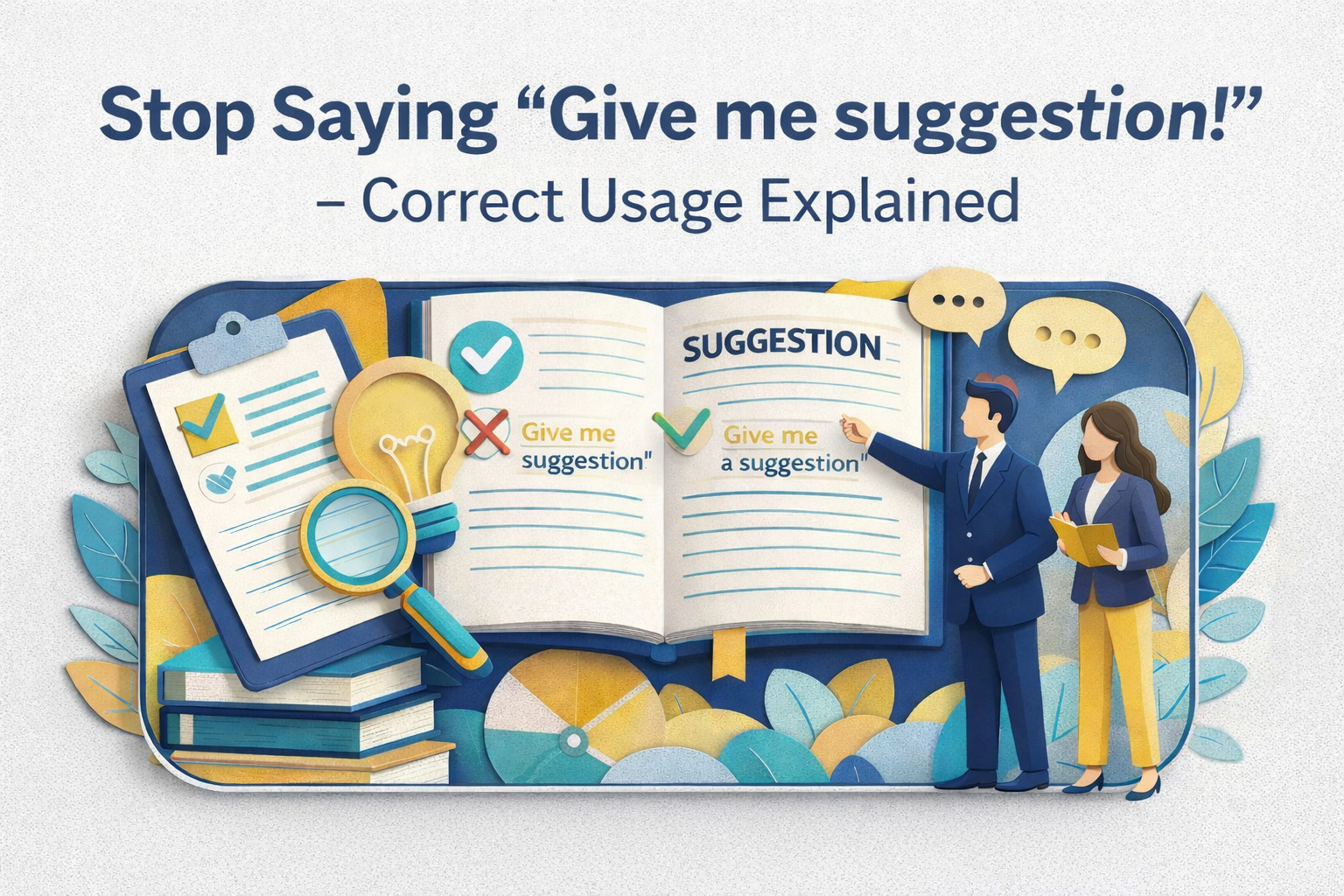
Have you ever said, “Please give me suggestion” in English? Don’t worry—you are not alone. Many English learners say this because it sounds logical. After all, suggestion is a real English word. But in natural English, this phrase is not correct. Native speakers usually say “give me a suggestion” or “give me some suggestions.” This is a small grammar point, but it can make a big difference in how natural and polished your English sounds.
For busy professionals, this matters more than you might think. You may need advice from a manager, feedback from a client, or ideas from a teammate. In those moments, using the right phrase helps you sound clearer and more confident. This is where correct usage explained in a simple way can make a real difference. Good grammar is not just about rules on paper. It helps you build trust and avoid confusion in real conversations at work.
Why “Give Me Suggestion” Sounds Wrong
The problem is simple: suggestion is usually a countable noun. That means it normally needs an article like a or a number, or it needs to be plural. You can say a suggestion, one suggestion, or some suggestions. But saying only suggestion by itself sounds incomplete in most situations. It is like saying, “Please give me idea.” Something is missing.
Here are the most natural choices. You can say, “Can you give me a suggestion?” if you want one idea. You can say, “Can you give me some suggestions?” if you want more than one. You can also use more natural business English like “Do you have any suggestions?” or “Could you give me some advice?” These phrases sound smooth, natural, and professional.
Countable vs. Uncountable Nouns
This mistake happens because English has countable and uncountable nouns, and they do not behave the same way. A countable noun can be counted: one suggestion, two suggestions. An uncountable noun usually does not take a in the same way: advice, information, feedback. That is why we say “some advice” but “a suggestion.” This small difference causes a lot of trouble for learners, but once you notice it, your grammar gets much stronger.
Think about the workplace. Your boss finishes a presentation and asks for feedback. You could say, “I have a suggestion.” If your team is discussing a new plan, you might say, “I have a few suggestions.” If you want help, you can ask, “Do you have any suggestions for improving this?” These are practical phrases you can use right away in meetings, emails, and conversations.
Correct Usage Explained for Professional Situations
Let’s make this even more useful. Imagine you are writing to a coworker. Instead of writing, “Please give me suggestion,” you could write, “Could you give me a suggestion?” or “Could you share some suggestions?” Both sound much better. In conversation, you might say, “I’d like a suggestion about how to improve this report.” That sounds clear, polite, and professional.
Common Natural Alternatives
Here are some strong alternatives you can start using today: “Do you have any suggestions?” “Can you give me a suggestion?” “Could you share some ideas?” “Do you have any advice?” Notice that each phrase fits a slightly different situation. Suggestion is often a specific idea. Advice is broader and more general. Ideas sounds flexible and collaborative. Choosing the right word helps you sound more natural and more aware of the situation.
The good news is that this is an easy fix. Once you stop saying “give me suggestion” and start using the correct form, your English will sound more natural almost immediately. In other words, this is correct usage explained in a way you can apply right away at work. It is one of those small changes that gives you a big return. Pretty nice deal for such a tiny grammar gremlin.
So the next time you want help, remember this: ask for a suggestion, some suggestions, or advice. Keep practicing these patterns out loud until they feel automatic. Small corrections like this help you speak more accurately, write more clearly, and sound more confident in professional English.
Vocabulary List
- countable (adjective) — able to be counted as individual items
Example: “Suggestion” is a countable noun, so it often needs an article or plural form. - uncountable (adjective) — not usually counted as separate items in grammar
Example: “Advice” is an uncountable noun, so we do not usually say “an advice.” - article (noun) — a word like a, an, or the used before a noun
Example: You need an article in the phrase “a suggestion.” - plural (adjective/noun) — showing more than one
Example: “Suggestions” is the plural form of “suggestion.” - grammar (noun) — the rules for using a language correctly
Example: Good grammar helps your message sound clear and professional. - natural (adjective) — sounding normal and correct to native speakers
Example: “Do you have any suggestions?” sounds more natural in English. - polished (adjective) — smooth, professional, and well-prepared
Example: Correct word choice makes your English sound more polished. - feedback (noun) — comments or opinions about something to help improve it
Example: The manager asked for feedback after the presentation. - alternative (noun) — another option or choice
Example: “Could you share some ideas?” is a good alternative phrase. - confidence (noun) — a feeling of trust in your ability
Example: Using correct English gives you more confidence at work.
5 Questions About the Article
- Why does the phrase “give me suggestion” sound incorrect in English?
- What is the difference between “a suggestion” and “some suggestions”?
- Why is “advice” different from “suggestion” in grammar?
- What are two natural alternatives to “give me suggestion”?
- How can this small grammar correction help professionals at work?
5 Open-Ended Discussion Questions
- What English grammar mistake do you make again and again?
- Why do you think small grammar mistakes can affect confidence?
- In what work situations do you often ask for advice or suggestions?
- What is the best way to practice natural phrases so they become automatic?
- What other countable and uncountable noun pairs confuse you in English?
📢 Want more tips like this? 👉 Sign up for the All About English Mastery Newsletter! Click here to join us!
Want to finally master English but don’t have the time? Mastering English for Busy Professionals is built for people with real schedules and real goals.
Follow our YouTube Channel @All_About_English for more tips, examples, and practical English you can use right away.
 English
  한국어
한국어