

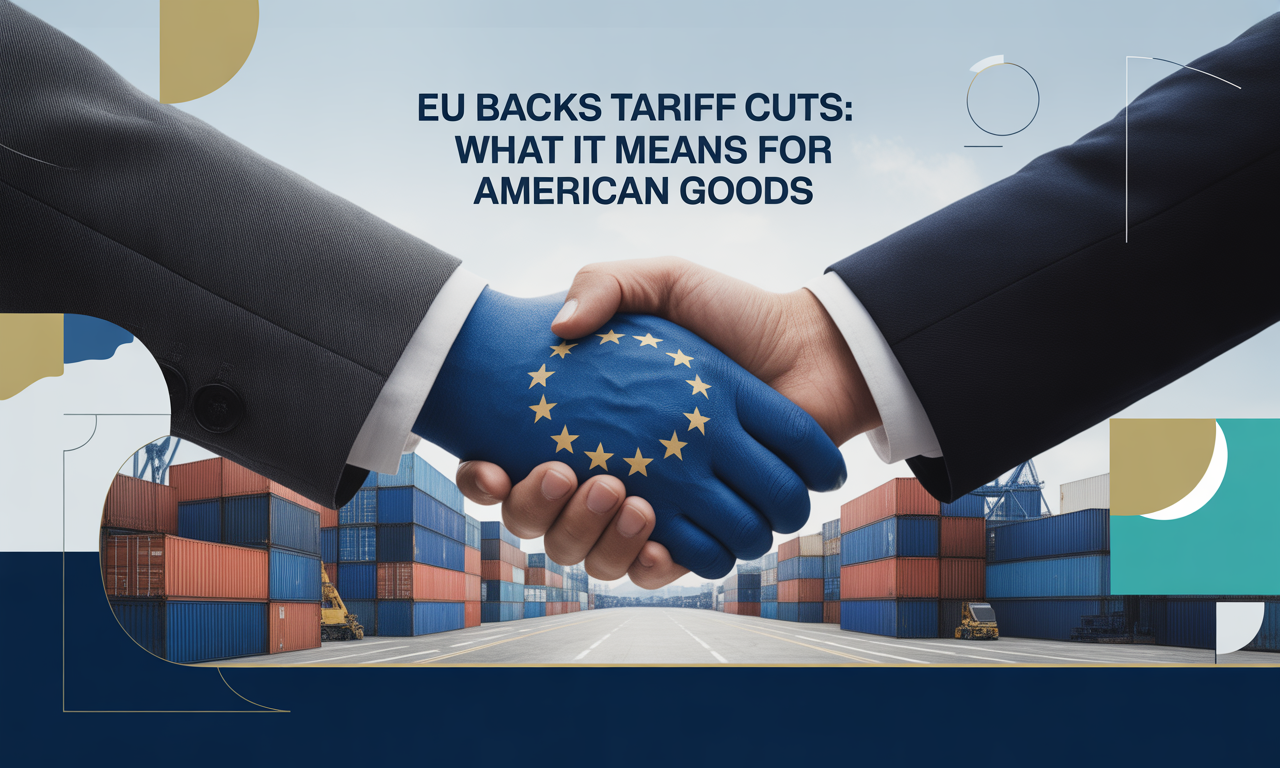
EU Backs Tariff Cuts: What It Means for American Goods
Intermediate | December 8, 2025
✨ Read the article aloud on your own or repeat each paragraph after your tutor.
EU Backs Tariff Cuts: A Turning Point in Trade Relations
The European Union (EU) recently agreed to slash tariffs on many American‑made goods — both farm products and manufactured items. In a notable shift from prior trade tensions, the EU voted to endorse “sweeping tariff cuts” for U.S. exports, as reported by The Epoch Times.
Under the emerging framework, the reductions apply to a broad range of American goods, aimed at encouraging bilateral trade with the United States. The goal is to smooth trade relations after a series of tariff threats and countermeasures from both sides earlier in 2025, according to coverage from AllSides. after a series of tariff threats and countermeasures from both sides earlier in 2025. (Source: AllSides)
What Changed: From Countermeasures to Cooperation
Earlier in 2025, the EU had responded to U.S. tariff increases — particularly on steel and aluminum — by preparing its own counter‑tariff measures, according to reporting by Reuters.
But the dynamic shifted after both sides reached a tentative deal in July: the U.S. agreed to cap tariffs on many EU exports at 15%. In return, the EU committed to reducing tariffs on a wide array of American agricultural and industrial goods, outlined in the Agreement on Reciprocal, Fair, and Balanced Trade. (Source: Wikipedia)
This framework — known informally as the Agreement on Reciprocal, Fair, and Balanced Trade — is designed to reduce friction and stabilize cross‑Atlantic commerce.
Who Wins: American Farmers, Manufacturers, and Consumers
For U.S. exporters, reduced tariffs mean greater access — and because the EU backs tariff cuts, American producers may see faster growth in key sectors. to Europe — one of the world’s largest consumer markets. Agricultural producers, processed‑food companies, and manufacturers may all see increased demand.
Meanwhile, EU consumers and businesses could enjoy lower‑priced American imports — another sign of how the EU backs tariff cuts to support smoother trade flows., from food items to industrial materials. For many industries, this shift could reignite competitiveness and reduce supply‑chain pressure.
What’s Likely Next: Stability — But With Watchful Eyes
Although this agreement signals a positive turn, its implementation requires formal EU approval and legislative steps, as noted in the Agreement on Reciprocal, Fair, and Balanced Trade. (Source: Wikipedia)
Some business groups remain cautiously optimistic, while others warn that tariff policy can change quickly depending on political conditions.
For now, U.S.–EU trade appears to be entering a calmer phase — but global markets will be watching closely.
Vocabulary
- Tariff (noun) – a tax on imported goods.
Example: “The EU agreed to cut tariffs on American farm products.” - Export (noun) – goods sold to another country.
Example: “Lower tariffs could boost U.S. agricultural exports.” - Manufactured (adjective) – produced in a factory.
Example: “Manufactured items are included in the tariff cuts.” - Counter‑tariff (noun) – a tariff imposed in retaliation.
Example: “The EU had prepared counter‑tariffs before the agreement.” - Framework (noun) – the structure of an agreement.
Example: “The trade framework outlines tariff reductions on both sides.” - Bilateral (adjective) – involving two parties.
Example: “This is a bilateral trade effort between the EU and the U.S.” - Commitment (noun) – a promise.
Example: “The EU made a commitment to lower duties on U.S. goods.” - Implementation (noun) – putting a plan into action.
Example: “Implementation requires approval from EU member states.” - Competitiveness (noun) – the ability to compete. Example: “The deal may increase U.S. exporters’ competitiveness.”
- Stability (noun) – steadiness and predictability.
Example: “Businesses welcomed the promise of greater stability.”
Discussion Questions (About the Article)
- Why did the EU decide to cut tariffs on American goods at this time?
- Which U.S. industries could benefit most from the tariff reductions?
- What does the new trade framework aim to accomplish?
- What steps must the EU take before the tariff cuts become official?
- What potential challenges could still impact U.S.–EU trade relations?
Discussion Questions (Broader Topic: Trade & Policy)
- Do you think lowering tariffs generally helps or harms domestic industries?
- How do tariff changes affect consumers differently from businesses?
- Should trade agreements be long‑term and stable, or flexible and adaptable?
- How do businesses protect themselves from rapid changes in trade policy?
- What role should politics play in international trade decisions?
Related Idiom
“Open the floodgates” — to allow something to happen more freely or rapidly.
Example: “Cutting tariffs could open the floodgates for U.S. exports to Europe.”
📢 Want more tips like this? 👉 Sign up for the All About English Mastery Newsletter! Click here to join us!
Want to finally master English but don’t have the time? Mastering English for Busy Professionals is the course for you!
Follow our YouTube Channel @All_About_English for more great insights and tips.
This article was inspired by reporting from The Epoch Times, AllSides, Reuters, and official EU public documentation, which provide further background and context on the trade discussions.


 English
  한국어
한국어