

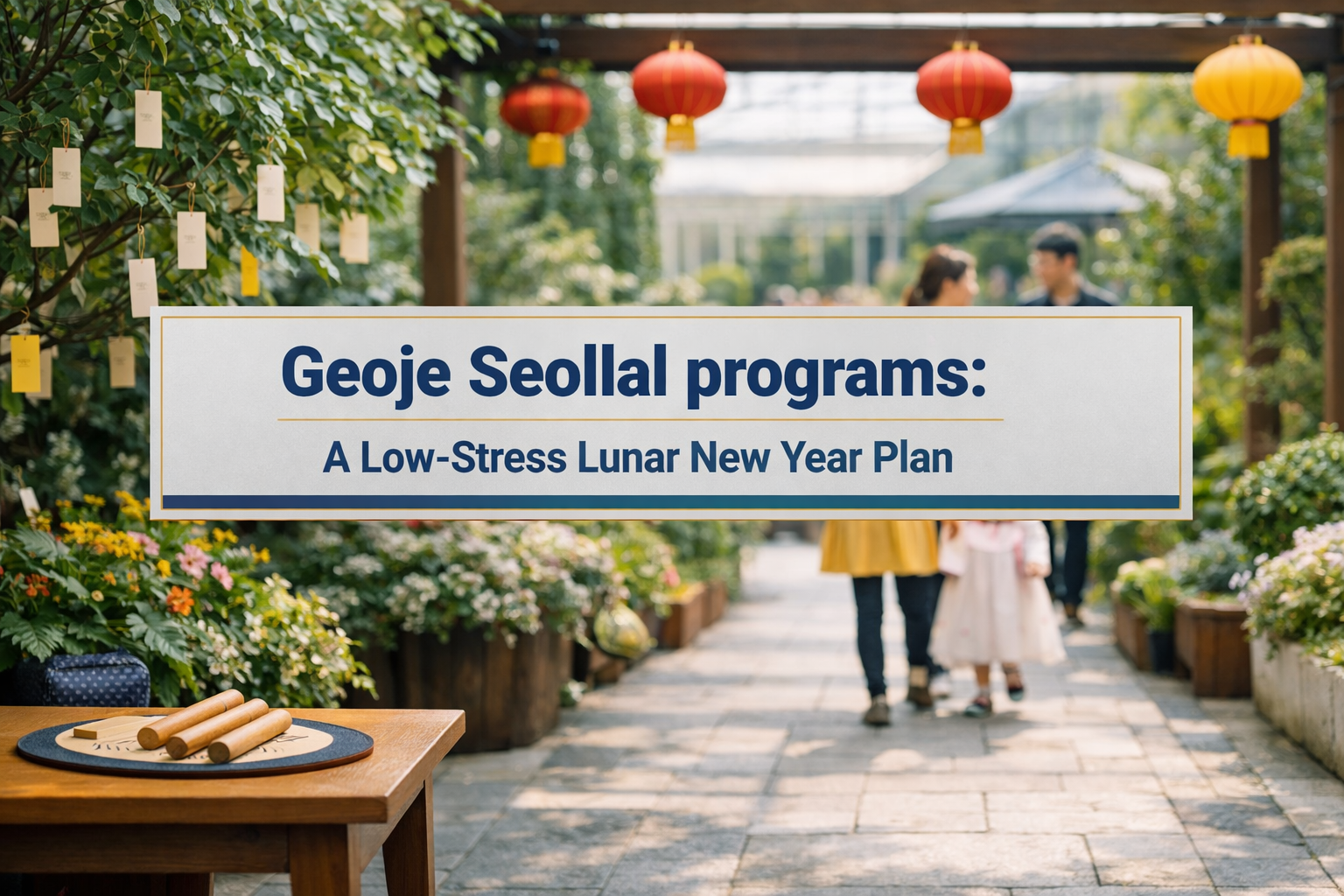
Geoje Seollal programs: A Low-Stress Lunar New Year Plan
Intermediate | February 16, 2026
✨ Read the article aloud on your own or repeat each paragraph after your tutor.
Why Geoje Seollal programs Are a Smart Holiday Choice
If Seollal usually means long drives, crowded houses, and the same questions from relatives… here’s a calmer plan. Geoje Seollal programs give you a simple, low-pressure way to enjoy the holiday outdoors. Geoje Botanical Garden is running special Lunar New Year experience programs during Seollal 2026, and the whole point is simple: get outside, do something fun, and keep the holiday mood without the pressure. (Stars and Stripes)
Dates, Hours, and Why This Is Convenient
The programs run February 14–18, and the event is spread across the garden so visitors can join at their own pace. A key detail: the garden will stay open on Lunar New Year’s Day, so you don’t have to “schedule a perfect moment” to go. You can just drop in when it fits your day. (Stars and Stripes)
Traditional Games (Plus a Small Incentive)
In the open area in front of the Plant Culture Center, visitors can play classic Korean games like jegichagi, tuho, spinning tops, and yutnori. And here’s the part that feels very “event marketing”: there’s also a traditional games challenge held twice daily (11 a.m. and 3 p.m.), with small gifts for people who complete the activities successfully. (Stars and Stripes)
Hands-On Activities That Feel Personal
The program list isn’t just “watch a performance and leave.” Visitors can join a wish tree experience made with preserved moss, where you write down your hopes for the new year. There’s also a gardening session where participants can plant and take home their own “companion plants.” It’s a smart value-add: you walk out with both a memory and something tangible. (Stars and Stripes)
One-Day Class: Herb and Fruit Cake (Reservation Required)
On February 14, the garden will hold a one-day class on making a herb and fruit cake. The class is advance reservation only, with on-site payment, and organizers ask participants to book carefully so they can prepare the materials smoothly. In other words: if you want the cake class, treat it like a limited-seat workshop—don’t wait until the last minute. (Stars and Stripes)
The Bigger Point: A “Low-Key” Seollal That Still Feels Special
This kind of event is basically a “holiday package” without the hotel price tag. It’s family-friendly, it’s outdoors, and it gives you a structured way to enjoy tradition while keeping your schedule flexible. If you’re trying to plan Seollal like a pro, this is a strong option. For a lot of people, Geoje Seollal programs hit the sweet spot: traditional, flexible, and genuinely relaxing. (Stars and Stripes)
Vocabulary
- Host (verb) — to organize and hold an event.
Example: The garden will host Seollal programs for visitors of all ages. - Festive (adjective) — cheerful and connected to a celebration.
Example: The festive period brings families together for Lunar New Year. - Grounds (noun) — the land around a building or attraction.
Example: Activities will take place across the botanical garden grounds. - Appeal (verb) — to attract interest.
Example: The event is designed to appeal to kids and adults. - Hands-on (adjective) — involving active participation.
Example: Hands-on activities help visitors feel part of the holiday. - Alternative (noun) — another choice.
Example: This is a relaxed alternative to indoor holiday plans. - Convenience (noun) — ease and practicality.
Example: Staying open on Lunar New Year’s Day adds convenience for visitors. - Participant (noun) — a person who takes part in an activity.
Example: Participants can win small gifts during the games challenge. - Reservation (noun) — an advance booking.
Example: The cake class requires a reservation before you arrive. - Tangible (adjective) — real and touchable.
Example: Taking home a companion plant is a tangible souvenir.
Discussion Questions (About the Article)
- Why might a “low-stress” Seollal plan be attractive for families?
- Which program sounds most interesting to you: games, wish tree, gardening, or the cake class? Why?
- How does the “small gifts” challenge change the mood of the event?
- What does “open on Lunar New Year’s Day” suggest about the garden’s business strategy?
- If you were promoting this event, what would you highlight first?
Discussion Questions (About the Topic)
- Do you prefer holidays that are planned carefully, or more flexible “drop-in” style holidays? Why?
- What kinds of traditional games or activities exist in your culture?
- Why do you think hands-on experiences are becoming more popular in tourism?
- What makes an event feel “worth the money” to you?
- If you could design a Lunar New Year program for foreigners, what would you include?
Related Idiom
“Take it easy” — relax and don’t overwork yourself.
Example: Instead of rushing through Seollal plans, you can take it easy and spend the day outdoors at the garden.
📢 Want more practical English with real-world topics? 👉 Sign up for the All About English Mastery Newsletter! Click here to join us.
Want to finally Master English but don’t have the time? Mastering English for Busy Professionals is the course for you.
Follow our YouTube Channel @All_About_English for more great insights and tips.
This article was inspired by: Stars and Stripes (Stripes Korea)


 English
  한국어
한국어