

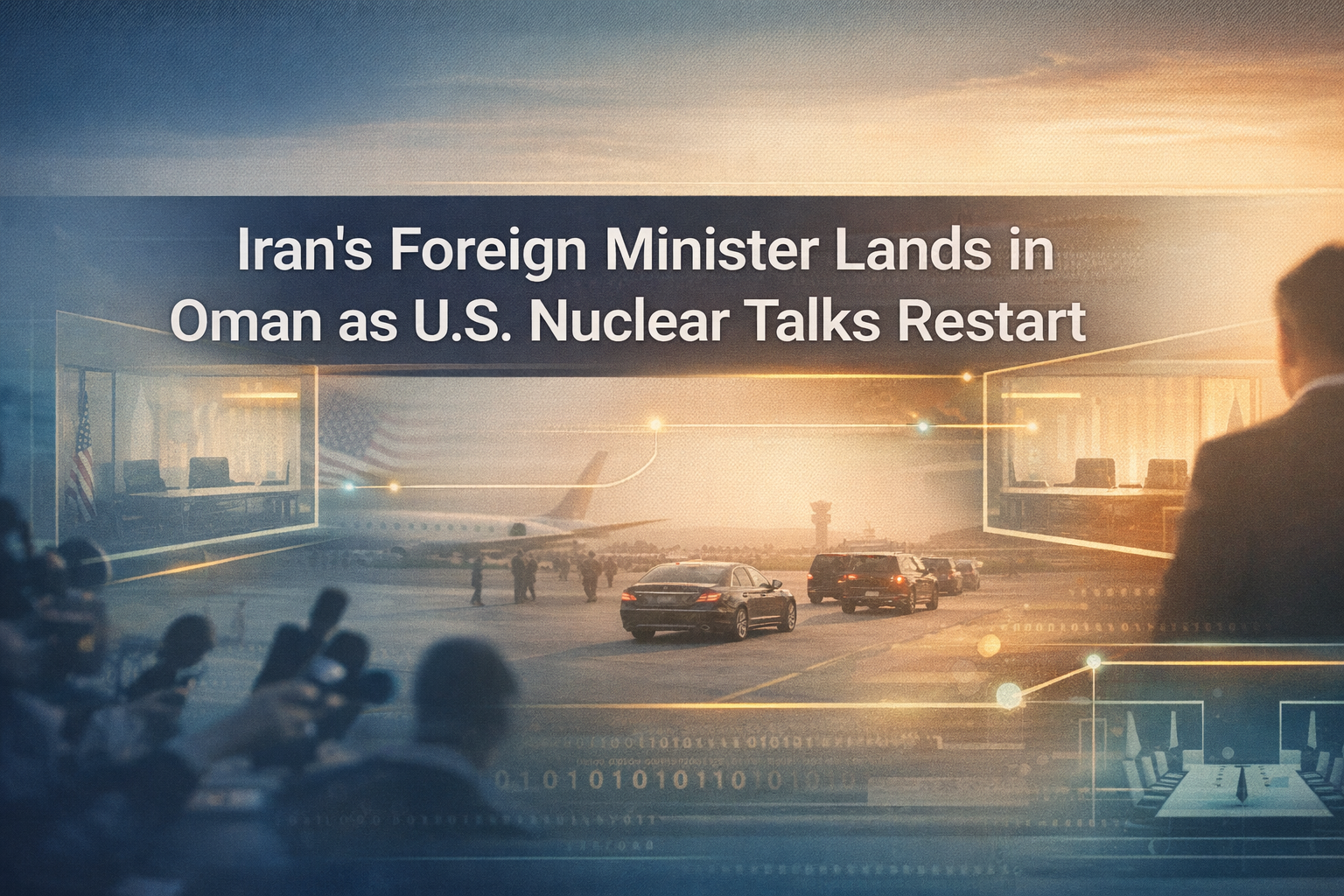
Iran’s Foreign Minister Lands in Oman as U.S. Nuclear Talks Restart
Advanced | February 15, 2026
✨ Read the article aloud on your own or repeat each paragraph after your tutor.
Iran nuclear talks Oman: A High-Stakes Meeting in Muscat
As Iran nuclear talks Oman resumed, Iran’s Foreign Minister Abbas Araghchi traveled to Muscat, Oman, and indirect talks with the United States picked up again—this time with Omani mediation. At the same time, the region stayed tense, because diplomacy and military pressure moved forward in parallel, like two conversations happening side by side. (Reuters, Al Jazeera)
Indirect Talks: Same Building, Different Rooms
These talks did not happen face-to-face. Instead, Oman’s Foreign Minister Badr bin Hamad Al Busaidi reportedly met the U.S. and Iranian sides separately multiple times and carried messages between them—classic “shuttle diplomacy.” According to Oman’s foreign ministry, the consultations aimed to create the right conditions to restart diplomatic and technical negotiations. (Al Jazeera, The Guardian)
Who Showed Up (And Why That Matters)
According to reporting, the U.S. delegation included special envoy Steve Witkoff and Jared Kushner. Notably, reports also said U.S. Central Command chief Brad Cooper joined—an unusual detail that suggests the talks did not happen in a vacuum. On Iran’s side, Araghchi led the team, and Tehran framed its goal as reaching a “fair” and “dignified” understanding on the nuclear issue. (Al Jazeera, Reuters)
The Big “Sticking Points” on the Table
Here’s where things get complicated. Iran has insisted the talks stay focused on the nuclear program only. However, U.S. officials have pushed to include broader security issues—especially Iran’s missile arsenal. Because of that, the two sides risk a familiar negotiation trap: if they don’t align the agenda, progress can stall before it even starts. (Reuters, Reuters)
A “Good Start,” But No Victory Lap
After the Oman round, Iranian officials called the talks “a good start” and hinted that more discussions could follow. Still, they stressed that leaders back in the capitals must weigh major decisions. Meanwhile, separate reporting said officials planned a second round in Geneva after the Muscat meeting, which suggests the process kept moving—just cautiously. (Al Jazeera, AP News)
Why This Story Matters (Even If You’re Not a Politics Nerd)
When the U.S. and Iran talk, the ripple effects can hit energy markets, shipping routes, and regional stability—things that shape prices, business confidence, and everyday life. Even more importantly, the risk of escalation changes behavior. That’s why headlines like Iran nuclear talks Oman draw close attention from governments, companies, and investors. In business terms, uncertainty works like a tax: it pushes people to freeze, hedge, or overreact.
Vocabulary
- Mediation (noun) – help from a third party to reach an agreement.
Example: Oman offered mediation by carrying messages between the two sides. - Indirect (adjective) – not face-to-face; happening through an intermediary.
Example: The countries held indirect talks in separate rooms. - Delegation (noun) – a group of people representing a government or organization.
Example: Iran sent a delegation led by Foreign Minister Araghchi. - Sticking point (noun phrase) – a major issue that prevents agreement.
Example: The missile program became a sticking point in negotiations. - Scope (noun) – the range or limits of what is included.
Example: Iran wanted the scope limited to the nuclear issue. - Sanctions (noun) – penalties used to pressure a country or group.
Example: Iran often demands sanctions relief as part of a deal. - Verification (noun) – checking that something is true or compliant.
Example: Verification measures can build trust in an agreement. - Escalation (noun) – a situation becoming more intense or dangerous.
Example: Both sides tried to prevent escalation while talks continued. - Agenda (noun) – a list of topics to discuss in a meeting.
Example: Negotiations can stall if the agenda isn’t aligned. - Shuttle diplomacy (noun phrase) – a mediator moving between sides to negotiate.
Example: Oman used shuttle diplomacy to keep talks moving.
Discussion Questions (About the Article)
- Why were the talks in Oman described as “indirect,” and how did that format work?
- What role did Oman’s foreign minister play during the negotiations?
- Why might it matter that a top U.S. military commander was reportedly present?
- What are the main issues each side wants to include—or exclude—from the talks?
- What does it mean when a negotiation is called “a good start,” but not a breakthrough?
Discussion Questions (About the Topic)
- Do you think indirect talks are more effective than face-to-face talks? Why?
- Should negotiations stick to one topic (nuclear) or include related topics (missiles)?
- How do sanctions influence diplomacy—do they help, hurt, or both?
- Why do international conflicts affect energy prices and business decisions?
- What would a “fair deal” look like from each side’s perspective?
Related Idiom / Phrase
“On the table” – available to be discussed or considered.
Example: Iran wanted only the nuclear issue on the table, while the U.S. pushed to add missiles.
📢 Want more English practice with real-world topics? Sign up for the All About English Mastery Newsletter! 👉 Click here
Want to finally Master English but don’t have the time? Mastering English for Busy Professionals is the course for you!
Follow our YouTube Channel @All_About_English for more tips.
This article was inspired by: Al Jazeera (Feb. 6, 2026) and additional reporting from Reuters, AP News, and The Guardian.


 English
  한국어
한국어