

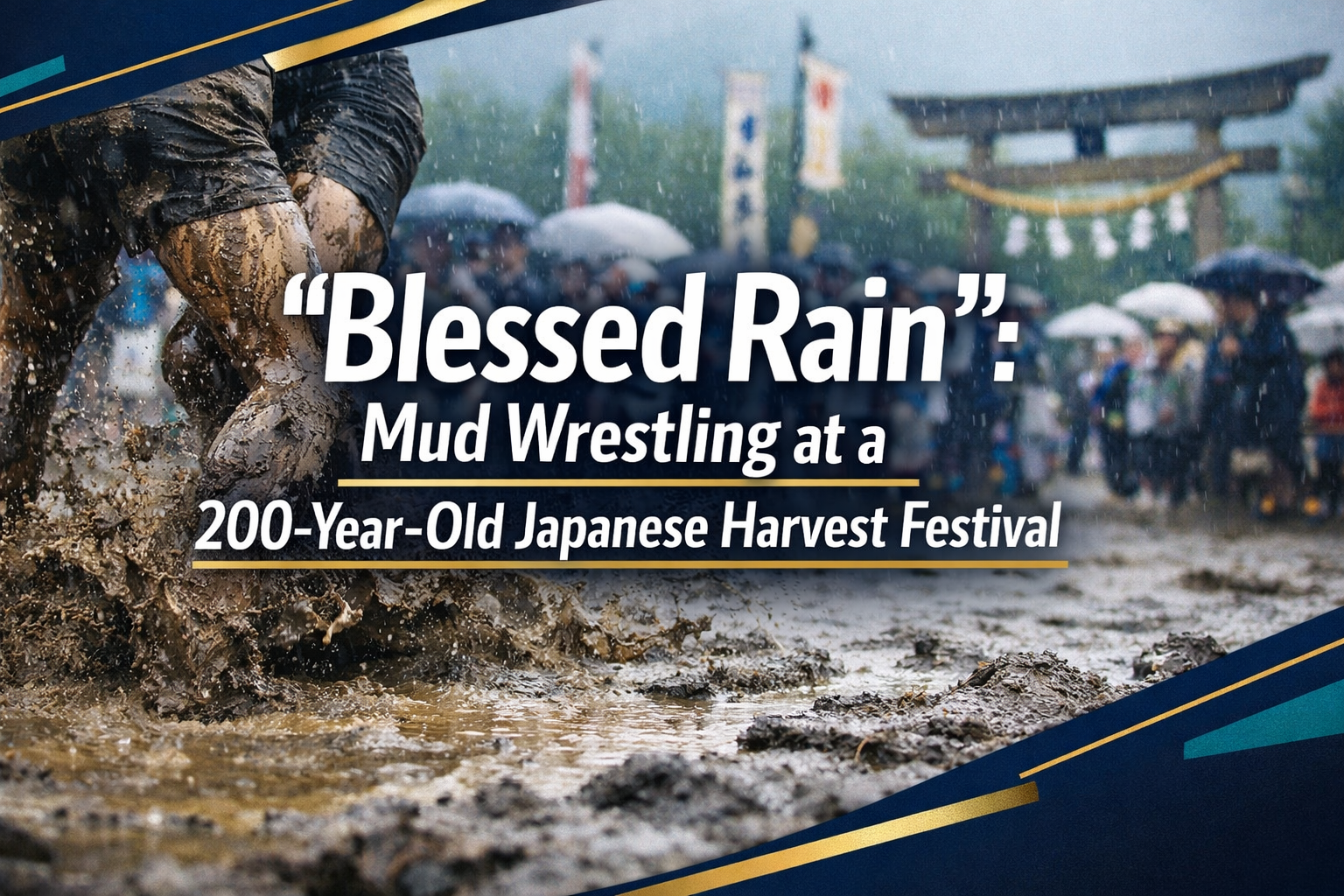
‘Blessed Rain’: Mud Wrestling at a 200-Year-Old Japanese Harvest Festival
Beginner | March 1, 2026
✨ Read the article aloud on your own or repeat each paragraph after your tutor.
Japanese harvest festival mud wrestling near Tokyo
If you think “team bonding” is intense at your office, wait until you see this. In late February 2026, more than 30 Japanese men put on traditional loincloths and met in a small, muddy field in Yotsukaido, a city outside Tokyo—for a Japanese harvest festival mud wrestling ritual that locals have kept alive for generations. (Reuters) (Reuters) They weren’t there for sports or a competition—they were there for a harvest ritual that is more than 200 years old.
Wrestling in the Mud (On Purpose)
The men split into groups and shivered in the cold rain. (Reuters Photos) Then they formed human pyramids, charged, and threw each other into the mud. It looked wild, but the meaning is serious: the wrestling is a way to pray for a bountiful harvest. (Reuters)
“Blessed Rain” After a Dry Year
One participant, Kenji Nagata (60), said it hasn’t rained much this year, but it poured on festival day. He called it “blessed rain.” (Reuters) In a farming culture, rain is not just weather—it can represent hope for future growth.
A Tradition That Survived Modern Life
A teacher named Takeshi Seino joined the festival for the third time, saying the event has a long history. Organiser Kenji Tsuruoka explained that the ritual goes back to a time when the area was farmland and people even wrestled with horses in rice paddies. (Reuters)
It’s Also About Children and Community
The festival isn’t only about crops. Organisers say participants also pray for the healthy growth of children, and some families even bring newborn babies to the muddy field for blessings. (Reuters) Even though the area has become much more urban—and there are few farms left—locals still see the festival as an important part of community life.
Why This Story Matters (Even for Busy Professionals)
This story is a reminder that culture is like a company’s “core values.” And this Japanese harvest festival mud wrestling tradition is a perfect example: You can modernize the building, the tools, and the schedule—but people still want meaning, tradition, and belonging. And honestly, after reading this, your next rainy commute might feel a little less dramatic.
Vocabulary
- Harvest (noun) — the time when crops are collected from the fields.
Example: Farmers hope for a good harvest every year. - Ritual (noun) — a traditional action done in the same way each time.
Example: The festival is a ritual that has continued for over 200 years. - Loincloth (noun) — a simple piece of cloth worn around the waist.
Example: The men wore loincloths during the ceremony. - Bountiful (adjective) — large in amount; plentiful.
Example: They prayed for a bountiful harvest of rice. - Shiver (verb) — to shake because you are cold.
Example: They shivered in the heavy rain. - Form (verb) — to make a shape or structure.
Example: They formed human pyramids in the mud. - Charge (verb) — to run forward quickly and strongly.
Example: The teams charged toward each other. - Organizer (noun) — a person who plans and manages an event.
Example: An organizer explained the history of the festival. - Urban (adjective) — related to a city.
Example: The area is now more urban than it was in the past. - Blessing (noun) — something believed to bring good luck or protection.
Example: Some parents brought their babies for a blessing.
Discussion Questions (About the Article)
- What happened at the Warabi Hadaka Matsuri festival, and where was it held?
- Why do the participants wrestle in the mud?
- Why did one man call the rain “blessed rain”?
- What details show that this festival is very old?
- Why do you think the community still values this tradition, even with few farms left?
Discussion Questions (About the Topic)
- What traditions does your culture still keep today? Why?
- Do you think traditions should change as society becomes more modern?
- Why do people connect festivals with “luck” or “blessings”?
- What is one tradition you would like to experience in another country?
- How can traditions help people feel connected at work or in a community?
Related Idiom
“Come rain or shine” — to do something no matter what happens (even bad weather).
Example: These men showed up to the festival come rain or shine—even in cold mud.
📢 Want more practical English using real news? 👉 Sign up for the All About English Mastery Newsletter! (Newsletter)
Want to finally Master English but don’t have the time? Mastering English for Busy Professionals (Course) is the course for you! Check it out now!
Follow our YouTube Channel @All_About_English (YouTube) for more great insights and tips.
This article took inspiration from: (Reuters) and (Reuters Photos)


 English
  한국어
한국어