

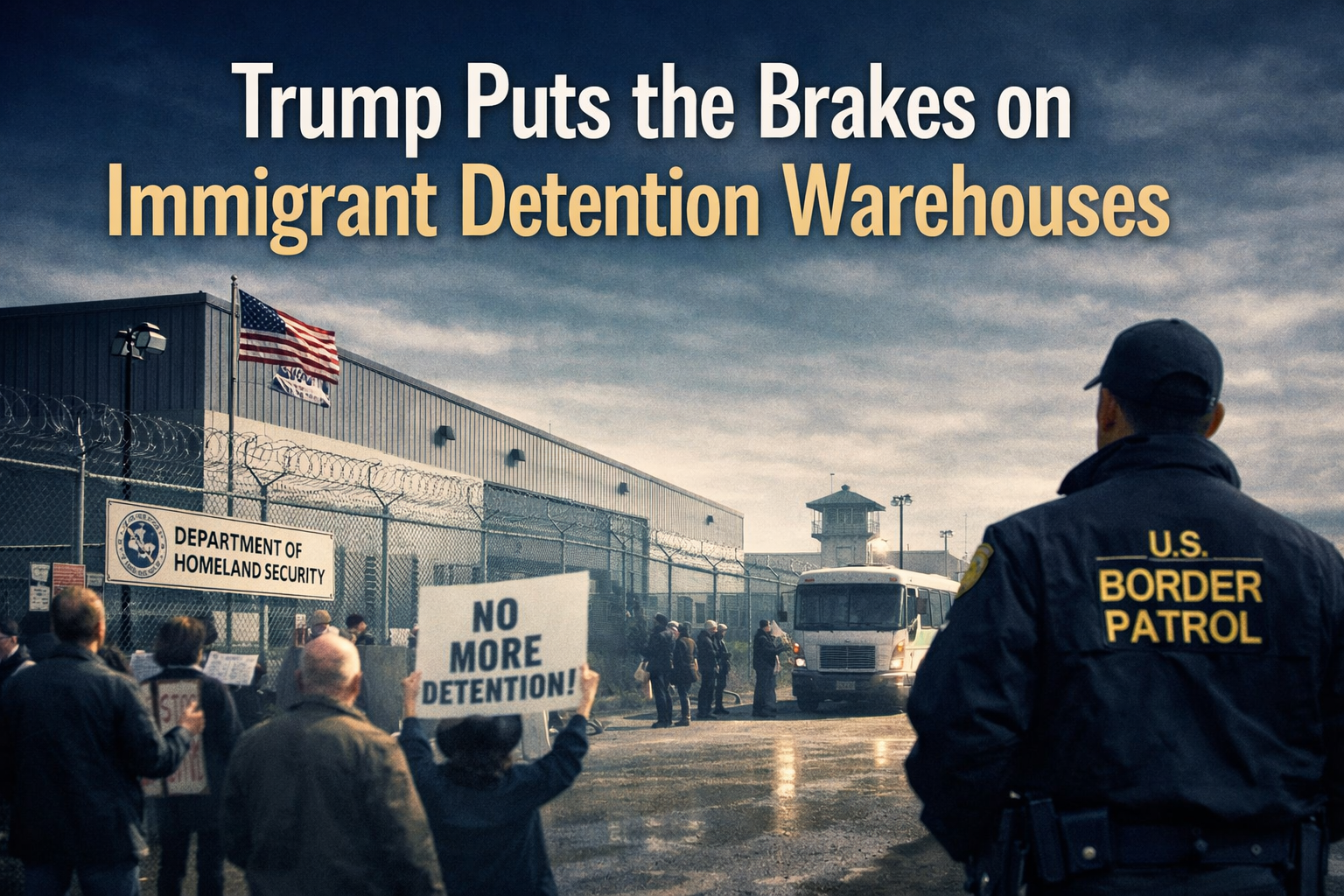
Trump Puts the Brakes on Immigrant Detention Warehouses
Advanced | April 6, 2026
✨ 혼자서 기사를 소리 내어 읽거나 튜터를 따라 각 단락을 반복해서 읽으세요. 레벨...
A Sudden Pause in a Big Immigration Plan
The Trump administration has paused plans to buy more warehouses for immigrant detention, and that decision has created a lot of discussion across the United States. The proposed immigrant detention warehouses quickly became a flashpoint in the national debate over immigration enforcement. The Department of Homeland Security had been moving ahead with a major expansion plan, but new Homeland Security Secretary Markwayne Mullin is now reviewing the policy and taking a closer look at contracts made under former Secretary Kristi Noem (Reuters). In simple terms, the government hit the brakes before pushing the project any further.
Why Immigrant Detention Warehouses Became So Controversial
This was not a small idea. According to reports, the broader detention expansion plan was worth $38.3 billion and aimed to raise detention capacity to 92,000 beds. The plan included eight very large centers, each designed to hold around 7,000 to 10,000 detainees, as well as 16 smaller regional processing centers (AP News). That scale alone made the proposal controversial, especially because these centers were expected to process and detain large numbers of immigrants as part of Trump’s immigration crackdown.
Communities Pushed Back Hard
One reason this story matters is that local communities did not simply sit quietly and accept the plan. Residents, mayors, and other officials in several places objected to having large detention sites in their neighborhoods. Some raised moral concerns about immigrant detention. Others worried that these huge facilities would strain local infrastructure like water and sewer systems (AP News). In other words, people were not only debating immigration policy. They were also asking a practical question: can towns and cities even handle projects this large?
Money Spent, Questions Still Growing
Even with the pause, a lot has already happened. Reports say the federal government has already bought 11 warehouses in eight states—Arizona, Georgia, Maryland, Michigan, New Jersey, Pennsylvania, Texas, and Utah—for a combined total of about $1.074 billion. At the same time, lawsuits are already pending in three states, and at least one project has been reduced in size. In Surprise, Arizona, a site that was first expected to hold 1,500 beds is now expected to be capped at 542 occupied beds (AP News). So while the policy is paused, the debate is far from over.
A New Secretary, A New Tone
Mullin appears to be signaling a different style, at least for now. During his confirmation process, he said the department still needed to protect the homeland, but also stressed the importance of working with community leaders and understanding whether local infrastructure could support these projects (Reuters, AP News). That is a more cautious message than simply rushing forward. It suggests the administration may still want more detention space, but it may need to handle the rollout more carefully if it wants to avoid more legal fights and political backlash.
What This Means Going Forward
For now, the immigrant detention warehouses plan is paused—not dead. That distinction is important. The administration has not abandoned the idea of expanding detention capacity, but it is clearly reassessing how to do it. For English learners, this story is also a useful reminder that phrases like pause plans, review contracts, face backlash, and scale back are common in real political and business news. They are the kind of expressions that come up when leaders overplay their hand, face pressure, and then have to regroup.
Vocabulary
- Pause (verb) – to stop something for a period of time before deciding what to do next.
Example: The government decided to pause the warehouse plan for review. - Detention (noun) – the act of keeping someone in custody, especially by the government.
Example: The warehouses were meant to expand immigrant detention capacity. - Scrutinize (verb) – to examine something very carefully.
Example: Officials said they would scrutinize contracts signed earlier. - Capacity (noun) – the maximum amount or number something can hold.
Example: The plan aimed to increase detention capacity to 92,000 beds. - Backlash (noun) – a strong negative reaction from the public.
Example: The proposal faced backlash in several communities. - Infrastructure (noun) – basic systems and services such as roads, water, and sewage.
Example: Some towns worried their infrastructure could not support the project. - Detainee (noun) – a person being held in custody.
Example: Some of the large centers were designed to hold thousands of detainees. - Pending (adjective) – waiting to be decided or completed.
Example: Lawsuits are still pending in several states. - Scale back (phrasal verb) – to reduce the size or scope of something.
Example: Officials decided to scale back the Arizona project. - Rollout (noun) – the way a new plan or system is introduced.
Example: The new secretary may change the rollout of the detention plan.
Discussion Questions (About the Article)
- Why did the Trump administration pause plans to buy more warehouses for detention?
- What made the warehouse expansion plan so controversial?
- Why were local communities worried about these facilities?
- What details from Arizona show that the plan is already changing?
- Do you think this pause is temporary, or could it become a bigger policy shift?
Discussion Questions (About the Topic)
- How much power should local communities have over large federal projects?
- What are the risks of moving too fast on a policy without local support?
- Should governments focus more on processing immigration cases quickly rather than expanding detention space?
- How can leaders balance border security with community concerns?
- What kinds of phrases from political news are also useful in business English?
Related Idiom
“Hit the brakes” – to slow down or stop a plan before it goes further.
Example: After public backlash and contract concerns, DHS hit the brakes on the warehouse plan.
📢 Want more practical English practice with real-world stories? Sign up for the All About English Mastery Newsletter! Click here to join us.
Want to finally master English but don’t have the time? Mastering English for Busy Professionals is built for busy people like you.
Follow our YouTube Channel @All_About_English for more useful English tips and real-world practice.
This article was inspired by: Reuters, AP News


 한국어
한국어  English