

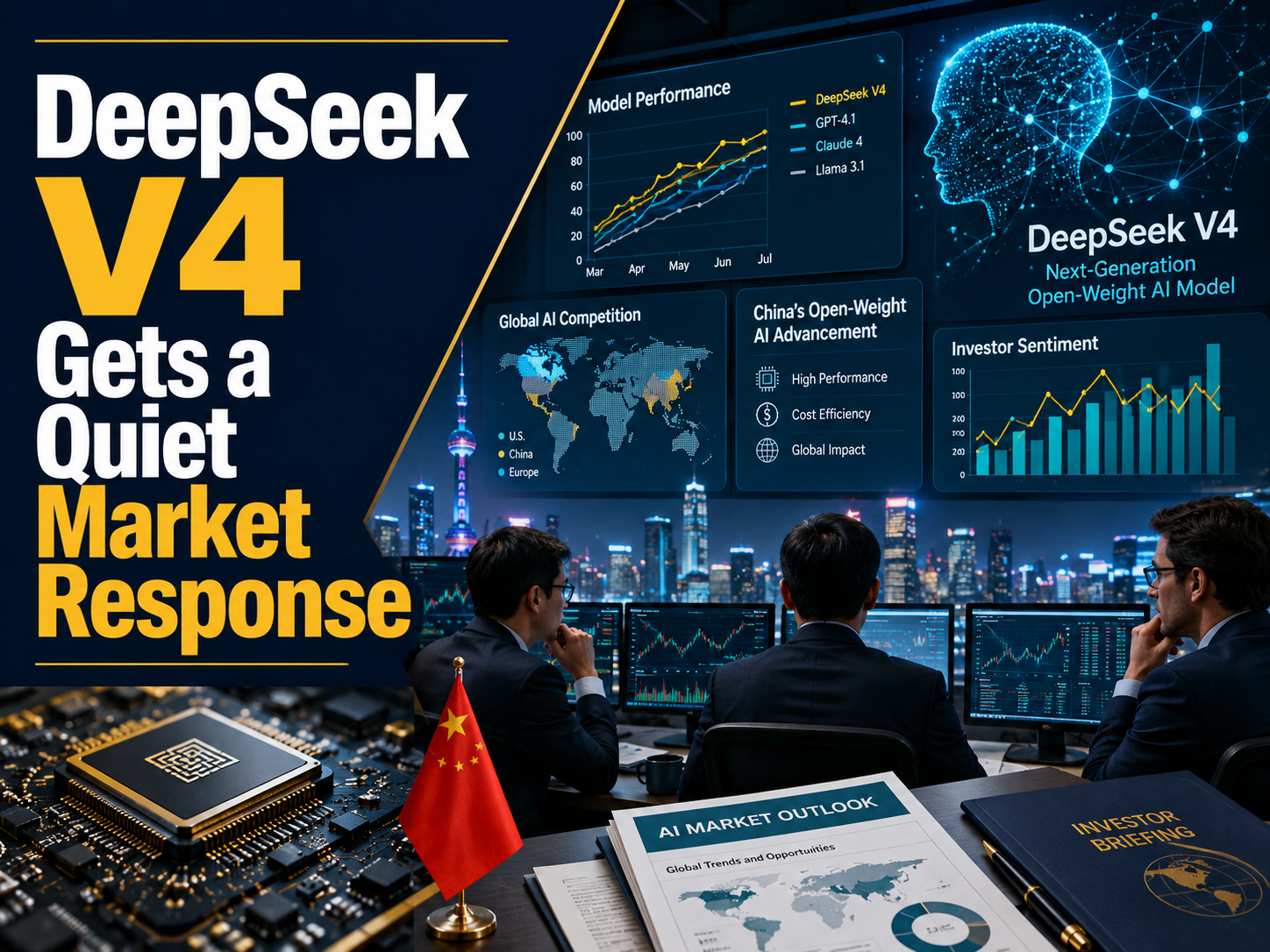
DeepSeek V4 Gets a Quiet Market Response
Advanced | May 9, 2026
✨ 혼자서 기사를 소리 내어 읽거나 튜터를 따라 각 단락을 반복해서 읽으세요. 레벨...
DeepSeek V4 Market Reaction Is Quieter Than Expected
China’s AI startup DeepSeek released a preview of its next-generation model, DeepSeek-V4, but investors did not react with the same excitement they showed last year. In 2025, DeepSeek’s earlier V3 and R1 models shocked global markets because the company said they were trained with only a fraction of the computing power used by some U.S. rivals. That surprise helped trigger a global tech-share selloff as investors questioned whether massive AI infrastructure spending was really necessary. This time, the DeepSeek V4 market reaction was much calmer. (Reuters)
Why the Surprise Factor Is Gone
Analysts told Reuters that DeepSeek’s earlier success was like a “black swan” event—rare, unexpected, and market-moving. But the AI industry moves fast. By April 2026, investors had already adjusted their expectations. Strong, efficient models are no longer shocking on their own. Lian Jye Su, chief analyst at Omdia, said the new announcement followed a more predictable path because many companies and researchers have explored model efficiency since DeepSeek’s big breakthrough. In plain business English: DeepSeek may still be impressive, but the market has already priced in the idea that new AI players can appear quickly. (Reuters)
DeepSeek V4 Market Reaction Shows Tougher Competition
The DeepSeek V4 market reaction also shows how crowded China’s AI race has become. Reuters reported that benchmark data from Artificial Analysis showed DeepSeek-V4 Pro improved significantly over earlier versions, but it ranked among leading open-weight models rather than clearly beating rivals. Competitors such as Kimi and Qwen have narrowed the gap. That matters because investors do not reward “good” forever. In a fast-moving industry, companies need to show clear leadership, not just steady improvement. It is a classic case of raising the bar.
The Huawei Chip Angle May Matter More Than the Model Itself
The biggest business story may not be the model’s market reaction. It may be DeepSeek’s hardware strategy. Reuters reported that DeepSeek-V4 was adapted to run on Huawei’s Ascend AI chips, including Huawei’s most advanced Ascend chip systems. Huawei said its Ascend supernode product line supports the DeepSeek-V4 series, and that its chips were used for part of V4-Flash training. This is important because U.S. export controls have limited Chinese access to advanced American AI chips. If Chinese AI models can run well on Chinese chips, that changes the long-term strategy game. (Reuters)
Big Chinese Tech Firms Rush Toward Huawei Chips
A few days after the V4 release, Reuters reported that demand for Huawei Ascend 950 AI chips had surged. Sources said major Chinese internet firms, including ByteDance, Tencent, and Alibaba, were reaching out to Huawei about new chip orders. Reuters also reported that Huawei’s 950PR chip significantly outperforms Nvidia’s H20, which had been the strongest Nvidia chip allowed for China before Beijing blocked its import last year. However, the 950PR still trails Nvidia’s more advanced H200. So, this is not a simple “China has already caught up” story. It is more like: China is building a serious alternative while the U.S.-China chip fight continues. (Reuters)
What This Means for Business English Learners
For English learners, this story is useful because it shows how business people talk about expectations, competition, and strategic value. A product can improve and still disappoint investors if the market expected more. A company can lose the “wow factor” but still become strategically important. That is the key lesson here. When you talk about business performance in English, do not only say whether something is “good” or “bad.” Explain whether it beat expectations, missed expectations, or changed the bigger picture.
Vocabulary
- Subdued (adjective) – quiet, controlled, or less excited than expected.
Example: “The market reaction to DeepSeek-V4 was subdued compared with last year.” - Preview (noun) – an early look at something before the full version is released.
Example: “DeepSeek released a preview of its next-generation AI model.” - Benchmark (noun) – a standard test used to compare performance.
Example: “Benchmark data showed that V4 Pro improved over earlier versions.” - Open-weight Model (noun phrase) – an AI model whose trained parameters are made available for others to use or study.
Example: “DeepSeek-V4 Pro ranked among leading open-weight models.” - Rival (noun) – a competitor.
Example: “Kimi and Qwen are important rivals in China’s AI market.” - Export Controls (noun phrase) – government rules that limit the sale of certain products to other countries.
Example: “U.S. export controls have limited China’s access to advanced AI chips.” - Self-Reliance (noun) – the ability to depend on yourself instead of others.
Example: “China is pushing for more AI self-reliance.” - Strategic (adjective) – connected to a long-term plan or advantage.
Example: “DeepSeek’s Huawei chip strategy may be strategically important.” - Infrastructure (noun) – the basic systems, equipment, or facilities needed for something to operate.
Example: “AI companies need powerful computing infrastructure.” - Valuation (noun) – the estimated financial value of a company.
Example: “Reuters reported that DeepSeek could be valued at up to $50 billion in fundraising talks.”
Discussion Questions (About the Article)
- Why was the market reaction to DeepSeek-V4 quieter than last year’s reaction to V3 and R1?
- What does it mean when analysts say the “wow factor” was already priced in?
- How have competitors like Kimi and Qwen changed investor expectations?
- Why is DeepSeek’s connection to Huawei chips important?
- Why does the article say this is not a simple “China has already caught up” story?
Discussion Questions (About the Topic)
- Do investors sometimes expect too much from AI companies? Why or why not?
- Should countries try to build their own AI hardware instead of depending on foreign suppliers?
- What makes a technology product truly impressive in a fast-changing market?
- How can companies keep a competitive lead when rivals copy or improve quickly?
- What risks come from the global race to develop AI faster and cheaper?
Related Idiom
“Raise the bar” – to make the standard higher or harder to reach.
Example: “DeepSeek raised the bar last year, so investors now expect more from each new AI model.”
📢 Want more practical English through real news stories? Sign up for the All About English Mastery Newsletter here: allaboutenglishmastery.com/newsletter
Want to build stronger English in less time? Check out Mastering English for Busy Professionals.
Follow our YouTube channel @All_About_English for more English tips and practice.
This article was inspired by: Reuters, Reuters, Reuters, and Reuters


 한국어
한국어  English