

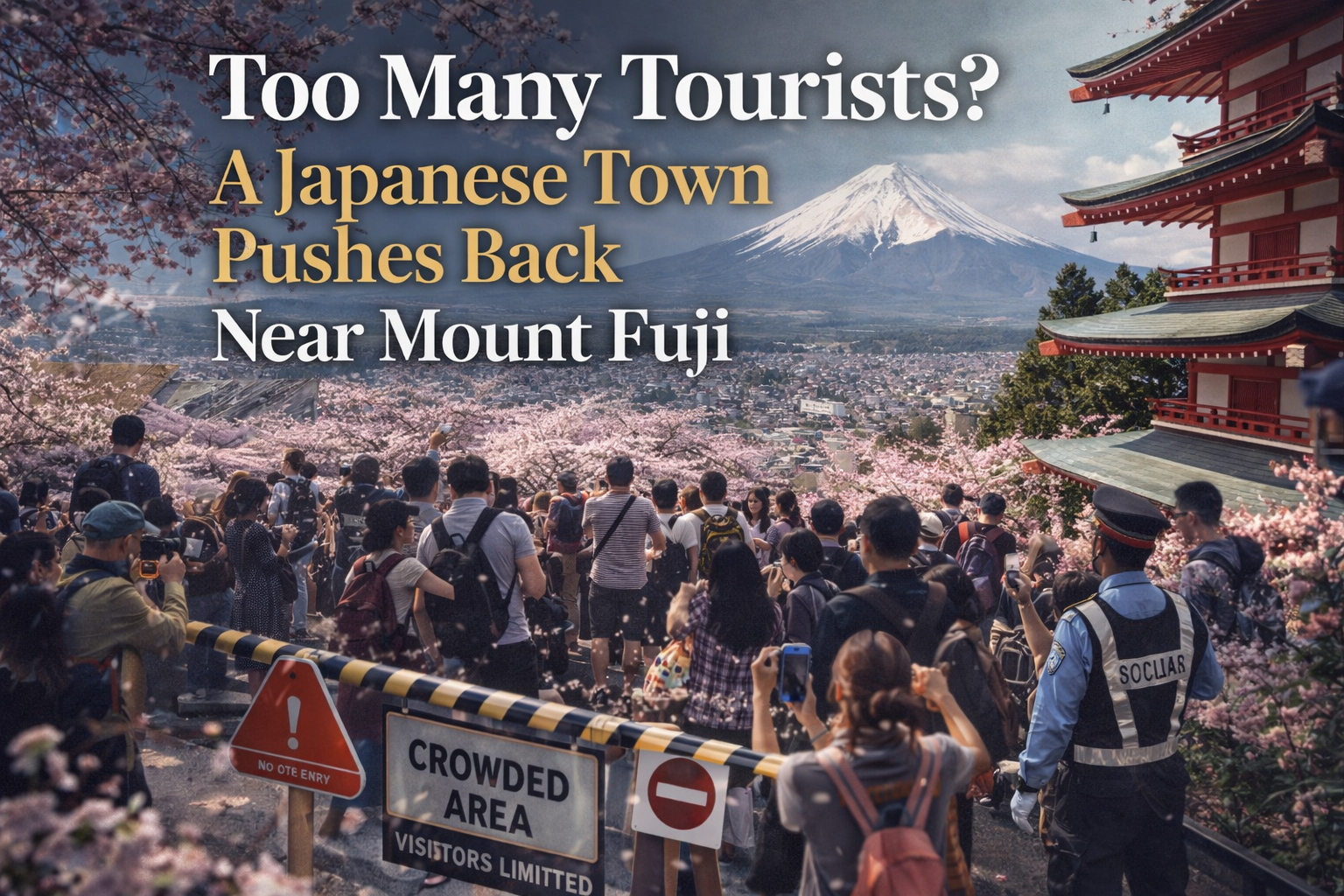
Too Many Tourists? A Japanese Town Pushes Back Near Mount Fuji
Beginner | April 17, 2026
✨ 혼자서 기사를 소리 내어 읽거나 튜터를 따라 각 단락을 반복해서 읽으세요. 레벨...
A Beautiful View Brings a Big Problem
Every spring, many people travel to Japan to see cherry blossoms. One of the most famous views is in Fujiyoshida, where visitors gather to photograph Mount Fuji, a red pagoda, and soft pink sakura trees. It looks peaceful in pictures, but this year the town had a different feeling. According to AP News, local people have grown frustrated as huge crowds bring traffic jams, litter, noise, and rude behavior into quiet residential areas.
Why Mount Fuji Overtourism Has Become a Real Issue
The problem became so serious that city officials canceled Fujiyoshida’s annual cherry blossom festival in February. AP reported that the event had started about 10 years ago to promote tourism, but officials no longer wanted to encourage even more visitors. City official Masatoshi Hada said the area is mainly an ordinary residential neighborhood, and balancing tourism with daily life had become too difficult. In recent years, the city said, more than 10,000 foreign tourists a day have come to the area during peak season.
The Town Is Using New Crowd-Control Measures
Even without the festival, the crowds still came when the cherry blossoms reached their best stage in early April. AP reported that Fujiyoshida increased the number of security guards and restricted access for tour buses and other vehicles in the scenic neighborhood. The city also put safety measures in place around Arakurayama Sengen Park. On the official Fujiyoshida tourism site, the city said security guards, road closures, temporary parking, and temporary toilets would be used during the cherry blossom season. Another city notice said tour buses were not allowed to approach the station area from April 1 to April 19, 2026 because of congestion. (Fujiyoshida tourism info)
Residents Feel Divided About the Change
This story is not just about angry locals. It is more complicated than that. Some residents say tourism helps local business, especially in shopping areas that had been quiet in the past. But others say daily life has become harder. AP quoted Hitoshi Mori, a 93-year-old resident, saying the situation is “good but annoying.” He explained that the area had become so crowded that he could only shop for groceries once a week. Another local, Masami Nakamura, said she hoped tourists would respect local rules and manners.
Tourists Still Love the View
Of course, visitors were still excited to be there. AP said some tourists waited in long lines just to get a few minutes at famous photo spots. One visitor from Paris said the system felt organized and the view was amazing. Another tourist from Melbourne said her group could not get all the way to the top viewing area because it was too crowded, but they still enjoyed the neighborhood. That is the strange business reality here: the place is successful because people love it, but that same success is causing the trouble.
A Bigger Lesson for Travel and Business
This story shows how Mount Fuji overtourism is not only a travel issue. It is also a planning issue, a business issue, and a community issue. Japan wants to keep growing tourism, and AP noted that the national government still hopes to raise inbound travel from about 40 million to 60 million visitors by 2030. But local towns need better systems if they want tourism growth without damaging everyday life. For English learners, this article is useful because it teaches the kind of language people use when talking about crowds, local rules, tourism, and public behavior.
Vocabulary
- Crowd (noun) – a large number of people in one place.
Example: A big crowd gathered to see Mount Fuji and the cherry blossoms. - Residential (adjective) – related to places where people live.
Example: The photo spot is close to a residential area. - Festival (noun) – a special public celebration.
Example: The city canceled its annual cherry blossom festival. - Congestion (noun) – too much traffic or too many people in one area.
Example: The town added new rules because of congestion. - Restrict (verb) – to limit or control something.
Example: The city restricted tour buses during the busy season. - Resident (noun) – a person who lives in a place.
Example: Some residents said daily life had become harder. - Manners (noun) – polite behavior.
Example: Local people want visitors to follow good manners. - Scenic (adjective) – beautiful to look at.
Example: The scenic area is famous around the world. - Overtourism (noun) – too many tourists in one place.
Example: Overtourism can hurt local communities. - Viewpoint (noun) – a place where you can see a wide view.
Example: Many tourists lined up for the viewpoint near the pagoda.
Discussion Questions (About the Article)
- Why did Fujiyoshida cancel its cherry blossom festival?
- What problems did local residents complain about?
- What new rules or safety measures did the town introduce?
- Why are some residents divided about tourism in the area?
- Why do tourists continue to visit even when the area is very crowded?
Discussion Questions (About the Topic)
- Have you ever visited a place that was too crowded? What was it like?
- Should famous tourist spots limit the number of visitors? Why or why not?
- How can towns protect residents while still welcoming tourists?
- What is the difference between good tourism and bad tourism?
- Do social media photos help travel destinations, or do they sometimes hurt them?
Related Idiom or Phrase
“Love something to death” – to damage something by enjoying it too much or using it too heavily.
Example: Some people worry that tourists may love this Mount Fuji photo spot to death.
📢 Want more useful English practice with real-world international news? Sign up for the All About English Mastery Newsletter! Click here to join us.
Want to finally Master English but don’t have the time? Mastering English for Busy Professionals is built for busy learners. Check it out now.
Follow our YouTube Channel @All_About_English for more English tips and real-world practice.
This article was inspired by: AP News, Fujiyoshida tourism info, and Fujiyoshida bus access notice


 한국어
한국어  English