

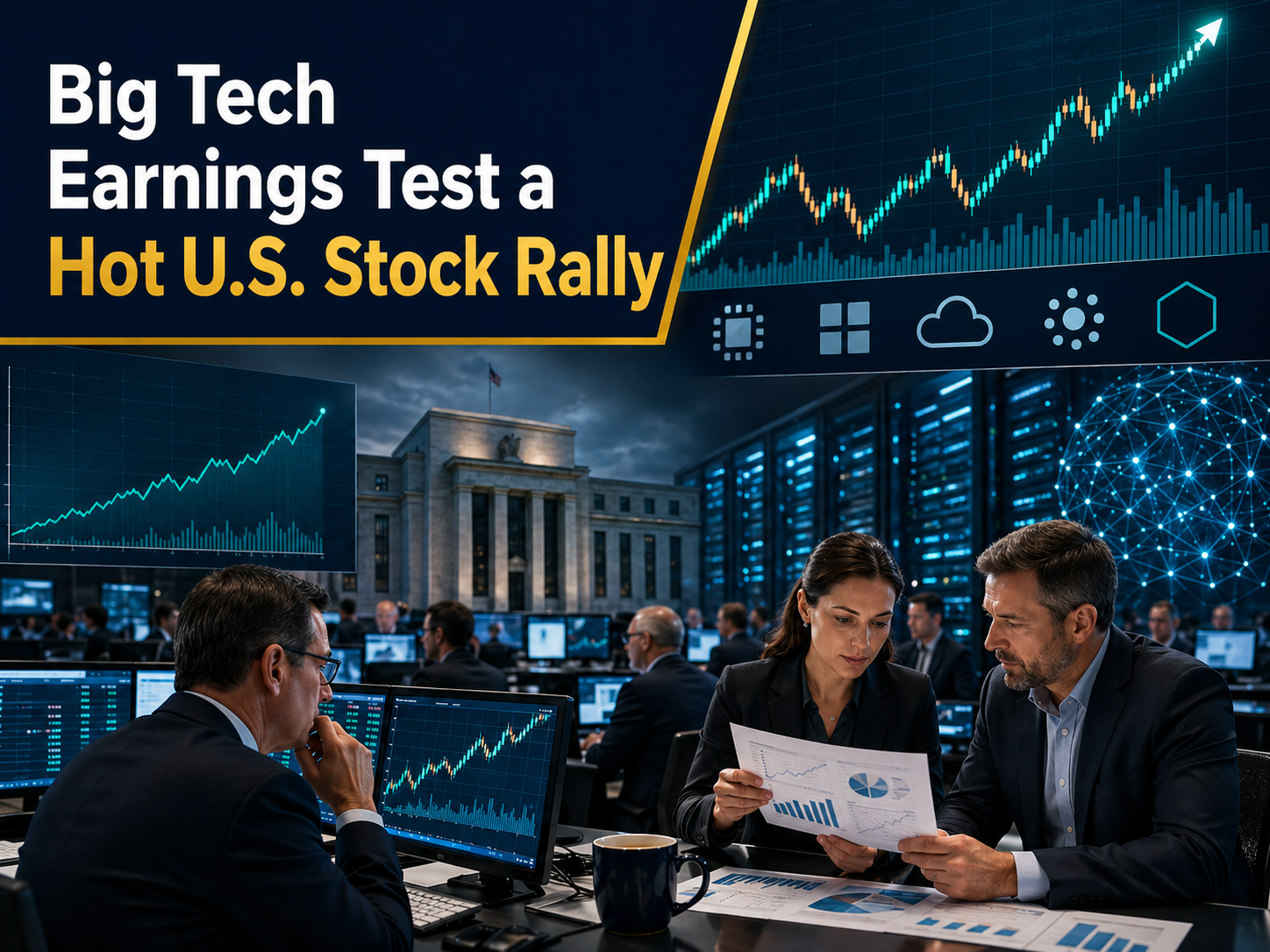
Big Tech Earnings Test a Hot U.S. Stock Rally
Intermediate | April 29, 2026
✨ 혼자서 기사를 소리 내어 읽거나 튜터를 따라 각 단락을 반복해서 읽으세요. 레벨...
A Big Week for U.S. Stocks
U.S. stocks have been climbing quickly, but investors are now watching a very important test: Big Tech earnings and the Federal Reserve meeting. The S&P 500 was up about 13% since March 30, while the tech-heavy Nasdaq jumped more than 19% during the same period (Reuters). That is a strong rebound, especially after earlier worries about the economic impact of the Middle East conflict.
Why Big Tech Earnings Matter
This week is important because several major technology companies are expected to report their results. Microsoft, Alphabet, Amazon, Meta, and Apple were all set to release earnings, with more than one-third of S&P 500 companies reporting results in the same week (Reuters). These companies are not just famous names. They are large enough to move the whole market, especially because many investors are still excited about artificial intelligence.
Investors Want Proof, Not Promises
The market has been optimistic, but investors want to see real numbers. Many people are watching whether companies like Microsoft, Alphabet, Amazon, and Meta can show that their huge spending on AI data centers and infrastructure is starting to pay off. By April 29, these four companies represented more than $10 trillion in market value and about 17% of the S&P 500’s weight (Reuters). In plain English, when these companies move, the market feels it.
The Federal Reserve Is Also in Focus
At the same time, investors are watching the Federal Reserve. The Fed was widely expected to hold interest rates steady at its Wednesday meeting (Reuters). That matters because lower interest rates can often help stocks, while higher rates can make investors more cautious. There was also extra attention on Fed Chair Jerome Powell because his term as chair was set to end on May 15, making this meeting possibly one of his final moments leading the central bank.
Oil, War, and Market Risk
The stock rally has not happened in a quiet world. The market was still reacting to the U.S.-Israeli war with Iran and the risk of higher energy prices (Reuters). Investors had reduced their expectations for interest rate cuts because a war-driven energy shock could increase inflation. One strategist told Reuters that the longer the conflict continues, the greater the risk to the real economy. In other words, the market may be happy now, but the story is not finished.
What English Learners Can Learn From This Story
For English learners, this story is useful because it shows how business news often connects several ideas at once: stocks, earnings, interest rates, inflation, and global events. The phrase Big Tech earnings and the Federal Reserve meeting is a helpful way to describe the two main forces investors are watching. When you read financial news, try to ask: “What are investors worried about?” and “What are they hoping for?” Those two questions can make complicated market stories much easier to understand.
Vocabulary
- Rally (noun) – a period when prices rise after being lower.
Example: “The U.S. stock rally continued as investors hoped for strong tech earnings.” - Earnings (noun) – company profits or financial results.
Example: “Investors are waiting for Big Tech earnings this week.” - Federal Reserve (noun) – the central bank of the United States.
Example: “The Federal Reserve is expected to keep interest rates steady.” - Interest Rates (noun) – the cost of borrowing money.
Example: “Higher interest rates can make investors more cautious.” - Rebound (noun/verb) – a recovery after falling.
Example: “The Nasdaq had a strong rebound after earlier market worries.” - Infrastructure (noun) – basic systems and structures needed for business or technology.
Example: “Tech companies are spending heavily on AI infrastructure.” - Inflation (noun) – a general rise in prices.
Example: “Higher oil prices can add pressure to inflation.” - Volatility (noun) – quick and unpredictable changes in price.
Example: “Global conflict can create more market volatility.” - Market Value (noun) – the total value of a company’s shares.
Example: “The four large tech companies had more than $10 trillion in market value.” - Investor Confidence (noun) – how positive or negative investors feel about the market.
Example: “Strong earnings can improve investor confidence.”
Discussion Questions (About the Article)
- Why are Big Tech earnings important for the U.S. stock market?
- How much had the S&P 500 and Nasdaq risen since March 30?
- Why are investors watching AI spending so closely?
- What was the Federal Reserve expected to do at its meeting?
- How could the conflict in the Middle East affect markets?
Discussion Questions (About the Topic)
- Do you think technology companies have too much influence on the stock market? Why or why not?
- Should investors be worried when a market rises very quickly?
- How do interest rates affect businesses and consumers?
- Why do global conflicts affect financial markets?
- Would you invest in AI-related companies? Why or why not?
Related Idiom
“The proof is in the pudding” – results matter more than promises or plans.
Example: “Big Tech companies have spent heavily on AI, but for investors, the proof is in the pudding. They want to see real profits.”
📢 Want more practical English through real news stories? Sign up for the All About English Mastery Newsletter here: allaboutenglishmastery.com/newsletter
Want to build stronger English in less time? Check out Mastering English for Busy Professionals.
Follow our YouTube channel @All_About_English for more English tips and practice.
This article was inspired by: Reuters and Reuters


 한국어
한국어  English