

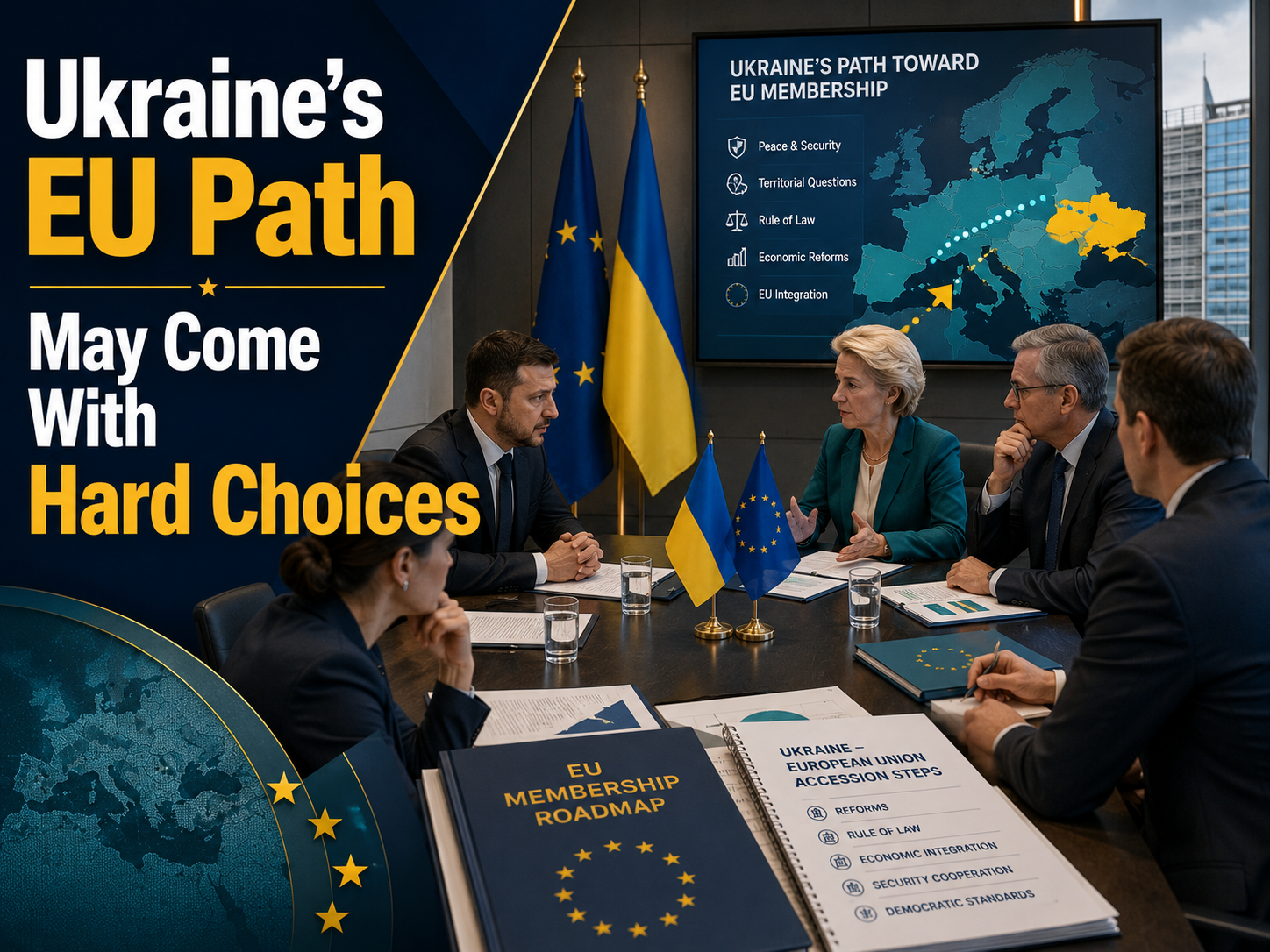
Ukraine’s EU Path May Come With Hard Choices
Advanced | May 9, 2026
✨ 혼자서 기사를 소리 내어 읽거나 튜터를 따라 각 단락을 반복해서 읽으세요. 레벨...
Ukraine’s EU Path Faces a Difficult Reality
German Chancellor Friedrich Merz suggested that Ukraine may eventually have to accept the loss of some territory as part of a future peace deal with Russia. Speaking to students in Marsberg, Germany, Merz said he was working on ideas to bring Ukraine closer to the European Union step by step. According to Reuters, he connected this painful possibility with a larger goal: giving Ukrainians a clear future inside Europe. The message was not cheerful, but it was direct. In business-casual English, we might say: this is where the conversation gets real.
Why the Territorial Question Matters
Merz said that if there is eventually a peace treaty with Russia, part of Ukraine’s territory may no longer be under Ukrainian control. That is a very sensitive point because Ukraine has fought for years to defend its land and independence. Merz also suggested that Ukrainian President Volodymyr Zelenskiy would need to explain any difficult peace decision to the Ukrainian people, possibly through a referendum. In other words, this would not just be a diplomatic decision made behind closed doors. It would be a national decision with deep emotional, political, and security consequences. (Reuters Connect)
Ukraine’s EU Path Will Not Be Fast
The Ukraine’s EU path question is not only about ending the war. It is also about whether Ukraine can meet the EU’s membership requirements. Merz said Ukraine cannot realistically join the EU while it is still at war. He also ruled out accession in 2027 or even 2028, saying Ukraine must first meet strict conditions related to the rule of law and anti-corruption reforms. That means even if the fighting stops, Ukraine’s entry into the EU would still take time. For Kyiv, the challenge is not just winning support. It is also proving that the country can meet the standards of a major political and economic union. (Reuters)
A Step-by-Step Approach Instead of Full Membership
Merz proposed intermediate steps that could bring Ukraine closer to the EU before full membership. One idea was allowing Ukraine to take part in meetings of important EU bodies without voting rights. He said this kind of arrangement received broad support at a recent EU summit attended by Zelenskiy. This approach could give Ukraine a stronger European connection while avoiding the problem of immediate full accession. It is a practical middle step: not full membership, but not standing outside the door either. For many businesses and governments, that kind of phased approach is often how large, complicated deals move forward. (Reuters Connect)
Hungary’s Political Shift Could Open the Door Wider
Another important detail is the recent political change in Hungary. Reuters reported that Hungary’s election removed Viktor Orban, who had long been one of Ukraine’s biggest obstacles inside the EU. His successor, Peter Magyar of the center-right Tisza party, is not described as strongly pro-Ukraine, but he is expected to be less hostile to Kyiv’s EU ambitions. This matters because EU decisions often require broad agreement among member states. With Orban gone, Ukraine may have a clearer path on aid, sanctions, and accession talks—but that does not mean everything suddenly becomes easy. The road is still long, but one major roadblock may be smaller now. (Reuters)
What This Means for Business English Learners
For English learners, this story is useful because it shows how leaders use careful language when the topic is serious. Merz did not say Ukraine “must” give up territory. Reports used words like suggested, may, might, and possibly. That matters. In advanced English, especially in business or diplomacy, careful language helps people discuss difficult choices without sounding reckless or absolute. The Ukraine’s EU path story is also a good reminder that big goals often require stages, conditions, and trade-offs. Whether you are talking about politics, business strategy, or career growth, it helps to explain both the goal and the obstacles.
Vocabulary
- Territorial Loss (noun phrase) – losing control of land or territory.
Example: “Merz suggested Ukraine may face territorial loss in a future peace deal.” - Peace Treaty (noun phrase) – an official agreement to end a war.
Example: “A peace treaty with Russia could create difficult choices for Ukraine.” - Referendum (noun) – a public vote on an important political question.
Example: “Zelenskiy might need a referendum to ask Ukrainians about a major peace decision.” - Accession (noun) – the process of joining an organization, especially the EU.
Example: “Ukraine’s EU accession will likely take several years.” - Rule of Law (noun phrase) – the principle that laws are fair and apply to everyone.
Example: “The EU requires strong rule of law before accepting new members.” - Anti-Corruption Reforms (noun phrase) – changes designed to stop dishonest use of power.
Example: “Ukraine must continue anti-corruption reforms to move closer to the EU.” - Intermediate Step (noun phrase) – a stage between the beginning and the final goal.
Example: “Observer access to EU meetings could be an intermediate step.” - Voting Rights (noun phrase) – the official power to vote in decisions.
Example: “Ukraine might attend some EU meetings without voting rights.” - Roadblock (noun) – something that prevents progress.
Example: “Orban had been a major roadblock to Ukraine’s EU ambitions.” - Trade-Off (noun) – a situation where you give up one thing to gain another.
Example: “Ukraine may face a painful trade-off between peace and territorial control.”
Discussion Questions (About the Article)
- What did Friedrich Merz suggest Ukraine may have to accept in a future peace deal?
- Why would Zelenskiy possibly need to hold a referendum?
- Why did Merz say Ukraine cannot join the EU while still at war?
- What intermediate steps did Merz suggest for bringing Ukraine closer to the EU?
- How could Hungary’s political change affect Ukraine’s EU hopes?
Discussion Questions (About the Topic)
- Should a country ever accept territorial loss to end a war? Why or why not?
- What should matter more in peace talks: justice, security, or speed?
- Should the EU allow countries at war to become members?
- How can leaders explain painful compromises to their citizens?
- What makes a political compromise acceptable or unacceptable?
Related Idiom
“Between a rock and a hard place” – stuck between two very difficult choices.
Example: “Ukraine may be between a rock and a hard place if peace requires territorial loss but EU membership requires the war to end.”
📢 Want more practical English through real news stories? Sign up for the All About English Mastery Newsletter here: allaboutenglishmastery.com/newsletter
Want to build stronger English in less time? Check out Mastering English for Busy Professionals.
Follow our YouTube channel @All_About_English for more English tips and practice.
This article was inspired by: Reuters, Reuters Connect, Reuters, and Kyiv Independent


 한국어
한국어  English