

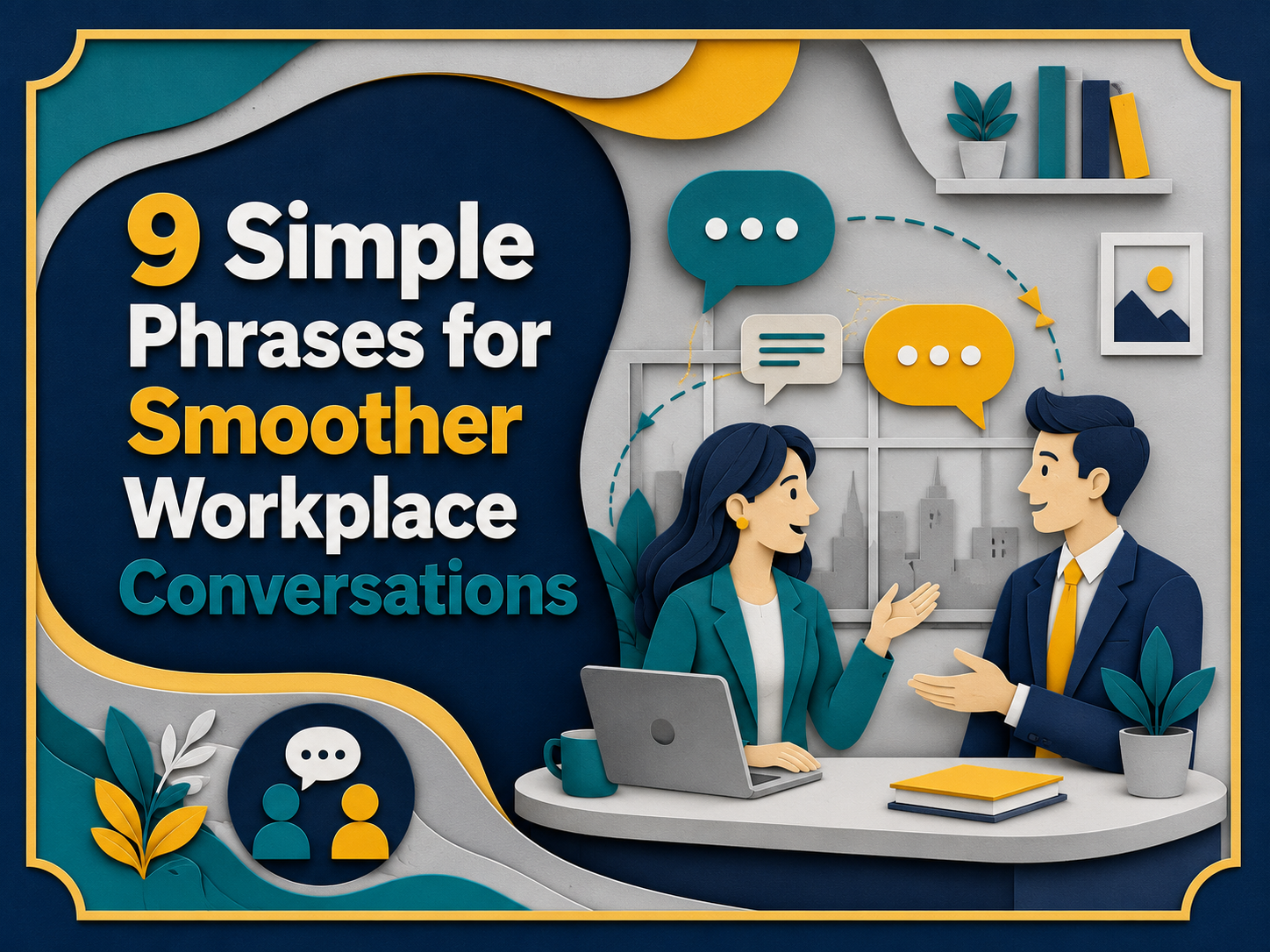
9 Workplace Conversation Phrases for Smoother English 💬
Beginner Level | June 15, 2026
혼자서 기사를 소리 내어 읽거나 튜터를 따라 각 단락을 반복해서 읽으세요. 레벨...
Workplace conversations can feel stressful when you are learning English. You may know the words in your head, but when someone talks to you suddenly, your brain freezes. That is normal. The good news is that you do not need complicated English to sound friendly and professional. You just need a few simple phrases you can use again and again.
Today, let’s learn 9 workplace conversation phrases you can use to make daily office English smoother, clearer, and more professional. These phrases are useful for meetings, emails, small talk, and everyday office situations. They help you sound polite, clear, and confident without trying to sound like a walking business dictionary. Nobody needs that guy in the break room.
Why Workplace Conversation Phrases Matter
Simple phrases help conversations move forward. When you use clear English, people understand you faster. This makes you easier to work with. It also helps you feel less nervous because you do not have to create a new sentence every time you speak.
In professional English, smooth conversation is not about using big words. It is about making other people feel comfortable. A short phrase like “Could you clarify that?” can be much better than staying silent. A phrase like “That sounds good to me” can show agreement quickly and naturally.
1. “Could you clarify that?”
Use this phrase when you do not fully understand something. It is polite and professional. Instead of saying, “I don’t understand,” you can say, “Could you clarify that?” This shows that you are listening and that you want to understand correctly.
Example: “Could you clarify that last point about the deadline?”
2. “That sounds good to me.”
This phrase is useful when you agree with a plan or suggestion. It sounds natural and positive. You can use it in meetings, team chats, or emails.
Example: “Moving the meeting to Thursday sounds good to me.”
3. “Let me check and get back to you.”
This is a great phrase when you do not know the answer right away. It gives you time to confirm information instead of guessing. Very professional. Very adult. Slightly less exciting than pretending you know everything, but much safer.
Example: “Let me check and get back to you this afternoon.”
4. “I’m not sure, but I can find out.”
This phrase helps you sound honest and helpful. You do not need to know everything. What matters is showing that you are willing to help.
Example: “I’m not sure, but I can find out and send you the details.”
5. “Could we go over that again?”
Use this when you need someone to repeat or review something. It is especially helpful in meetings or training sessions.
Example: “Could we go over that again before we make the final decision?”
6. “I see your point.”
This phrase shows that you understand another person’s opinion. It does not always mean you agree. It simply means you are listening carefully.
Example: “I see your point. Maybe we should look at the budget again.”
7. “What do you think?”
This is a simple question, but it is powerful. It invites the other person to share ideas. It also helps keep the conversation balanced instead of making you do all the talking.
Example: “I think this design is clearer. What do you think?”
8. “Thanks for the update.”
Use this phrase when someone gives you new information. It is short, polite, and useful in many work situations.
Example: “Thanks for the update. I’ll review the file today.”
9. “Let’s follow up later.”
This phrase is helpful when a conversation needs to continue another time. It keeps things organized and professional.
Example: “We need more information, so let’s follow up later this week.”
How to Practice These Phrases
Choose three phrases from today’s list and say them out loud five times. Then imagine a real work situation where you could use each one. For example, picture yourself in a meeting, on a video call, or writing a short message to a coworker.
The goal is not to memorize every phrase perfectly. The goal is to make these phrases feel natural. When you practice them aloud, your mouth and brain start working together. Then, when the real moment comes, you will not freeze as easily.
Final Thoughts
These 9 workplace conversation phrases can help you speak more clearly and confidently at work. You do not need advanced grammar to start better conversations. You just need practical phrases that help you ask, answer, agree, explain, and continue the discussion.
Try using one phrase today. Just one. Small steps build real confidence over time. And remember: smooth English does not mean perfect English. It means useful, clear, human English.
Vocabulary List
- Phrase (noun) — A short group of words with meaning.
Example: “Thanks for the update” is a useful workplace phrase. - Clarify (verb) — To make something easier to understand.
Example: Could you clarify the deadline for this project? - Professional (adjective) — Related to work or business; polite and appropriate at work.
Example: She used a professional tone in the meeting. - Deadline (noun) — The final time or date to finish something.
Example: The deadline for the report is Friday. - Suggestion (noun) — An idea or plan offered for others to consider.
Example: His suggestion helped improve the project. - Confirm (verb) — To check that something is correct or true.
Example: I need to confirm the meeting time. - Update (noun) — New information about a situation.
Example: Thanks for the update about the client call. - Review (verb) — To look at something carefully again.
Example: Let’s review the proposal before sending it. - Follow up (phrasal verb) — To continue a conversation or action later.
Example: I’ll follow up with you tomorrow. - Balanced (adjective) — Fair or equal between two sides.
Example: A balanced conversation gives both people time to speak.
5 Questions About the Article
- Why are simple phrases useful in workplace conversations?
- What phrase can you use when you do not understand something clearly?
- What can you say when you do not know the answer right away?
- What does “I see your point” mean?
- Why should you practice these phrases out loud?
5 Open-Ended Discussion Questions
- Which phrase from today’s article would be most useful for your job?
- When do you usually feel nervous speaking English at work?
- What is one workplace conversation you want to handle more smoothly?
- How can simple English help you build better relationships at work?
- What phrase do you already use often in English?
📢 Want more tips like this? 👉 Sign up for the All About English Mastery Newsletter! Click here to join us!
Want to finally Master English but don’t have the time? Mastering English for Busy Professionals is the course for you! Check it out now!
Follow our YouTube Channel @All_About_English for more great insights and tips.
 한국어
한국어  English