

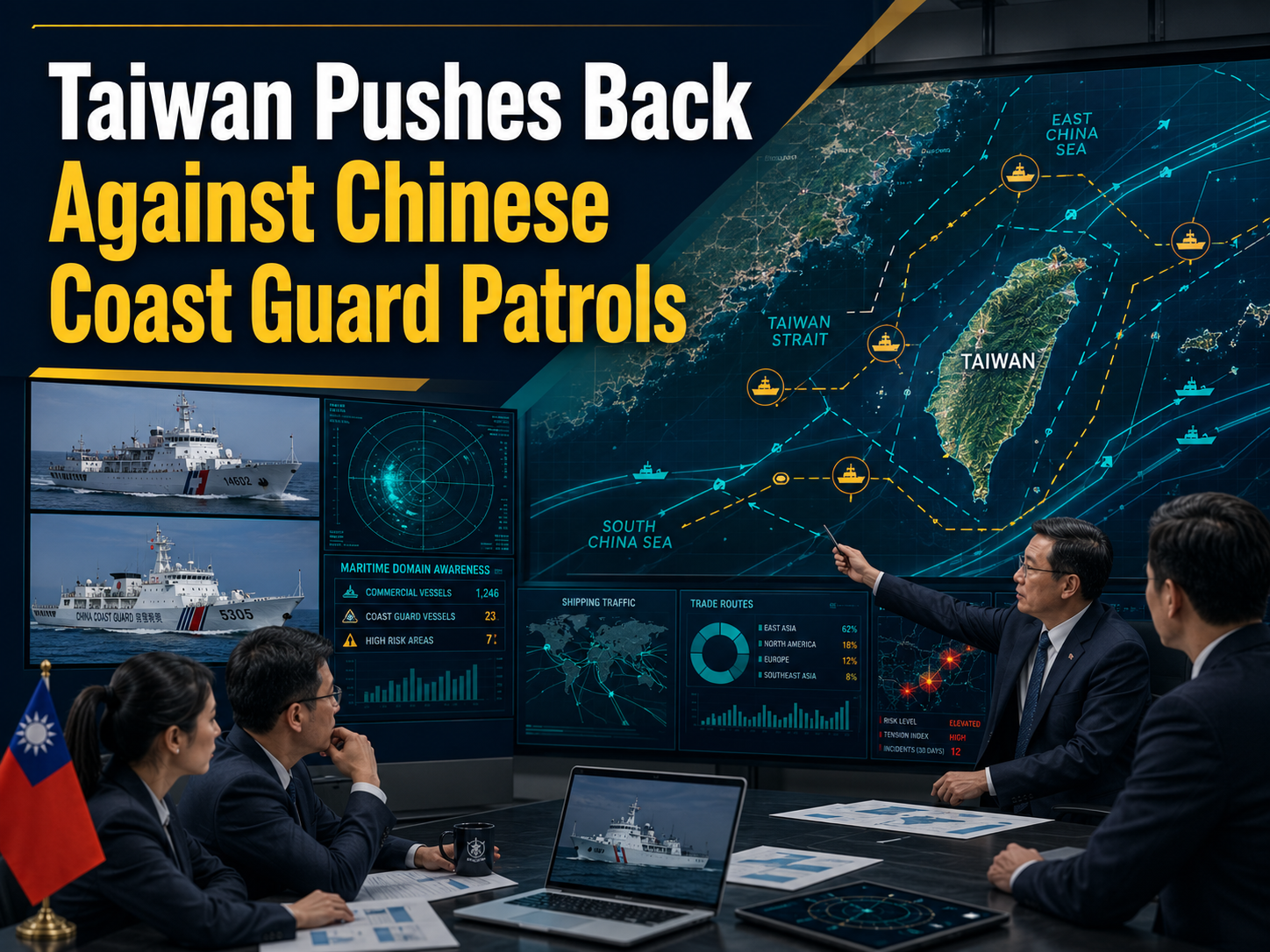
Taiwan Pushes Back Against Chinese Coast Guard Patrols
Intermediate | June 14, 2026
✨ 혼자서 기사를 소리 내어 읽거나 튜터를 따라 각 단락을 반복해서 읽으세요. 레벨...
Taiwan Draws a Clear Line at Sea
Taiwan is warning China not to treat nearby waters as Chinese territory. On June 11, 2026, Reuters reported that Taiwan’s coast guard said the island’s maritime sovereignty “cannot be violated” after China ended a coast guard patrol east of Taiwan. Taiwan said it would not tolerate any country trying to create a false impression of control over those waters. In plain English: Taiwan is saying, “These are not your waters, and we will not pretend they are.” (Reuters)
Why Chinese Coast Guard Patrols Matter
The issue is not just about boats moving around the sea. Chinese coast guard patrols matter because they can be used to show power without starting a direct military conflict. This is often called “gray zone” pressure — actions that are serious, but not quite war. Taiwan says China is trying to act like it has legal authority over waters around Taiwan. Beijing, however, claims Taiwan as part of China and says it has the right to protect its sovereignty and maritime interests. That is why every patrol, radio message, and ship movement becomes politically important. (Reuters)
China’s “Law-Enforcement Operation”
According to Reuters, China said it had carried out a “special maritime traffic law-enforcement operation” east of Taiwan. Chinese state media said the coast guard inspected 198 vessels and conducted a hydrographic survey, which means collecting information about the sea, such as depth and underwater conditions. Taiwan rejected China’s actions and said Beijing has no jurisdiction in those waters. Taiwan’s coast guard said that if Chinese ships appear and claim authority, Taiwan will “forcefully drive them away” to protect freedom and safety of navigation. (Reuters)
Merchant Ships Caught in the Middle
Taiwan also said Chinese coast guard ships had harassed three merchant ships by asking them where they came from, where they were going, and by claiming jurisdiction over the area. According to Reuters, Taiwan told commercial ships to ignore Chinese communications if Chinese vessels tried to question them. No ships were boarded, but the message was clear: Taiwan does not want normal commercial shipping to become part of Beijing’s pressure campaign. For businesses, this matters because safe shipping routes are the bloodstream of trade. Block the flow, and the whole body starts complaining. (Reuters)
A Wider Regional Dispute
This latest tension came after Japan and the Philippines said in May that they would begin formal talks about maritime boundaries. China viewed those talks as involving waters near Taiwan, which made Beijing angry. Taiwan rejected that idea and said China had no right to interfere in matters involving waters east of Taiwan. Taiwanese officials have also accused China of using “law enforcement” as an excuse to expand its control. In other words, this is not only a Taiwan-China issue. It also connects to Japan, the Philippines, shipping routes, and the balance of power in the region. (Reuters)
Taiwan Expels Chinese Ships from Restricted Waters
The same week, Taiwan said it had already expelled Chinese government ships from restricted waters near its southern coast. Reuters reported that Taiwan’s coast guard dispatched vessels to confront Chinese ships that entered restricted waters southwest of Taiwan. The Chinese vessels later left. Taiwan also said two Chinese ships briefly entered restricted waters near Itu Aba, a Taiwan-controlled island in the South China Sea, before withdrawing after being challenged. These actions show that Taiwan is not just making statements. It is using its coast guard to respond directly. (Reuters)
The Big Picture
The Chinese coast guard patrols story matters because it shows how tensions around Taiwan are moving beyond fighter jets and warships. Coast guard vessels, merchant ships, radio warnings, and maritime law are now part of the dispute. Taiwan wants to protect its sovereignty and shipping safety. China wants to show that it has authority around Taiwan. For English learners, this is a useful news topic because it includes real business and diplomacy language: sovereignty, jurisdiction, patrols, commercial shipping, and regional security.
Vocabulary
- Coast Guard (noun) – a government service that protects a country’s waters and helps enforce maritime law.
Example: “Taiwan’s coast guard responded to the Chinese ships.” - Patrol (noun/verb) – the act of watching or moving through an area to check security.
Example: “Chinese ships conducted a patrol east of Taiwan.” - Sovereignty (noun) – the power of a country or government to control its own territory.
Example: “Taiwan said its maritime sovereignty cannot be violated.” - Jurisdiction (noun) – legal authority over an area or issue.
Example: “Taiwan rejected China’s claim of jurisdiction over the waters.” - Maritime (adjective) – related to the sea or ships.
Example: “The dispute involves maritime boundaries.” - Merchant Ship (noun) – a ship that carries goods for trade.
Example: “Taiwan said Chinese vessels contacted merchant ships.” - Harass (verb) – to bother, pressure, or repeatedly trouble someone.
Example: “Taiwan accused China’s coast guard of harassing commercial ships.” - Expel (verb) – to force someone or something to leave a place.
Example: “Taiwan said it would expel ships that claimed jurisdiction.” - Navigation (noun) – the movement and direction of ships, aircraft, or vehicles.
Example: “Taiwan said it wants to protect freedom of navigation.” - Gray Zone (noun/adjective) – actions that are aggressive but stay below the level of open war.
Example: “Coast guard patrols can be part of gray zone pressure.”
Discussion Questions About the Article
- What did Taiwan say about its maritime sovereignty?
- Why are Chinese coast guard patrols important?
- What did China say it was doing east of Taiwan?
- How were merchant ships affected by the patrols?
- Why do Japan and the Philippines appear in this story?
Discussion Questions About the Topic
- Why are shipping routes important for business and trade?
- Should coast guard ships be treated differently from navy ships?
- How can countries respond to gray zone pressure without starting a war?
- Why do maritime boundaries often create international disputes?
- How could this kind of tension affect companies in East Asia?
Related Idiom
“Draw a line in the sand” – to set a clear limit that should not be crossed.
Example: “Taiwan is drawing a line in the sand by saying it will expel ships that try to claim jurisdiction over its waters.”
📢 Want more practical English through real news stories? Sign up for the All About English Mastery Newsletter here: allaboutenglishmastery.com/newsletter
Want to build stronger English in less time? Check out Mastering English for Busy Professionals.
Follow our YouTube channel @All_About_English for more English tips and practice.
This article was inspired by: Reuters, Reuters on Chinese coast guard activity near commercial shipping, Reuters on Taiwan expelling Chinese ships, and Reuters on Taiwan calling the patrols provocative


 한국어
한국어  English