

U.S. Business Activity Keeps Growing, But Hiring Stays Cautious
Intermediate | June 24, 2026
✨ 혼자서 기사를 소리 내어 읽거나 튜터를 따라 각 단락을 반복해서 읽으세요. 레벨...
A Better Month for U.S. Business Activity
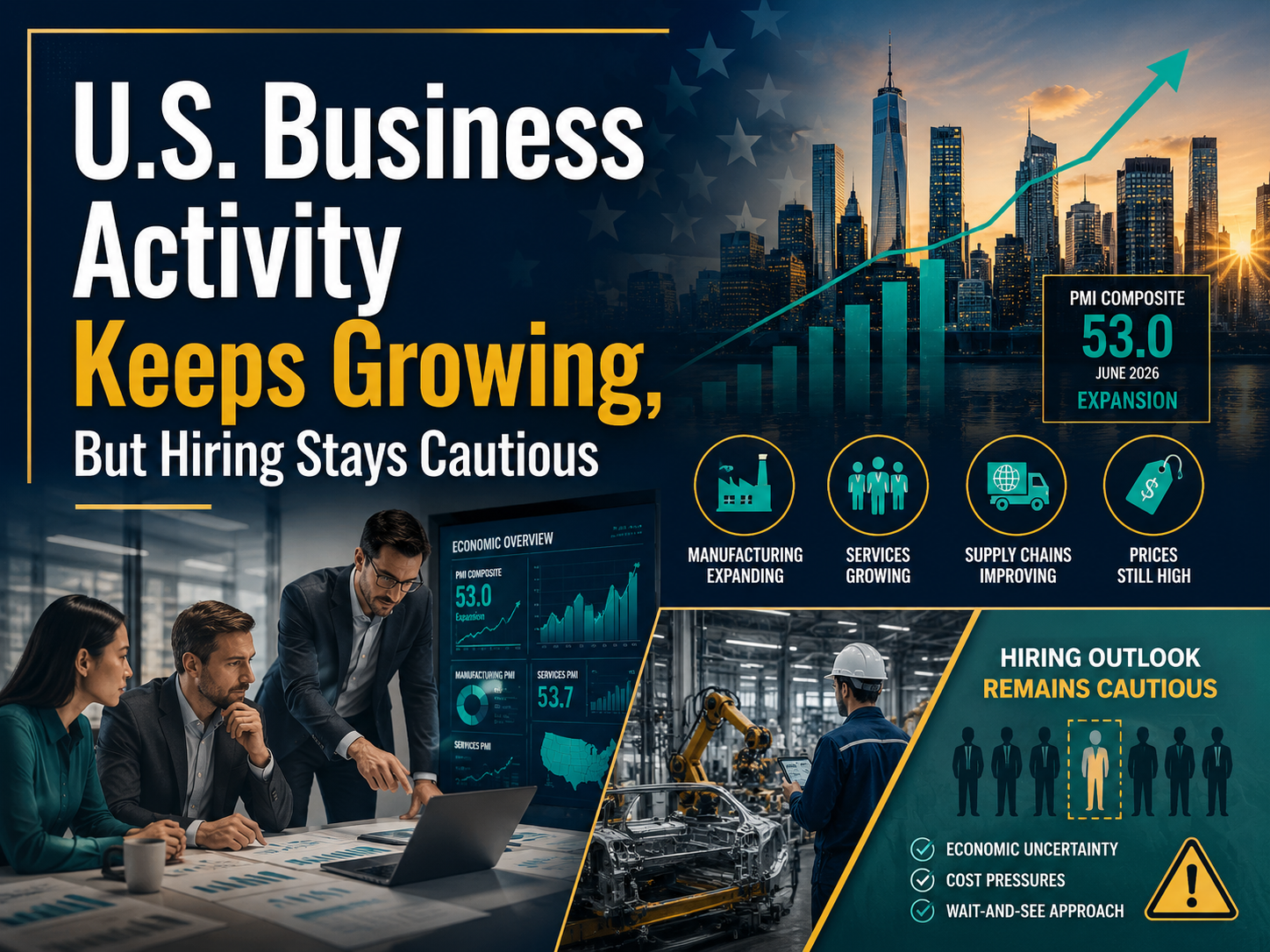
U.S. business activity continued to grow in June, according to new survey data from S&P Global. The Flash U.S. Composite PMI rose to 52.2, up from 51.5 in May. A PMI score above 50 means activity is growing, while a score below 50 means it is shrinking. So, in simple English: U.S. companies were still moving forward in June, but not exactly throwing a victory parade down Wall Street. (The Wall Street Journal, S&P Global)
Why U.S. Business Activity Matters
The report is important because the PMI gives an early look at how private businesses are doing before many official government reports come out. The survey is based on responses from both manufacturing companies and service providers. S&P Global said the June data showed the biggest rise in output since January, helped by stronger manufacturing and a modest improvement in services. (S&P Global)
Manufacturing Had a Strong Month
Manufacturing was the bright spot. The S&P Global U.S. Manufacturing PMI rose to 55.7, its highest level since May 2022. Manufacturing output also rose to 57.7, its highest level in 59 months. Reuters reported that factories saw a strong increase in new orders, partly because some companies were trying to buy early before possible shortages or price increases. In business terms, companies were trying to stay ahead of the curve. (Reuters, S&P Global)
Services Improved, But Customers Stayed Careful
The services side also improved, but more slowly. The Flash U.S. Services PMI Business Activity Index rose to 51.3, up from 50.7 in May. S&P Global said some service companies were helped by the 2026 FIFA World Cup, which the United States is co-hosting with Canada and Mexico. Still, service providers also reported pressure from high prices, higher interest rates, and low confidence among customers. That means people and businesses are still spending carefully. (MarketWatch, S&P Global)
The Warning Sign: Jobs
Even though business activity improved, hiring was a weak point. S&P Global said employment fell for the second month in a row. Manufacturing jobs were hit especially hard, with factory headcounts falling at the fastest pace since the early COVID-19 lockdowns in 2020. Reuters reported that the manufacturing employment index dropped to 47.0, the lowest reading since May 2020. Companies blamed cost concerns, raw material prices, and worries about future demand. (Reuters, S&P Global)
The Big Picture
Overall, the June report gives a mixed picture. U.S. business activity is still expanding, manufacturing looks stronger, and some confidence returned because of better news from the Middle East. But prices remain high, supply chains are still under pressure, and companies are cautious about hiring. So the economy is not falling apart—but it is not running at full speed either. It is more like a tired office worker on his third coffee: still moving, but don’t ask him to sprint.
Vocabulary
- Business Activity (noun) – the amount of work, production, sales, or services happening in an economy.
Example: “U.S. business activity continued to grow in June.” - PMI (noun) – Purchasing Managers’ Index; a survey that shows whether business activity is growing or shrinking.
Example: “A PMI above 50 usually means expansion.” - Composite (adjective) – made from several parts.
Example: “The Composite PMI includes both manufacturing and services.” - Manufacturing (noun) – the business of making products in factories.
Example: “Manufacturing had a strong month in June.” - 서비스 (noun) – businesses that provide help or activities instead of physical goods.
Example: “Hotels, banks, and software companies are part of the services sector.” - Output (noun) – the amount of goods or services produced.
Example: “Factory output grew faster in June.” - Shortage (noun) – a situation where there is not enough of something.
Example: “Companies ordered early because they feared shortages.” - Raw Materials (noun) – basic materials used to make products.
Example: “Higher raw material prices made companies nervous.” - Employment (noun) – the number of people with jobs.
Example: “Employment fell for the second month in a row.” - Confidence (noun) – the feeling that things will go well.
Example: “Better news from the Middle East helped restore some business confidence.”
Discussion Questions About the Article
- What happened to the U.S. Composite PMI in June?
- Why is a PMI score above 50 important?
- Which part of the economy looked stronger: manufacturing or services?
- Why were some companies placing orders early?
- What was the biggest warning sign in the report?
Discussion Questions About the Topic
- Do you think business growth always leads to more jobs? Why or why not?
- How do high prices affect business confidence?
- Why do companies sometimes reduce hiring even when business improves?
- How can global events affect local businesses?
- What economic signs do you personally pay attention to?
Related Idiom
“Stay ahead of the curve” – to prepare early or act before others.
Example: “Some manufacturers ordered supplies early to stay ahead of the curve before possible shortages or price increases.”
📢 Want more practical English through real news stories? Sign up for the All About English Mastery Newsletter here: allaboutenglishmastery.com/newsletter
Want to build stronger English in less time? Check out Mastering English for Busy Professionals.
Follow our YouTube channel @All_About_English for more English tips and practice.
This article was inspired by: The Wall Street Journal, S&P Global, Reuters, and MarketWatch


 한국어
한국어  English