

How to Tell a Short Story in English Without Getting Lost 🧭
Advanced Level | June 25, 2026
혼자서 기사를 소리 내어 읽거나 튜터를 따라 각 단락을 반복해서 읽으세요. 레벨...
Telling a story in English sounds easy—until you actually start. You begin with confidence, then suddenly your sentence gets too long, your details go everywhere, and your listener looks politely confused. Not exactly the heroic business communication moment we were hoping for. For many professionals, the problem is not vocabulary. The problem is structure. If you want to tell a short story in English, you need a simple path to follow from beginning to end.
A good short story does not need to be dramatic. You do not need to sound like a movie narrator or give every tiny detail from the beginning of time. In professional English, a short story is often just a quick example that helps people understand your point. Maybe you are explaining a problem, sharing a lesson, describing a client situation, or giving background in a meeting. When you can tell a short story in English clearly, people understand you faster and remember your message longer.
Why Short Stories Matter at Work
Stories make your English feel more natural and human. Facts are useful, but stories create connection. Imagine saying, “The project was delayed because communication was poor.” That is clear, but a little flat. Now imagine saying, “Last month, our design team changed one detail, but the update never reached the sales team. By Friday, everyone was working from different versions of the same file.” Suddenly, people can see the problem. A short story turns an idea into a picture.
Step 1: Start With the Situation
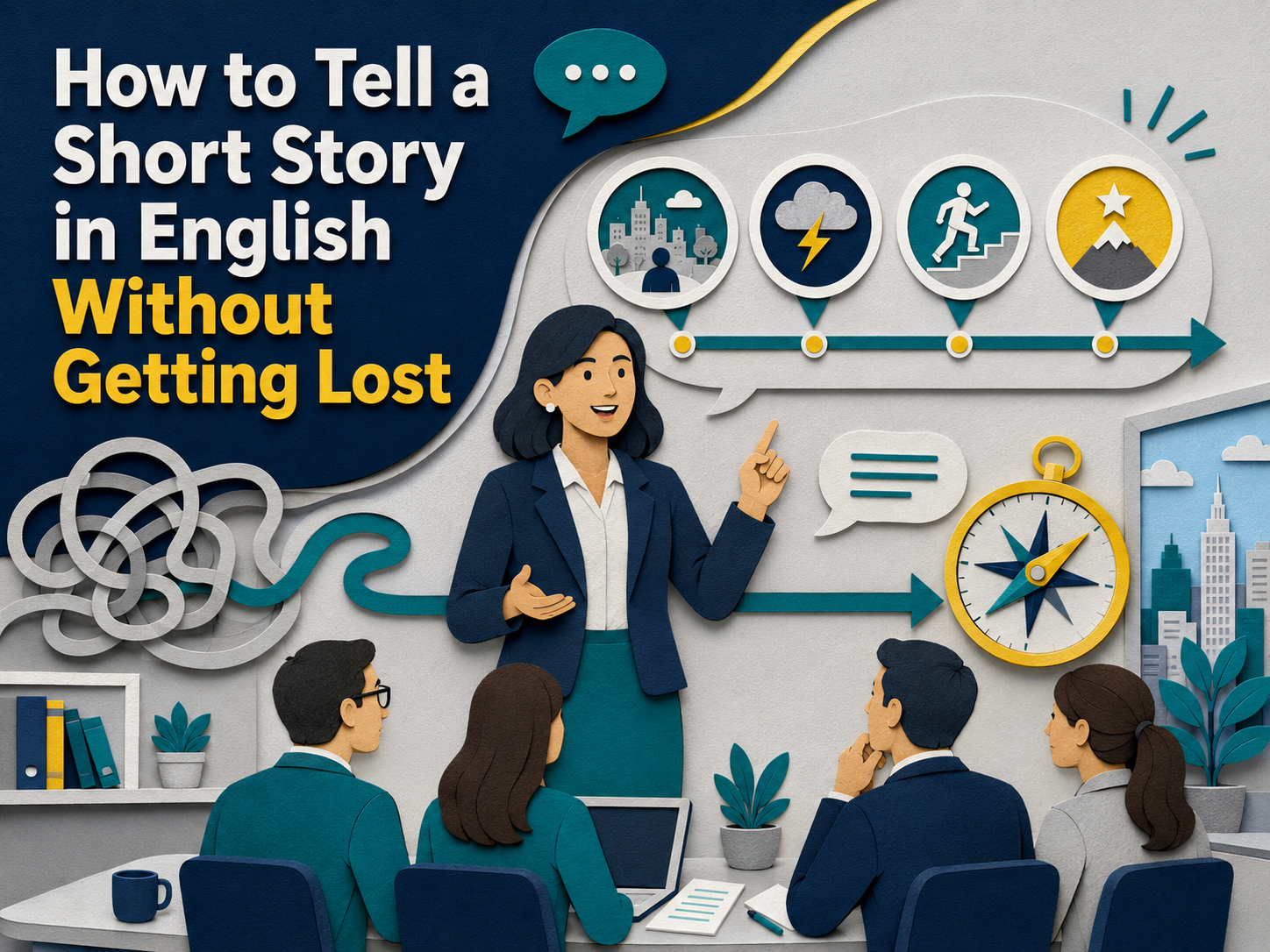
The first step is to give your listener the basic situation. Keep it short. Who was involved? Where did it happen? What was the general topic? For example, you might say, “Last week, I was in a client meeting about our new software update.” That one sentence gives your listener a clear starting point. Do not start with five background details, your company history, and the weather that day. This is a story, not a government report. Mercy, please.
Step 2: Explain the Problem or Change
Every useful story needs a small problem, surprise, or change. This is what makes people listen. You can use phrases like, “The problem was…,” “Then something changed…,” or “What surprised me was…” For example: “The problem was that the client expected one feature, but our team had prepared something different.” Now the listener knows why the story matters. Without this part, your story may feel like a random collection of events floating around the office like lost sticky notes.
Step 3: Share What Happened Next
After the problem, explain the action. What did you or your team do? Keep the order simple. Use time phrases like “first,” “then,” “after that,” and “finally.” These words are small, but they are powerful. They help your listener follow the story without getting lost. For example: “First, we paused the presentation. Then, we asked the client to explain their expectation. After that, we adjusted our demo and focused on the feature they cared about most.”
Step 4: End With the Point
This is where many English learners get lost. They tell the story, but they forget to land the plane. A short business story should end with a lesson, result, or main point. You can say, “The lesson for me was…,” “That’s why I think…,” or “In the end, we learned…” For example: “The lesson for me was that we need to confirm expectations before every client meeting.” That final sentence tells your listener why the story matters.
Step 5: Use the 4-Part Story Formula
Here is a simple formula you can use anytime: Situation → Problem → Action → Point. This structure works in meetings, presentations, interviews, and casual workplace conversations. Try this example: “Last month, our team had a tight deadline. The problem was that two departments were using different information. First, we created one shared document. Then, we had a short daily check-in. In the end, we finished on time, and I learned how important shared updates are.” Short, clear, useful. No wandering through the English jungle with a broken compass.
Practice: Tell a Short Story in English in Under One Minute
A strong short story should usually take less than one minute. That limit helps you choose only the most important details. Before your next meeting, prepare one short story using the formula. Write four quick notes: situation, problem, action, point. Then practice saying it out loud. Do not memorize every word. Just practice the structure. When the moment comes, your brain will have a map, and your English will feel more natural.
When you learn to tell a short story in English, you become easier to understand and more interesting to listen to. You can explain ideas, share lessons, and build trust without overexplaining. Remember: your goal is not to tell a perfect story. Your goal is to guide the listener clearly from beginning to end. Keep it short. Keep it simple. Land the plane.
Vocabulary List
- Structure (noun) — The way something is organized.
Example: A clear structure helps people follow your story. - Situation (noun) — The background or setting of an event.
Example: Start your story by explaining the situation. - Background (noun) — Information that helps people understand the context.
Example: Give only the background details your listener needs. - Expectation (noun) — What someone believes or thinks will happen.
Example: The client’s expectation was different from our plan. - Adjust (verb) — To change something slightly to make it better or more suitable.
Example: We adjusted the presentation after hearing the client’s concern. - Demonstrate (verb) — To show how something works or why something is true.
Example: A short story can demonstrate your main point clearly. - Sequence (noun) — The order in which things happen.
Example: Use time phrases to show the sequence of events. - Relevant (adjective) — Connected to the topic or useful for the situation.
Example: Only include relevant details in a short business story. - Overexplain (verb) — To explain too much or give too many details.
Example: Try not to overexplain when telling a short story. - Conclusion (noun) — The final idea or ending of something.
Example: End your story with a clear conclusion or lesson.
5 Questions About the Article
- Why do many professionals get lost when telling stories in English?
- What are the four parts of the short story formula?
- Why is it important to explain the problem or change in a story?
- What time phrases can help organize a story?
- Why should a short business story usually end with a lesson or main point?
5 Open-Ended Discussion Questions
- What kind of short stories do you often need to tell at work?
- When do you feel most likely to get lost while speaking English?
- What details do you usually include too much of when telling a story?
- How could storytelling help you in meetings or presentations?
- What is one short professional story you could practice this week?
📢 Want more tips like this? 👉 Sign up for the All About English Mastery Newsletter! Click here to join us!
Want to finally Master English but don’t have the time? Mastering English for Busy Professionals is the course for you! Check it out now!
Follow our YouTube Channel @All_About_English for more great insights and tips.

 한국어
한국어  English