

Bank of Korea Holds Rates as Inflation Risks Grow
Intermediate | May 30, 2026
✨ 혼자서 기사를 소리 내어 읽거나 튜터를 따라 각 단락을 반복해서 읽으세요. 레벨...
Bank of Korea holds rates as inflation risks grow
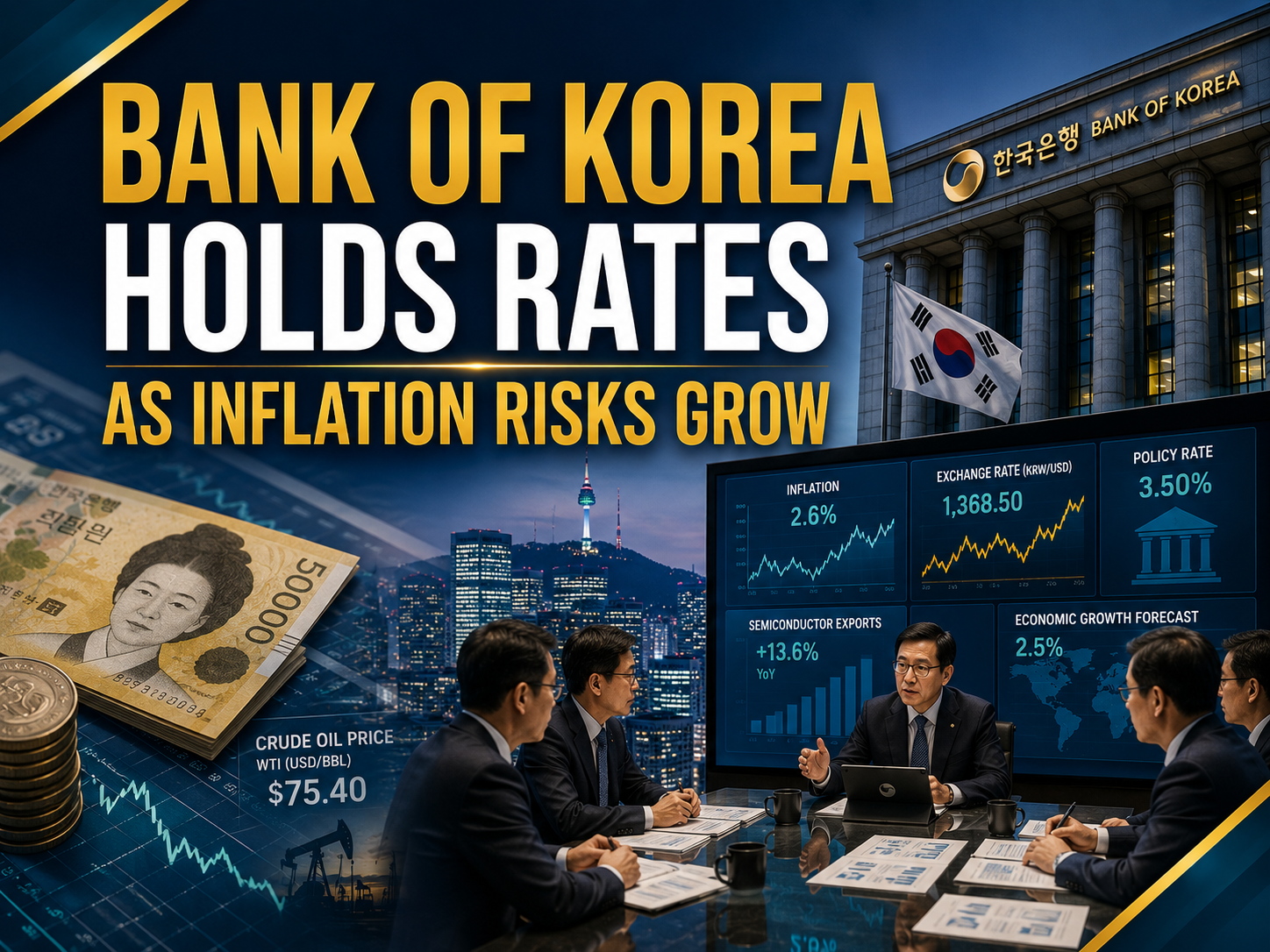
South Korea’s central bank kept its key interest rate unchanged this week, but the message was not exactly relaxed. On May 28, 2026, the Bank of Korea left its base rate at 2.50%, according to the official Bank of Korea monetary policy decision. The decision was expected, but the central bank also made it clear that inflation, the weak Korean won, and global uncertainty are still major concerns.
Why Bank of Korea Holds Rates Matters
The phrase Bank of Korea holds rates may sound like boring central-bank language, but it matters for real life. Interest rates affect loans, mortgages, business investment, exchange rates, and even prices at the supermarket. When a central bank keeps rates steady, it usually means policymakers want more time to understand the economy before making a bigger move. In this case, the Bank of Korea is trying to balance stronger growth with rising inflation pressure.
A 5–2 Vote Shows Growing Pressure
The decision was not unanimous. Reuters reported that five members of the seven-member Monetary Policy Board voted to keep the rate at 2.50%, while two members wanted to raise it by 25 basis points to 2.75%. That split matters because it shows some policymakers believe inflation is becoming serious enough to require action sooner rather than later. Reuters also noted that 30 of 32 economists in its poll expected the Bank of Korea to hold rates, so the decision itself did not surprise the market.
New Governor, More Hawkish Tone
This was also the first policy meeting under new Bank of Korea Governor Shin Hyun Song. After the decision, Shin said the bank would need to think carefully about when, how quickly, and how far to raise rates. Reuters reported that the central bank’s forward guidance showed a stronger bias toward higher rates, with many projections pointing toward 3.00% within the next six months. In business English, we could say the bank is “keeping its options open,” but it is clearly watching inflation closely.
Inflation and the Won Are Big Concerns
The Bank of Korea said inflation pressure has increased because of the Middle East war, higher global oil prices, and supply problems. The official decision noted that consumer price inflation reached 2.6% in April, while the bank raised its 2026 inflation forecast from 2.2% to 2.7%. The Korean won has also been under pressure. The Bank of Korea said the won-dollar exchange rate rose back to around 1,500 won per U.S. dollar, partly because of a stronger dollar and foreign investors selling Korean stocks. For families and businesses, a weaker won can make imported goods and energy more expensive.
Strong Chips, Stronger Growth
The story is not all negative. South Korea’s economy has been helped by strong semiconductor exports and AI-related investment. The Bank of Korea raised its 2026 growth forecast from 2.0% to 2.6%, saying the economy has grown more than expected because of strong exports, investment, and a solid semiconductor sector. The bank also said first-quarter growth rebounded to 1.7%. In plain English, South Korea is feeling pressure from higher prices, but it is also getting a boost from chips and technology.
What English Learners Can Notice
This story is useful for English learners because central-bank news uses many common business expressions: “hold rates,” “raise rates,” “inflation pressure,” “exchange rate volatility,” and “growth forecast.” These phrases are not just for economists. They show up in business meetings, investment reports, and international news conversations. The Bank of Korea holds rates story is a good example of how one decision can connect money, prices, exports, politics, and everyday life.
Vocabulary
- Central Bank (noun) – the main bank that manages a country’s money policy.
Example: “The central bank decided to keep interest rates unchanged.” - Interest Rate (noun) – the cost of borrowing money, shown as a percentage.
Example: “Higher interest rates can make loans more expensive.” - Base Rate (noun) – the main interest rate set by a central bank.
Example: “The Bank of Korea kept the base rate at 2.50%.” - Inflation (noun) – a general rise in prices.
Example: “Inflation makes food, fuel, and services more expensive.” - Basis Point (noun) – one-hundredth of one percentage point.
Example: “A 25 basis point increase would move the rate from 2.50% to 2.75%.” - Forecast (noun) – a prediction about what may happen.
Example: “The bank raised its growth forecast for the year.” - Exchange Rate (noun) – the value of one currency compared with another.
Example: “The won-dollar exchange rate affects import prices.” - Volatility (noun) – fast and uncertain changes in prices or markets.
Example: “High volatility makes business planning more difficult.” - Hawkish (adjective) – favoring higher interest rates to control inflation.
Example: “The central bank sounded more hawkish after the meeting.” - Semiconductor (noun) – a chip used in electronic devices and computers.
Example: “Strong semiconductor exports helped South Korea’s economy.”
Discussion Questions (About the Article)
- What interest rate did the Bank of Korea keep unchanged?
- Why did two board members want to raise rates?
- How can a weaker Korean won affect consumers and businesses?
- Why are semiconductors important for South Korea’s economy?
- What risks is the Bank of Korea watching closely?
Discussion Questions (About the Topic)
- How do interest rates affect people in daily life?
- Should central banks focus more on inflation or economic growth? Why?
- How can global conflicts affect prices in your country?
- Why do businesses care about exchange rates?
- What industries are most important for your country’s economy?
Related Idiom
“Walking a tightrope” – managing a difficult situation where one wrong move can cause problems.
Example: “The Bank of Korea is walking a tightrope between controlling inflation and supporting economic growth.”
📢 Want more practical English through real news stories? Sign up for the All About English Mastery Newsletter here: allaboutenglishmastery.com/newsletter
Want to build stronger English in less time? Check out Mastering English for Busy Professionals.
Follow our YouTube channel @All_About_English for more English tips and practice.
This article was inspired by: Reuters, Bank of Korea, The Wall Street Journal, and Financial Times


 한국어
한국어  English