

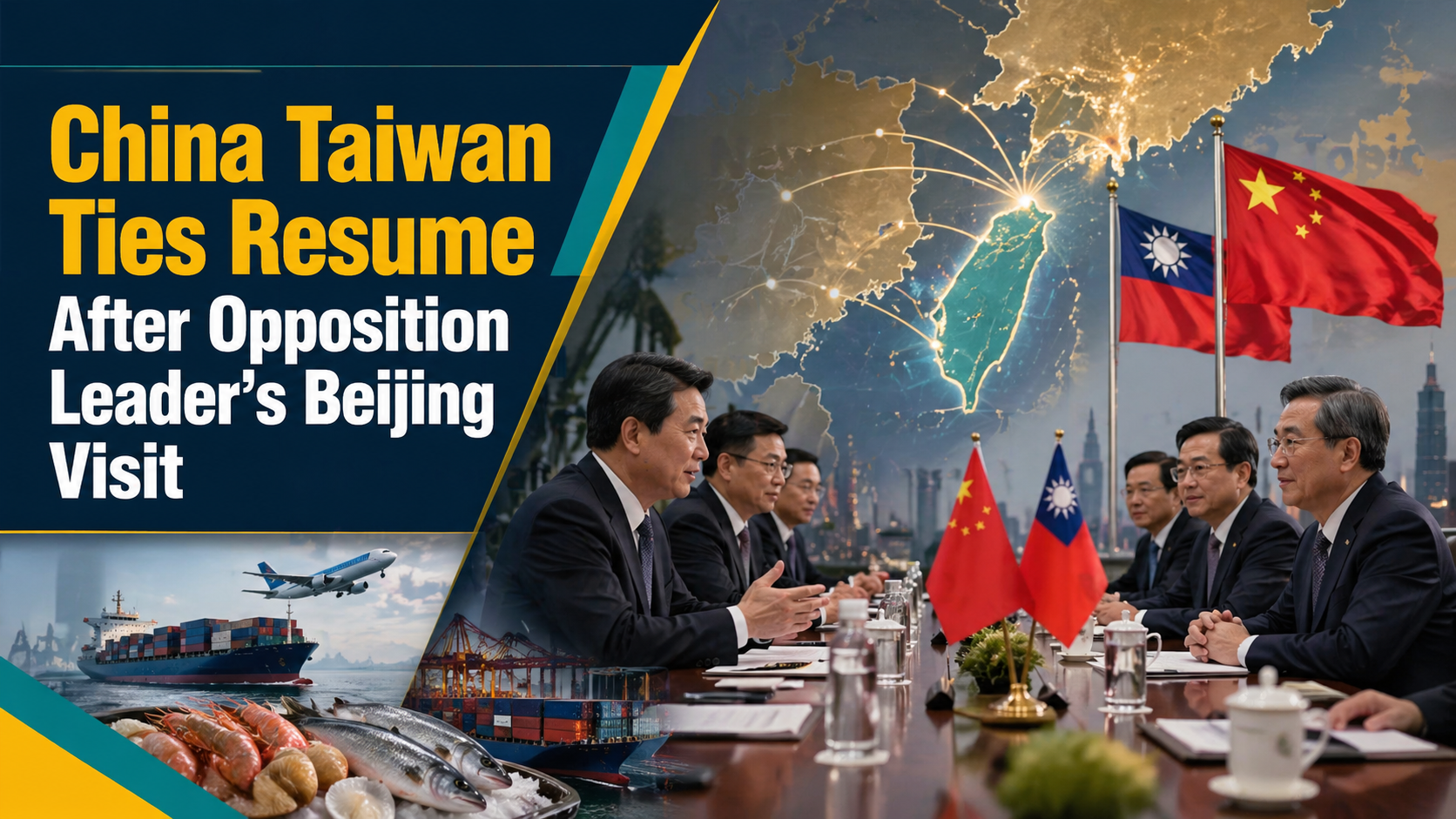
China-Taiwan Ties Resume After Opposition Leader’s Beijing Visit
Advanced | April 26, 2026
✨ 혼자서 기사를 소리 내어 읽거나 튜터를 따라 각 단락을 반복해서 읽으세요. 레벨...
A Careful Reopening: China-Taiwan Ties Resume
China said it would resume some suspended ties with Taiwan after Cheng Li-wun, the leader of Taiwan’s opposition Kuomintang Party, visited Beijing and met Chinese President Xi Jinping. According to AP News, China’s announcement included plans to restart some direct flights and allow imports of certain Taiwanese aquaculture products again. In plain English, this means Beijing is offering a partial reopening of travel and trade links—but not a full reset.
Why the China-Taiwan Ties Resume Story Matters
The China-Taiwan ties resume story matters because relations between China and Taiwan are tense, complicated, and closely watched around the world. China claims Taiwan as part of its territory and has not ruled out using force to bring it under Beijing’s control. Taiwan, meanwhile, has its own elected government, military, currency, and political system. That makes every small change in cross-strait relations important, especially when flights, food imports, or official communication channels are involved. (AP News)
What China Offered After Cheng’s Visit
China’s Taiwan Work Office said it would explore a long-term communication mechanism between the Chinese Communist Party and Taiwan’s KMT. Beijing also said it would help resume imports of Taiwanese aquaculture products that had previously been banned. Other reports said the plan could include direct flights between Taiwan and mainland cities such as Xi’an and Urumqi, although the details of how this would actually happen were still unclear. (Korea Times)
Cheng Li-wun Meets Xi Jinping in Beijing
Cheng Li-wun’s visit was politically important because she leads the KMT, a Taiwanese party that is generally more open to dialogue with Beijing than Taiwan’s ruling Democratic Progressive Party, or DPP. He met Xi Jinping at the Great Hall of the People in Beijing on April 10, 2026. Both sides spoke about peace, but they did not give many concrete details. Reuters reported that Xi said China would “absolutely not tolerate” Taiwan independence, while Cheng described her visit as a peace mission and called for improved relations. (Reuters)
Taiwan’s Government Pushes Back
Taiwan’s government was not exactly popping champagne over the announcement. Their Mainland Affairs Council criticized the measures as political deals between parties that bypassed Taiwan’s elected government. This is one of the key tensions in the story: Beijing is willing to talk with the KMT, but it refuses to engage directly with Taiwan’s President Lai Ching-te, whom China views as a separatist. For Taiwan’s government, that makes the offer look less like friendly cooperation and more like political pressure wrapped in a gift box. (AP News)
Business, Trade, and the Bigger Picture
For businesses, students, travelers, and families, even small openings can matter. More flights could make travel easier. More food imports could help Taiwanese producers. But the bigger issue is trust. A Taiwanese business group later urged both Beijing and Taipei to keep politics out of trade and tourism, saying stable exchanges are better for everyone. That sounds practical enough—because when governments keep changing the rules, businesses get stuck playing political dodgeball. (Reuters)
A Small Opening, Not a Solution
The China-Taiwan ties resume announcement may reduce some short-term tension, but it does not solve the deeper dispute. China still claims Taiwan, Taiwan’s government still rejects Beijing’s control, and both sides still disagree on the island’s future. For English learners, this story is useful because it shows how diplomacy often works: one side offers something practical, another side questions the motive, and everyone tries to read between the lines.
Vocabulary
- Resume (verb) – to start again after stopping.
Example: “China said it would resume some suspended ties with Taiwan.” - Suspended (adjective) – temporarily stopped.
Example: “Some flights and imports had been suspended before the announcement.” - Opposition Leader (noun) – the head of a political party that is not currently in power.
Example: “Cheng Li-wun is Taiwan’s opposition leader from the KMT.” - Aquaculture (noun) – the farming of fish, shellfish, or other water animals.
Example: “Taiwan hopes to sell more aquaculture products to China.” - Cross-Strait Relations (noun) – the political and economic relationship between China and Taiwan.
Example: “Cross-strait relations are closely watched by many countries.” - Mechanism (noun) – a system or process used to make something work.
Example: “China suggested a communication mechanism between the two parties.” - Bypass (verb) – to avoid or go around someone or something.
Example: “Taiwan’s government said the talks bypassed official channels.” - Separatist (noun) – a person who wants a region to become independent from a larger country.
Example: “Beijing has called President Lai a separatist.” - Concrete (adjective) – specific, clear, and real.
Example: “The leaders talked about peace but gave few concrete details.” - Political Pressure (noun) – actions used to influence another side politically.
Example: “Taiwan saw the offer as possible political pressure.”
Discussion Questions About the Article
- What did China say it would resume with Taiwan?
- Who is Cheng Li-wun, and why was her visit important?
- Why did Taiwan’s Mainland Affairs Council criticize the announcement?
- How could more flights and aquaculture imports help people or businesses?
- Why is this announcement only a small opening, not a full solution?
Discussion Questions About the Topic
- Can trade and travel improve political relationships? Why or why not?
- Should political parties talk directly with foreign governments if they are not in power?
- How can businesses protect themselves when politics affects trade?
- Why do small diplomatic gestures sometimes receive big media attention?
- What role should ordinary people, students, and business owners play in building peace?
Related Idiom
“Read between the lines” – to understand the hidden meaning behind what someone says.
Example: “When China says it wants better ties with Taiwan, many people try to read between the lines and understand the political message behind the offer.”
📢 Want more practical English through real news stories? Sign up for the All About English Mastery Newsletter here: allaboutenglishmastery.com/newsletter
Want to build stronger English in less time? Check out Mastering English for Busy Professionals.
Follow our YouTube channel @All_About_English for more English tips and practice.
This article was inspired by: AP News, Reuters, Reuters, and Korea Times


 한국어
한국어  English