

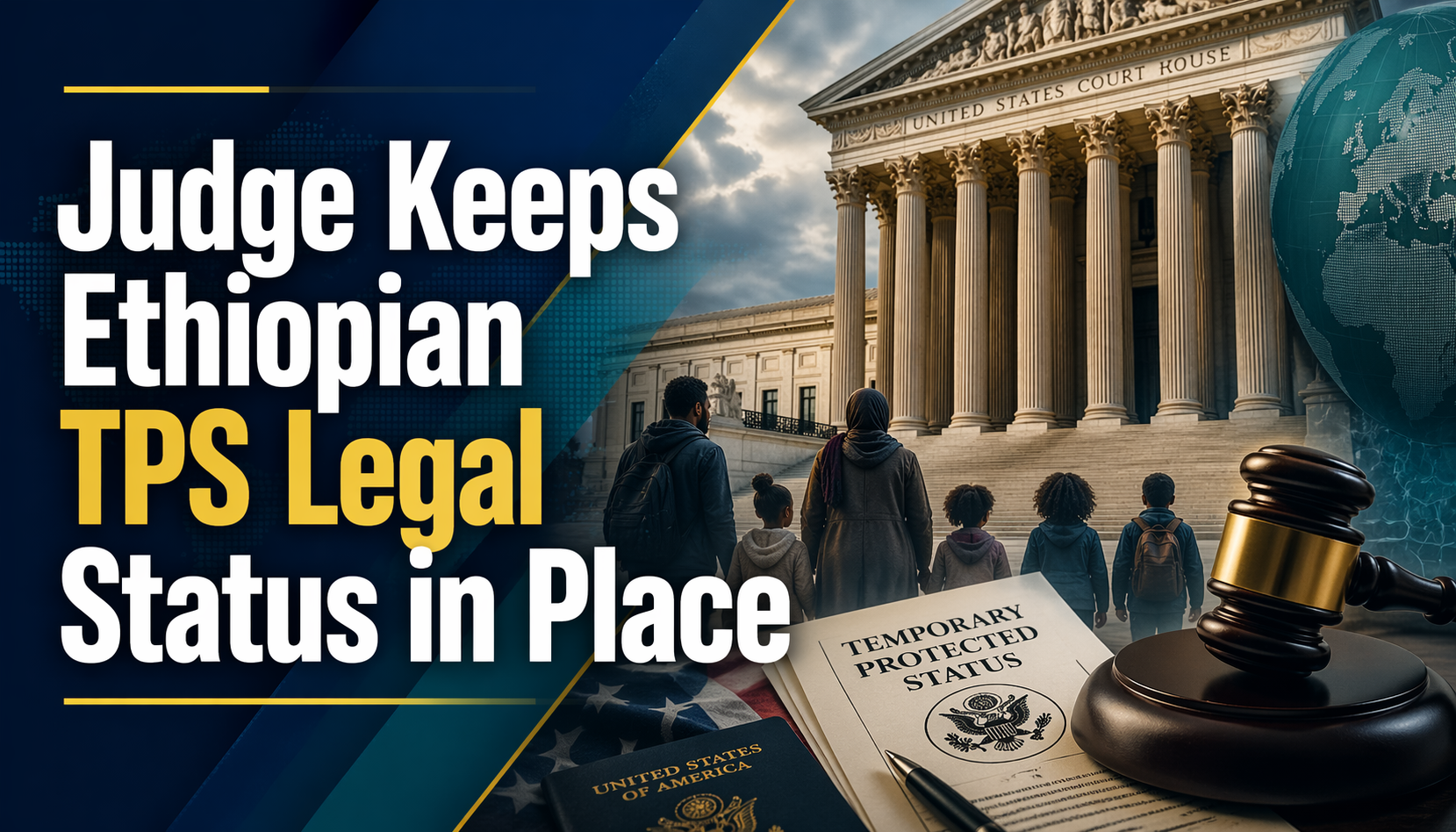
Judge Keeps Ethiopian TPS Legal Status in Place
Advanced | April 20, 2026
✨ 혼자서 기사를 소리 내어 읽거나 튜터를 따라 각 단락을 반복해서 읽으세요. 레벨...
A Court Steps In to Protect Ethiopian TPS Legal Status
A federal judge in Boston has blocked the Trump administration’s effort to end Temporary Protected Status (TPS) for more than 5,000 Ethiopians living in the United States. That status allows eligible people to live and work legally in the country for a limited time. The case became an important test of how much power the administration has to roll back immigration protections. (Reuters)
Why Ethiopian TPS Legal Status Became a Big Legal Fight
The Biden administration first gave TPS to Ethiopians in 2022, saying people should not be forced to return to a country facing armed conflict and humanitarian suffering. The protection was then extended in April 2024. But in December 2025, the Department of Homeland Security said conditions in Ethiopia had improved enough to end the program. (Reuters)
That decision was supposed to take effect on February 13, 2026, but the courts hit the brakes. Earlier in the case, Judge Brian Murphy temporarily paused the termination. Then, on April 8, he ruled more strongly against the administration and said the government had not followed the process required by Congress. (Reuters)
Judge Brian Murphy Says Process Matters
Murphy said the government had offered a “pretextual” reason for ending the protection and had ignored the legal steps built into the TPS system. In plain English, he believed the result looked decided in advance instead of being based on a fair review of the facts in Ethiopia. He also warned that a president’s wishes do not override federal law. (Reuters)
That is a big deal. TPS was created by Congress, and judges often pay close attention when an agency appears to cut corners. The ruling is also part of a wider battle over immigration policy, because the Trump administration has tried to end TPS protections for people from several other countries as well.
What the Government and Plaintiffs Argued
The administration said Ethiopia no longer met the conditions for TPS and repeated its broader argument that temporary protection should not become a long-term path to staying in the United States. Meanwhile, Ethiopian plaintiffs and the advocacy group African Communities Together argued that conflict still continues in several parts of Ethiopia and that the government ignored those dangerous realities. (Reuters)
They also argued that the decision was not just legally weak but unfairly motivated. That accusation raised the temperature of the case and helped turn this lawsuit into more than just a paperwork dispute. It became a fight over safety, legal procedure, and trust in how immigration decisions are made.
What Happens Next for Ethiopians in the U.S.?
For now, the ruling means thousands of Ethiopians can keep their legal protection while the case continues. In other words, they are not out of the woods forever, but they did win an important round. The bigger picture is still unfolding, too. The U.S. Supreme Court is set to hear arguments in another TPS case involving Haitians and Syrians, which could shape how similar cases move forward. (AP News)
So this story matters not only for Ethiopians but for many migrants watching from the sidelines. One ruling in Boston may not settle everything, but it definitely moved the needle.
Vocabulary
- Temporary Protected Status (noun) – a U.S. immigration status that lets people from unsafe countries stay and work legally for a limited time.
Example: Ethiopian nationals were allowed to remain in the U.S. under Temporary Protected Status. - Eligible (adjective) – allowed to do something or qualified for it.
Example: Only eligible migrants can receive TPS protection. - Humanitarian (adjective) – related to helping people who are suffering.
Example: The U.S. cited humanitarian concerns when it first granted TPS. - Terminate (verb) – to officially end something.
Example: The administration tried to terminate the protection in December 2025. - Pretextual (adjective) – given as a false reason to hide the real reason.
Example: The judge said the government’s explanation was pretextual. - Statutory (adjective) – required or controlled by law.
Example: The ruling said DHS ignored statutory procedures. - Advocacy group (noun) – an organization that supports a cause or group of people.
Example: An advocacy group joined the lawsuit on behalf of Ethiopians. - Override (verb) – to use power to cancel or replace something.
Example: The judge said a president cannot override the will of Congress. - Litigation (noun) – the process of taking legal action in court.
Example: The case is part of broader immigration litigation in the U.S. - Setback (noun) – a problem that slows progress.
Example: The ruling was a legal setback for the administration.
Discussion Questions (About the Article)
- Why did the judge decide to block the administration’s move?
- What is TPS, and why was it first given to Ethiopians in 2022?
- Why did the government say TPS for Ethiopia should end?
- What role did African Communities Together play in this case?
- Why could this ruling matter beyond just the Ethiopian community?
Discussion Questions (About the Topic)
- Should temporary immigration protections be easy or difficult for governments to end?
- How should courts balance executive power and congressional law?
- What kinds of conditions should qualify a country for TPS?
- Why do immigration cases often become political so quickly?
- How can legal uncertainty affect families, jobs, and communities?
Related Idiom or Phrase
“In limbo” – in an uncertain situation where the final result is still not clear.
Example: Many Ethiopian families were left in limbo while waiting for the court’s decision.
📢 Want more practical English through real news stories? Sign up for the All About English Mastery Newsletter here: allaboutenglishmastery.com/newsletter
Want to build stronger English in less time? Check out Mastering English for Busy Professionals.
Follow our YouTube channel @All_About_English for more English tips and practice.
This article was inspired by: Reuters, Reuters follow-up coverage, Reuters lawsuit background, and AP News.


 한국어
한국어  English