

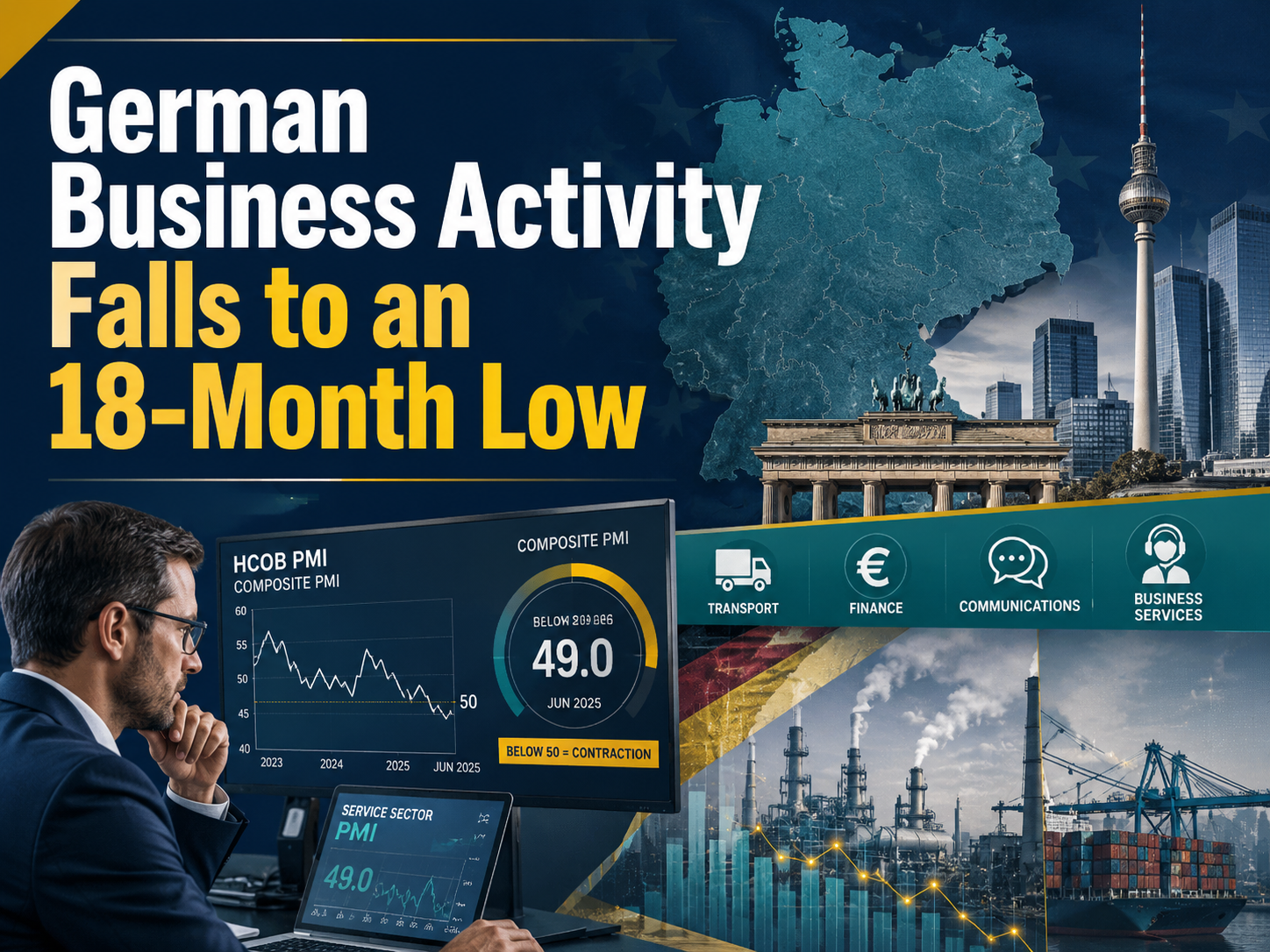
German Business Activity Falls to an 18-Month Low
Intermediate | June 30, 2026
✨ 혼자서 기사를 소리 내어 읽거나 튜터를 따라 각 단락을 반복해서 읽으세요. 레벨...
German Business Activity Shows New Signs of Weakness
Germany’s economy received another warning sign in June. According to Reuters, German business activity fell to its lowest level in 18 months, mainly because the country’s service sector became weaker. The report was based on the S&P Global Flash Germany PMI, which tracks how businesses are doing each month.
The S&P Global Flash Germany PMI report showed that the Composite PMI fell to 48.0 in June, down from 48.8 in May. That number matters because a PMI reading above 50 usually means business activity is growing, while a number below 50 means it is shrinking. In simple terms, Germany’s private sector is not completely falling apart, but it is clearly losing momentum.
Why German Business Activity Matters
Germany is the largest economy in Europe, so when German companies slow down, people pay attention. A weaker German economy can affect factories, workers, banks, investors, and businesses across the eurozone. It can also influence confidence in global markets because Germany is deeply connected to international trade.
The biggest problem in this report was the services sector. Reuters reported that the Flash Germany Services PMI fell to 46.8, down from 48.1 in May, its lowest level since November 2022. Services include areas like finance, communication, transport, real estate, insurance, and business services. When that part of the economy slows, it often means companies and consumers are being more careful with their money.
Services Lead the Decline Again
S&P Global said the June drop was the third straight monthly decrease in German business activity. The survey also showed that new business fell for the fourth month in a row, and at the fastest rate since December 2024. That is not exactly champagne-and-confetti economic news.
Phil Smith, Economics Associate Director at S&P Global Market Intelligence, said the service sector was still acting as a major drag on the economy. He also warned that the latest numbers increased the chance that Germany’s economy may have slipped back into contraction during the second quarter, a point also highlighted in the Reuters report.
Manufacturing Looks Slightly Better, But Not Strong
The manufacturing side of the report was not as weak as services, but it was not exactly booming either. Germany’s Manufacturing PMI slipped slightly to 50.0, down from 50.1 in May, according to the S&P Global PMI release. A reading of 50.0 is right on the line between growth and contraction.
There was one small positive sign: the Manufacturing Output Index rose to 50.8, up from 50.4 in May. That means factory output grew slightly. However, the overall picture still shows a cautious business environment, especially because demand remains weak and uncertainty is still weighing on companies.
Lower Inflation Pressure Gives Businesses Some Breathing Room
There was also some good news. The S&P Global report said inflationary pressures softened in June. Input cost inflation fell to a four-month low, and output price inflation slowed to its weakest pace in three months. That means companies were facing less pressure from rising costs and were raising prices less aggressively.
For businesses, this matters because lower cost pressure can make planning easier. Still, S&P Global said cost inflation remained high by historical standards, especially for manufacturers. In other words, things may be improving, but nobody is doing victory laps just yet.
What This Means for English Learners
This story is useful for English learners because it includes common business and economic vocabulary: activity, contraction, sector, output, inflation, expectations, and demand. These words appear often in business meetings, news reports, and market updates.
The big takeaway is simple: German business activity is weakening, mostly because services are slowing down. Manufacturing is holding close to neutral, but not strong enough to change the overall picture. For professionals, this is a good reminder that business data can tell a story before official government numbers arrive. HCOB explains that PMI reports are based on surveys of purchasing managers and are used to understand current business conditions.
Vocabulary
- Business activity (noun) – the amount of work, sales, production, or services happening in an economy.
Example: “German business activity fell to an 18-month low in June.” - PMI (noun) – Purchasing Managers’ Index; a survey that shows whether business conditions are improving or worsening.
Example: “A PMI below 50 usually signals contraction.” - Composite (adjective) – made by combining different parts or measures.
Example: “The Composite PMI includes both manufacturing and services.” - Contraction (noun) – a period when economic activity becomes smaller or weaker.
Example: “Germany’s private sector moved deeper into contraction.” - Services sector (noun) – the part of the economy that provides services instead of goods.
Example: “The services sector includes finance, transport, and business services.” - Manufacturing (noun) – the process or industry of making physical products.
Example: “Manufacturing output rose slightly in June.” - Output (noun) – the amount produced by a company, factory, or economy.
Example: “Factory output increased modestly.” - Demand (noun) – the desire or need for goods and services.
Example: “Weak demand hurt new business.” - Inflationary pressure (noun) – pressure that causes prices or costs to rise.
Example: “Inflationary pressure softened in June.” - Business expectations (noun) – what companies believe will happen in the future.
Example: “Business expectations weakened slightly.”
Discussion Questions About the Article
- What happened to Germany’s Composite PMI in June?
- Why is the number 50 important in PMI reports?
- Which part of Germany’s economy caused the biggest weakness?
- What small positive sign appeared in manufacturing?
- Why might lower inflationary pressure help businesses?
Discussion Questions About the Topic
- Why do investors care about PMI reports?
- How can weak service activity affect workers and companies?
- What industries in your country would be part of the services sector?
- Should business leaders rely more on surveys or official government data?
- How can companies prepare when demand becomes weaker?
Related Idiom
“A warning sign” – an early clue that something may become a problem.
Example: “The June PMI report was a warning sign that Germany’s economy may be losing momentum.”
📢 Want more practical English through real news stories? Sign up for the All About English Mastery Newsletter here: allaboutenglishmastery.com/newsletter
Want to build stronger English in less time? Check out Mastering English for Busy Professionals.
Follow our YouTube channel @All_About_English for more English tips and practice.
This article was inspired by: Reuters, S&P Global Flash Germany PMI, and HCOB PMI.


 한국어
한국어  English