

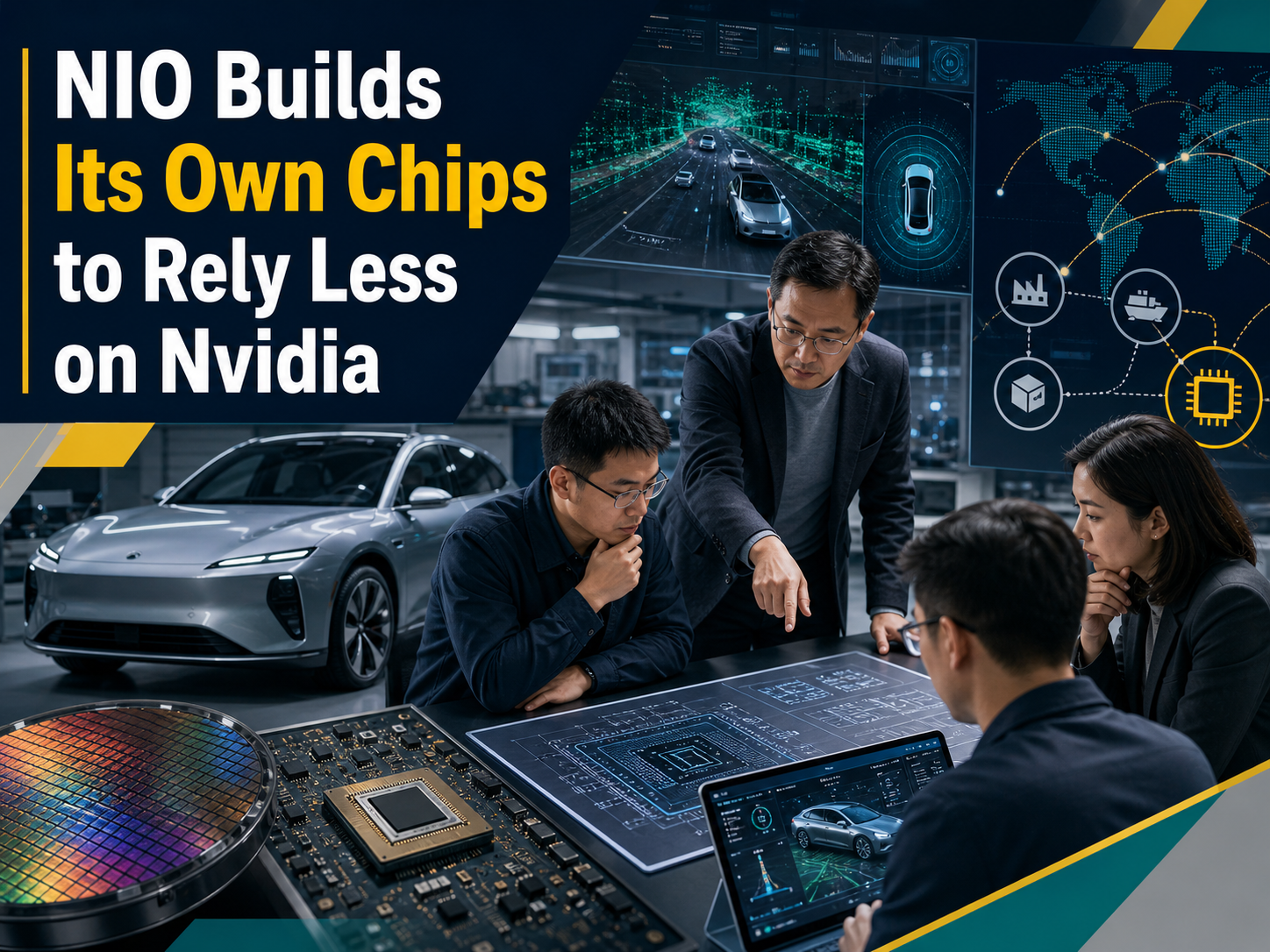
NIO Builds Its Own Chips to Rely Less on Nvidia
Intermediate | May 2, 2026
✨ 혼자서 기사를 소리 내어 읽거나 튜터를 따라 각 단락을 반복해서 읽으세요. 레벨...
NIO Makes a Bigger Bet on Its Own Technology
Chinese electric vehicle maker NIO is betting on in-house chip development to sharpen its technology and improve profitability. Reuters reported that CEO William Li said NIO wants to reduce its reliance on suppliers such as Nvidia, especially for AI-powered driving features. For a premium EV company, this is not just a hardware decision. It is a long-term business strategy. (Reuters)
Why the NIO In-House Chips Strategy Matters
The NIO in-house chips strategy matters because modern electric vehicles are becoming more like computers on wheels. Chips help power advanced driver-assistance systems, sensors, cameras, AI models, and vehicle software. Li told Reuters that NIO developed its own silicon so its chips could better match the company’s own algorithms and sensor layout. In plain English, NIO wants the brain of the car to fit the body of the car better. (Reuters)
The Nvidia Cost Problem
Nvidia has become one of the most important chip suppliers in AI and advanced vehicle technology. But Li told Reuters that Nvidia’s automotive chips have “very high gross margin.” That means Nvidia can make strong profit from selling those chips. For NIO, building its own chips costs more money upfront, especially in research and development. But if the plan works, NIO may lower long-term costs and improve its own profit margins. (Reuters)
Shenji Becomes Its Own Company
NIO has spun off its chip unit, Shenji, into an independent company. According to Reuters, Li said Shenji is open to supplying chips to outside customers. That is an interesting move because it could turn NIO’s chip project into more than an internal tool. If other automakers use Shenji chips, NIO could create a new business line instead of only saving money on its own vehicles. (Reuters)
China’s EV Industry Is Moving Toward AI Cars
This story also fits a bigger trend in China’s auto industry. Reuters reported that China’s latest five-year plan includes an “AI Plus” project to embed AI into manufacturing, healthcare, vehicles, and other parts of the economy. At the Beijing Auto Show, Chinese automakers showed new AI systems, smart-driving tools, and efforts to reduce dependence on high-end foreign semiconductors. NIO is one part of a much bigger race. (Reuters)
NIO Connects Chips With New Vehicle Technology
NIO also used the Beijing Auto Show to show its three-brand strategy and new vehicles, including the ES9 flagship executive SUV. The company said the ES9 brings together more than 40 industry-first technologies and nearly 40 class-leading features. The company’s ES9 page also says the vehicle is built on NIO’s proprietary smart-driving chip and full-domain operating system. This supports the idea that NIO wants tighter control over both hardware and software. (NIO) (NIO ES9)
What English Learners Can Take From This Story
For English learners, this article is useful because it connects technology, business strategy, and global competition. You can practice words like in-house, supplier, gross margin, research and development, semiconductor, and driver-assistance system. The NIO in-house chips strategy also gives you a strong conversation topic about how companies try to control costs, protect technology, and compete in fast-changing markets.
Vocabulary
- In-house (adjective) – done inside a company instead of by an outside supplier.
Example: “NIO is developing chips in-house.” - Supplier (noun) – a company that provides parts, materials, or services.
Example: “NIO wants to rely less on outside chip suppliers.” - Silicon (noun) – a material used to make computer chips.
Example: “NIO developed its own silicon for smart-driving features.” - Algorithm (noun) – a set of instructions a computer follows to solve a problem.
Example: “The chip needs to match NIO’s driving algorithms.” - Sensor layout (noun phrase) – the way sensors are arranged in a machine or vehicle.
Example: “NIO wants chips that fit its sensor layout.” - Driver-assistance system (noun phrase) – technology that helps a driver with tasks such as steering, parking, or avoiding danger.
Example: “The chips support advanced driver-assistance systems.” - Gross margin (noun) – the money a company keeps after direct product costs.
Example: “Nvidia’s automotive chips have high gross margins.” - Research and development (noun phrase) – work a company does to create or improve products.
Example: “Chip development requires high research and development costs.” - Spin off (verb phrase) – to separate part of a company into a new independent business.
Example: “NIO spun off its chip unit, Shenji.” - Semiconductor (noun) – a material or chip used in electronic devices.
Example: “Semiconductors are central to smart electric vehicles.”
Discussion Questions (About the Article)
- Why does NIO want to develop its own chips?
- How could in-house chips help NIO improve profitability?
- Why are Nvidia’s automotive chips important in this story?
- What is Shenji, and why did NIO spin it off?
- How does this story fit into China’s larger AI and EV strategy?
Discussion Questions (About the Topic)
- Should car companies make more of their own technology instead of buying from suppliers?
- What are the risks of depending too much on one major supplier?
- How are modern cars becoming more like computers?
- Would you trust AI-powered driving features? Why or why not?
- How might in-house chip development change competition in the EV market?
Related Idiom
“Cut out the middleman” – to avoid using another person or company between the producer and the customer.
Example: “By developing its own chips, NIO hopes to cut out the middleman and control more of its technology costs.”
📢 Want more practical English through real news stories? Sign up for the All About English Mastery Newsletter here: allaboutenglishmastery.com/newsletter
Want to build stronger English in less time? Check out Mastering English for Busy Professionals.
Follow our YouTube channel @All_About_English for more English tips and practice.
This article was inspired by: Reuters, Reuters on China’s AI auto industry, NIO Auto China 2026, and NIO ES9


 한국어
한국어  English