

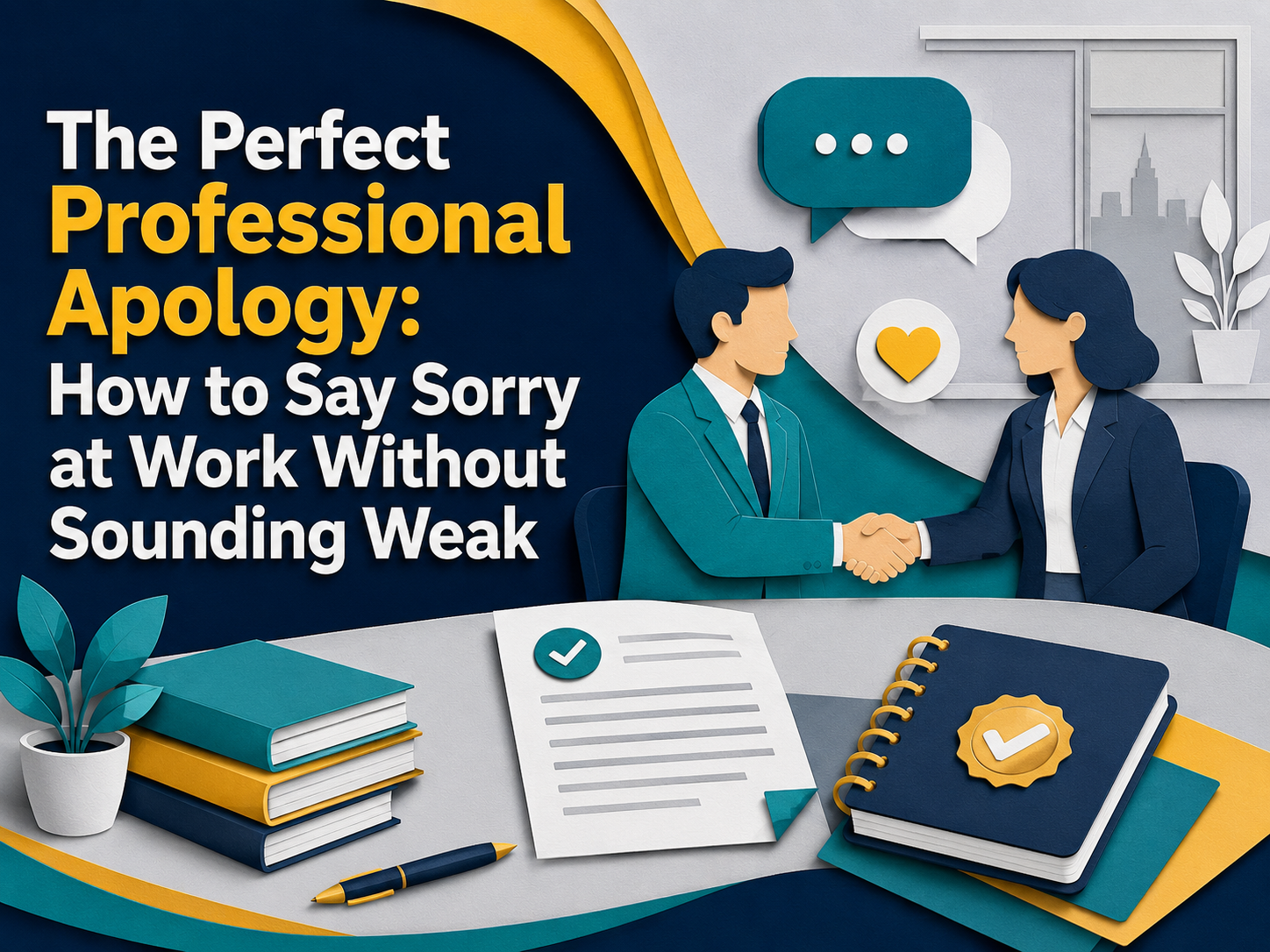
The Perfect Professional Apology: How to Say Sorry at Work Without Sounding Weak 🤝
Intermediate Level | May 30, 2026
혼자서 기사를 소리 내어 읽거나 튜터를 따라 각 단락을 반복해서 읽으세요. 레벨...
Saying sorry at work can feel uncomfortable. You do not want to sound weak, careless, or too emotional. But sometimes mistakes happen. Maybe you missed a deadline, sent the wrong file, misunderstood a client, or spoke too quickly in a meeting. In those moments, the perfect professional apology can protect trust and help the conversation move forward.
A professional apology is not about begging for forgiveness. It is about taking responsibility, showing respect, and giving the other person confidence that the problem will be fixed. In business English, this is an important speaking skill because your tone matters as much as your words.
Why The Perfect Professional Apology Matters
At work, people do not expect you to be perfect. They do expect you to be honest and responsible. When you apologize clearly, you show maturity. You also show that you care about the relationship, not just the mistake. A good apology can turn an awkward moment into a stronger professional connection.
Imagine you sent a report late. A weak apology might sound like this: “Sorry, I was really busy.” That may be true, but it sounds like an excuse. A stronger apology sounds like this: “I’m sorry the report was late. I understand it caused a delay, and I’ll send future updates earlier so this doesn’t happen again.” That sentence is calm, clear, and professional.
Step 1: Start With a Clear “I’m Sorry”
Do not hide the apology under too many words. Start simply. You can say, “I’m sorry for the delay,” or “I apologize for the confusion.” These phrases are polite and direct. They help the listener understand that you are taking the issue seriously.
Be careful with fake apologies. Phrases like “I’m sorry if you felt upset” can sound defensive. It pushes the problem back onto the other person. Instead, focus on the action: “I’m sorry my message was unclear.” That sounds much better.
Step 2: Take Responsibility Without Overexplaining
A professional apology should include responsibility, but it should not become a long speech. Keep it short. Say what happened, but do not bury the listener under details. For example: “I misunderstood the deadline and sent the file late.” That is enough.
Many English learners overexplain because they want to sound polite. But too much explanation can sound like an excuse. Think of it like cleaning a small coffee spill. You do not need to call a government committee and launch a three-month investigation. Just clean the table. Simple is better.
Step 3: Show You Understand the Impact
This is where your apology becomes more professional. Do not only say what you did wrong. Show that you understand how it affected the other person. You might say, “I know this created extra work for your team,” or “I understand this caused confusion before the meeting.”
This kind of sentence shows empathy. It tells the listener, “I see the problem from your side, too.” That matters in business because people want to know you understand the situation, not just your own feelings.
Step 4: Explain the Fix
The best professional apologies include a next step. This is what makes the apology useful. You can say, “I’ve corrected the document and attached the updated version,” or “Next time, I’ll confirm the deadline in writing.”
A fix gives people confidence. It shows that you are not just sorry; you are improving the process. That is why the perfect professional apology usually has three parts: the apology, the responsibility, and the action plan.
Step 5: Keep Your Voice Calm and Steady
When speaking, your voice can make the apology stronger or weaker. If you speak too quietly, you may sound nervous. If you speak too fast, you may sound panicked. Try to slow down and use a steady voice.
Here is a simple structure you can practice: “I’m sorry for _ . I understand it caused _ . I’ve already , and next time I’ll .” This structure works in emails, meetings, phone calls, and client conversations. Practice it out loud until it feels natural.
Vocabulary List
- Apology (noun) — A statement that shows you are sorry for a mistake.
Example: Her apology helped rebuild trust with the client. - Professional (adjective) — Suitable for a workplace or business situation.
Example: He gave a professional response during the meeting. - Responsibility (noun) — The duty to deal with something or accept your role in it.
Example: She took responsibility for the scheduling mistake. - Delay (noun) — A situation where something happens later than planned.
Example: The delay caused problems for the project team. - Confusion (noun) — A situation where people do not understand clearly.
Example: The unclear email created confusion about the deadline. - Defensive (adjective) — Acting like you are protecting yourself from blame.
Example: His defensive tone made the apology sound less sincere. - Impact (noun) — The effect that something has on someone or something.
Example: She understood the impact of the mistake on the team. - Empathy (noun) — The ability to understand another person’s feelings or situation.
Example: A good apology shows empathy and respect. - Solution (noun) — A way to fix a problem.
Example: The manager offered a clear solution after the mistake. - Sincere (adjective) — Honest and real, not fake.
Example: His sincere apology helped calm the client.
5 Questions About the Article
- Why is a professional apology important at work?
- What is the problem with saying, “Sorry, I was really busy”?
- Why should you avoid fake apologies like “I’m sorry if you felt upset”?
- What should you include after explaining the mistake?
- How can your voice affect the way your apology sounds?
5 Open-Ended Discussion Questions
- When was the last time you had to apologize in a professional situation?
- What kinds of mistakes are hardest to apologize for at work?
- How do people usually apologize in your workplace culture?
- What makes an apology sound sincere to you?
- How could you use today’s apology structure in your next meeting or email?
📢 Want more tips like this? 👉 Sign up for the All About English Mastery Newsletter! Click here to join us!
Want to finally Master English but don’t have the time? Mastering English for Busy Professionals is the course for you! Check it out now!
Follow our YouTube Channel @All_About_English for more great insights and tips.

 한국어
한국어  English