

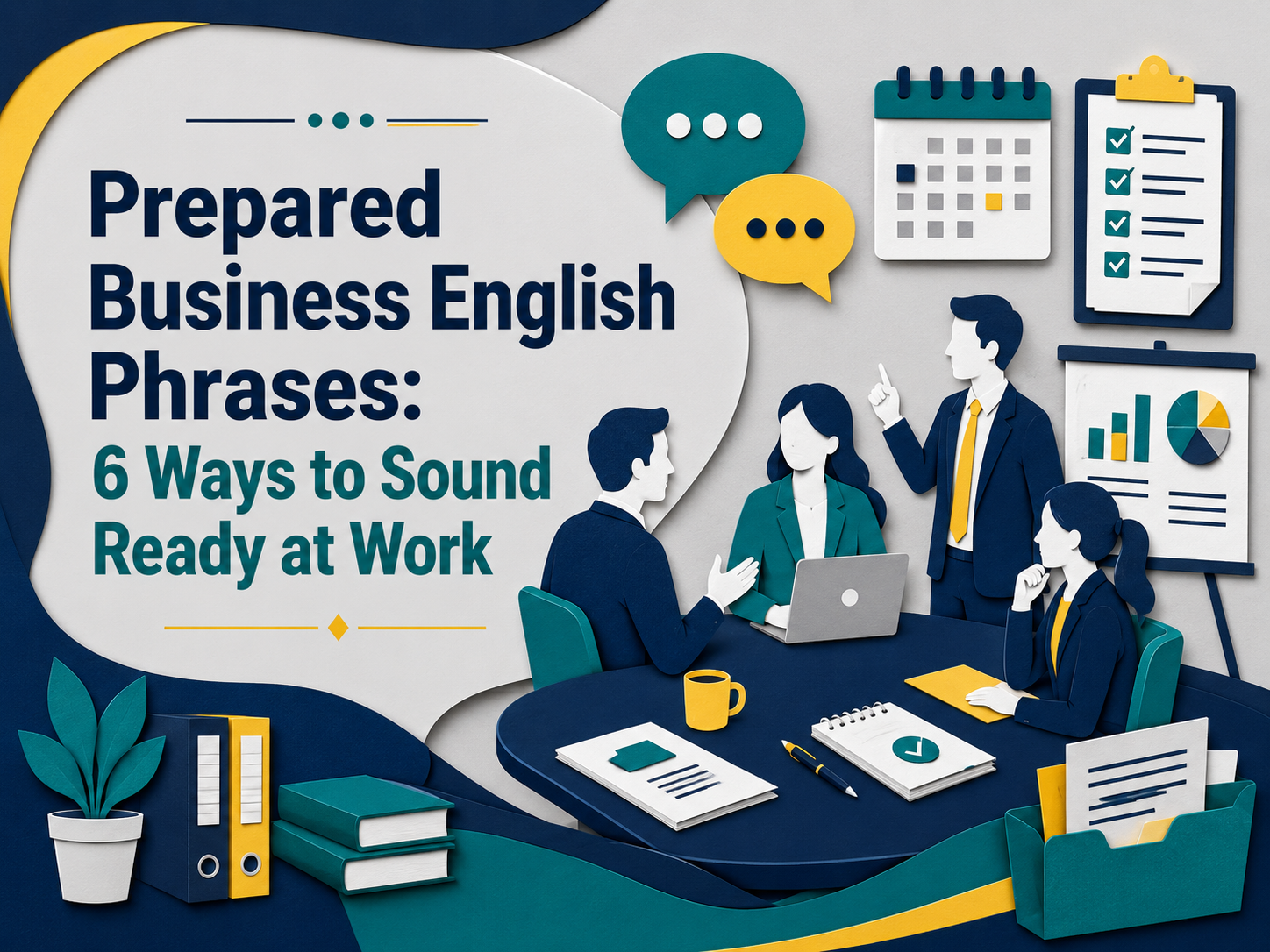
Prepared Business English Phrases: 6 Ways to Sound Ready at Work 💼
Intermediate Level | June 20, 2026
혼자서 기사를 소리 내어 읽거나 튜터를 따라 각 단락을 반복해서 읽으세요. 레벨...
Being prepared in English does not always mean using difficult words. In business, sounding prepared often means using the right phrase at the right moment. A short, clear sentence can make you sound organized, confident, and ready to contribute. That is why learning prepared business English phrases is so useful for busy professionals.
Imagine you join a meeting with your manager, your team, or an international client. You understand the topic, but when it is time to speak, your mind freezes. You know what you want to say, but you are not sure how to start. This is where prepared phrases can save you. They give your brain a simple path to follow.
Why Prepared Business English Phrases Matter
In professional conversations, people often judge your confidence by how clearly you speak. If you begin with, “Umm… maybe… I don’t know…” you may sound unsure, even if your idea is good. But if you say, “I’ve prepared a few key points,” people immediately feel that you are ready. Small phrases can create a big impression.
The goal is not to memorize robotic scripts. Nobody wants to sound like a customer service chatbot that escaped from a training manual. The goal is to build a toolbox of useful expressions. When you know these prepared business English phrases, you can speak more naturally in meetings, presentations, emails, and client conversations.
Phrase 1: “I’ve prepared a few key points.”
This phrase is perfect when you want to begin a presentation, meeting update, or explanation. It tells people that your ideas are organized. For example, you might say, “I’ve prepared a few key points about the project timeline.” This sounds much stronger than, “I want to talk about some things.”
You can also use it when your boss asks for an update. Instead of jumping into details too quickly, pause and say, “Yes, I’ve prepared a few key points.” This gives you a calm starting point and helps your listeners follow your message.
Phrase 2: “Let me give you a quick overview.”
This phrase is useful when you need to explain something without going too deep right away. It tells your listener, “I will keep this clear and simple.” For example, “Let me give you a quick overview of our current progress.” This works well in meetings because people are busy and appreciate direct communication.
A quick overview is especially helpful before you share details. First, give the big picture. Then, explain the smaller points. This makes your English easier to understand and makes you sound more professional.
Phrase 3: “I’d like to highlight one important point.”
Use this phrase when you want people to focus on something specific. In a meeting, there may be many numbers, ideas, and opinions flying around like angry office pigeons. This phrase helps you bring attention back to the most important idea.
For example, you could say, “I’d like to highlight one important point: the deadline has moved up by one week.” This sounds clear, confident, and useful. It also shows that you know what matters most.
Phrase 4: “Based on the information we have…”
This is a great phrase when you want to give an opinion without sounding too emotional or too direct. It shows that your idea is connected to facts. For example, “Based on the information we have, I think we should delay the launch by two weeks.”
This phrase is especially helpful when you are discussing decisions, risks, or plans. It makes your opinion sound thoughtful and professional. It also gives you a softer way to disagree or suggest a different direction.
Phrase 5: “I’ll follow up with more details.”
This phrase is simple, but powerful. It tells people that you are responsible and organized. You can use it at the end of a meeting, after a client call, or in an email. For example, “Thanks for your feedback. I’ll follow up with more details by tomorrow.”
This phrase also helps when you do not have all the information right now. Instead of panicking, you can say, “I don’t have the full numbers yet, but I’ll follow up with more details.” That sounds calm and prepared.
Phrase 6: “The next step is…”
This phrase helps you sound action-focused. Business communication should not only explain problems; it should move things forward. For example, “The next step is to confirm the schedule with the design team.” This gives people a clear direction.
You can use this phrase in meetings, project updates, and emails. It shows that you are not just talking—you are thinking ahead. When you use clear phrases like this, you help your team understand what is happening now and what should happen next.
Prepared English is not about sounding perfect. It is about sounding ready. Start with these six phrases and practice them out loud. Choose one phrase today and use it in a real work situation. Small changes in your language can make you sound more confident, more organized, and more professional.
Vocabulary List
- Prepared (adjective) — Ready for something.
Example: She sounded prepared during the client meeting. - Organized (adjective) — Arranged clearly and effectively.
Example: His organized update helped everyone understand the project. - Overview (noun) — A short general explanation of something.
Example: Let me give you a quick overview of the plan. - Highlight (verb) — To give special attention to something important.
Example: I’d like to highlight one important point from the report. - Timeline (noun) — A schedule showing when things will happen.
Example: We need to review the project timeline. - Deadline (noun) — The final time or date for completing something.
Example: The deadline has moved up by one week. - Launch (noun/verb) — The start or release of a product, service, or project.
Example: We should delay the launch until next month. - Follow up (phrasal verb) — To give more information or take the next action later.
Example: I’ll follow up with more details after the meeting. - Details (noun) — Specific pieces of information.
Example: Please send me the details by email. - Action-focused (adjective) — Concentrated on what should be done next.
Example: Her action-focused summary helped the team move forward.
5 Questions About the Article
- Why do prepared phrases help professionals sound more confident?
- What phrase can you use before giving a short explanation?
- When can you say, “I’d like to highlight one important point”?
- Why is “Based on the information we have…” useful in business discussions?
- What does the phrase “The next step is…” help you do?
5 Open-Ended Discussion Questions
- Which of the six phrases would be most useful in your work?
- When do you feel least prepared to speak English at work?
- How can prepared phrases help you reduce stress in meetings?
- What kind of meeting updates do you usually need to give?
- What is one phrase you already use that makes you sound professional?
📢 Want more tips like this? 👉 Sign up for the All About English Mastery Newsletter! Click here to join us!
Want to finally Master English but don’t have the time? Mastering English for Busy Professionals is the course for you! Check it out now!
Follow our YouTube Channel @All_About_English for more great insights and tips.
SEO Details
Focus Keyphrase: prepared business English phrases
SEO Title: Prepared Business English Phrases: 6 Ways to Sound Ready at Work
Slug: prepared-business-english-phrases
Meta Description: Learn prepared business English phrases to sound confident, organized, and ready in meetings, emails, and client calls.
Tags: business English, professional English, English phrases, workplace English, meeting English, English for professionals, prepared English, business vocabulary, English confidence, intermediate English
 한국어
한국어  English