

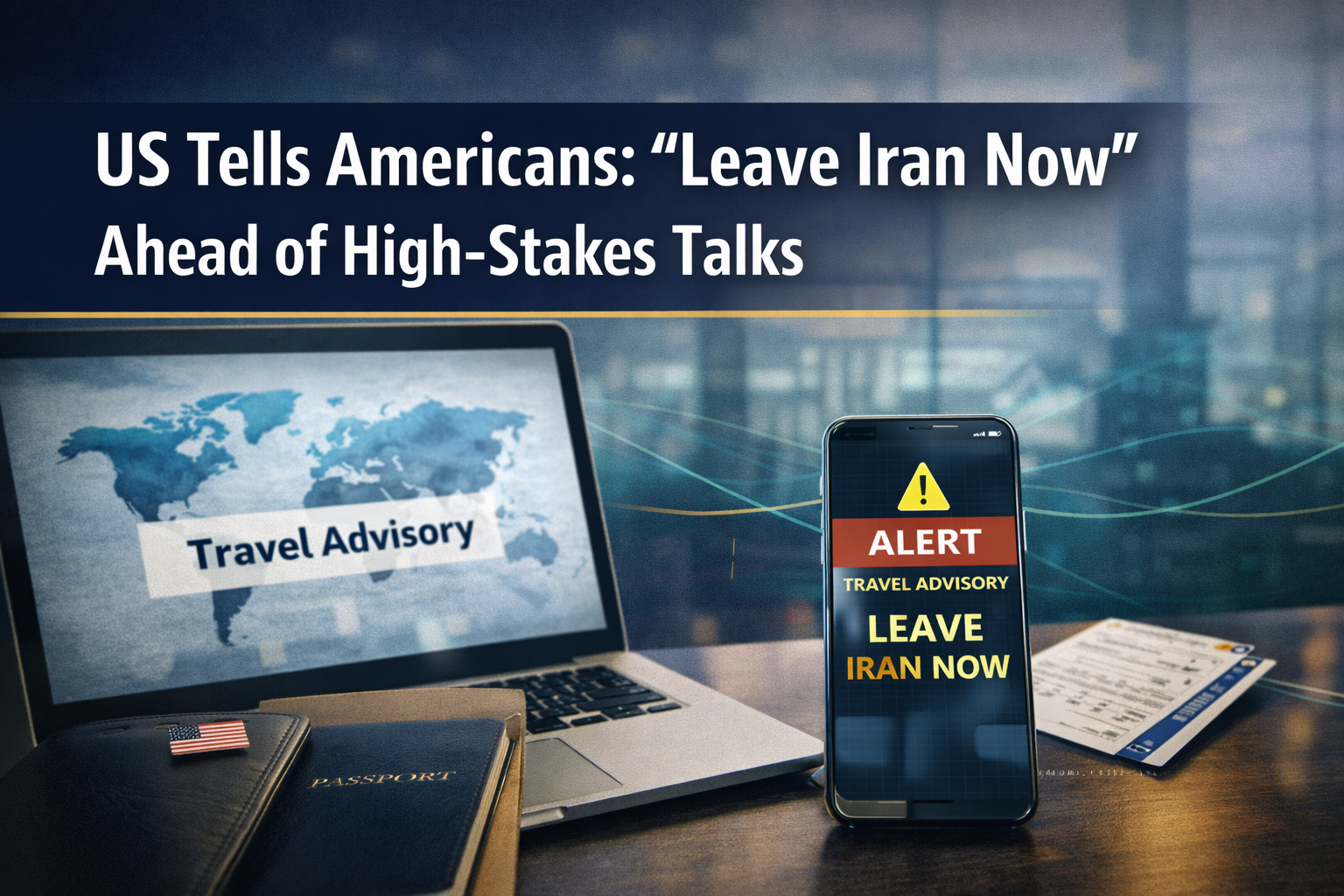
U.S. Tells Americans to “Leave Iran Now” as High-Stakes Talks Begin
Advanced | February 7, 2026
✨ Read the article aloud on your own or repeat each paragraph after your tutor.
Leave Iran now. Advisory: A Blunt Warning
In an unusually direct security alert, the U.S. Virtual Embassy in Iran urged American citizens to “leave Iran now” if possible—and to make a departure plan that does not rely on U.S. government help. The alert pointed to worsening security conditions, travel disruptions, and communication restrictions that could make it hard to move quickly if the situation gets worse. (TRT World)
What’s Driving the Warning
The advisory listed practical problems that can trap people in place: increased security measures, road closures, public transport disruptions, and continuing internet blockages. It also warned that airlines may limit or cancel flights to and from Iran, so travelers should expect last-minute schedule changes. In short: if you wait until the last minute, you might find the exits are suddenly crowded—or closed. (TRT World; Gulf News)
Options (If You Can Move Safely)
The U.S. advisory suggested that some people may need to leave by land if flights are disrupted. It specifically mentioned routes into Armenia or Turkey if it is safe to do so. Gulf News also noted that Americans were told to maintain a low profile, avoid demonstrations, and stay alert—because foreigners can face extra scrutiny during periods of unrest. (Gulf News)
Why Help May Be Limited
One key detail matters a lot: the United States has no diplomatic presence in Iran, which means official assistance can be extremely limited. That’s why the advisory emphasized self-reliance—keep essentials on hand (food, water, medication), keep your phone charged, monitor local updates, and maintain contact with family. Gulf News also flagged that U.S.–Iran dual nationals must leave Iran using an Iranian passport, because Iran does not recognize dual nationality. (TRT World; Gulf News)
The Bigger Backdrop: Talks in Oman
This warning landed right as the United States and Iran began high-stakes negotiations in Oman over Iran’s nuclear program. Iran wants talks focused on nuclear issues, while Washington has pushed to also discuss Iran’s missile program, regional activity, and human rights—an argument over scope that could derail diplomacy. Reuters reported the talks involved Iran’s foreign minister Abbas Araqchi and U.S. Middle East envoy Steve Witkoff. With both sides hinting that military options remain on the table if diplomacy fails, the travel warning feels like a “risk management” move in case tensions spike. In other words, the leave Iran now advisory is not just political theater—it’s a practical warning about real-world disruption. (Reuters)
What to Watch Next
If talks show progress, the temperature may drop. But if negotiations stall—or if protests, crackdowns, or military posturing intensify—travel can become chaotic fast. That’s why the leave Iran now advisory wasn’t subtle: it’s telling Americans to plan for disruption, not assume normal life will continue on schedule. (Gulf News; Reuters)
Vocabulary
- advisory (noun) — an official warning or guidance.
Example: The advisory told Americans to leave Iran now if possible. - departure plan (noun phrase) — a planned method and route for leaving.
Example: They were told to make a departure plan that doesn’t rely on the U.S. government. - disruption (noun) — an interruption that prevents normal activity.
Example: Transport disruption can make it difficult to reach the airport. - restrict (verb) — to limit access or freedom.
Example: Authorities may restrict internet access during unrest. - detention (noun) — being held by authorities.
Example: The alert warned of the risk of questioning or detention. - scrutiny (noun) — close observation or examination.
Example: Foreigners may face extra scrutiny at checkpoints. - consular (adjective) — related to government services for citizens abroad.
Example: Consular help is limited because the U.S. has no embassy in Iran. - high-stakes (adjective) — involving serious risks or consequences.
Example: The talks in Oman are high-stakes because conflict is possible. - derail (verb) — to cause something to fail or go off course.
Example: Disagreements about the agenda could derail the negotiations. - de-escalation (noun) — reducing tension or conflict.
Example: Successful diplomacy could lead to de-escalation.
Discussion Questions (About the Article)
- Who issued the “leave Iran now” alert, and what did it recommend?
- What specific problems did the advisory mention (travel and communication)?
- Why did the alert emphasize not relying on U.S. government assistance?
- What exit options did the advisory suggest?
- How do the Oman talks connect to the timing of this warning?
Discussion Questions (About the Topic)
- When governments issue travel warnings, how seriously should travelers take them?
- Is it better for advisories to be blunt or diplomatic? Why?
- What should people pack or prepare for sudden travel disruptions?
- Should countries keep diplomatic channels open even when tensions are high?
- What are the risks of mixing many issues (nuclear, missiles, human rights) into one negotiation?
Related Idiom
“Better safe than sorry” — it’s smarter to be cautious now than regret it later.
Example: For Americans in Iran, the leave Iran now advisory is a “better safe than sorry” message.
📢 Want more real-news English practice like this? 👉 Sign up for the All About English Mastery Newsletter! Click here to join us!
Want to finally Master English but don’t have the time? Mastering English for Busy Professionals is the course for you! Check it out now!
Follow our YouTube Channel @All_About_English for more great insights and tips.
This article was inspired by: CNBC (topic prompt), with reporting details cross-checked via Reuters, TRT World, and Gulf News.


 English
  한국어
한국어