

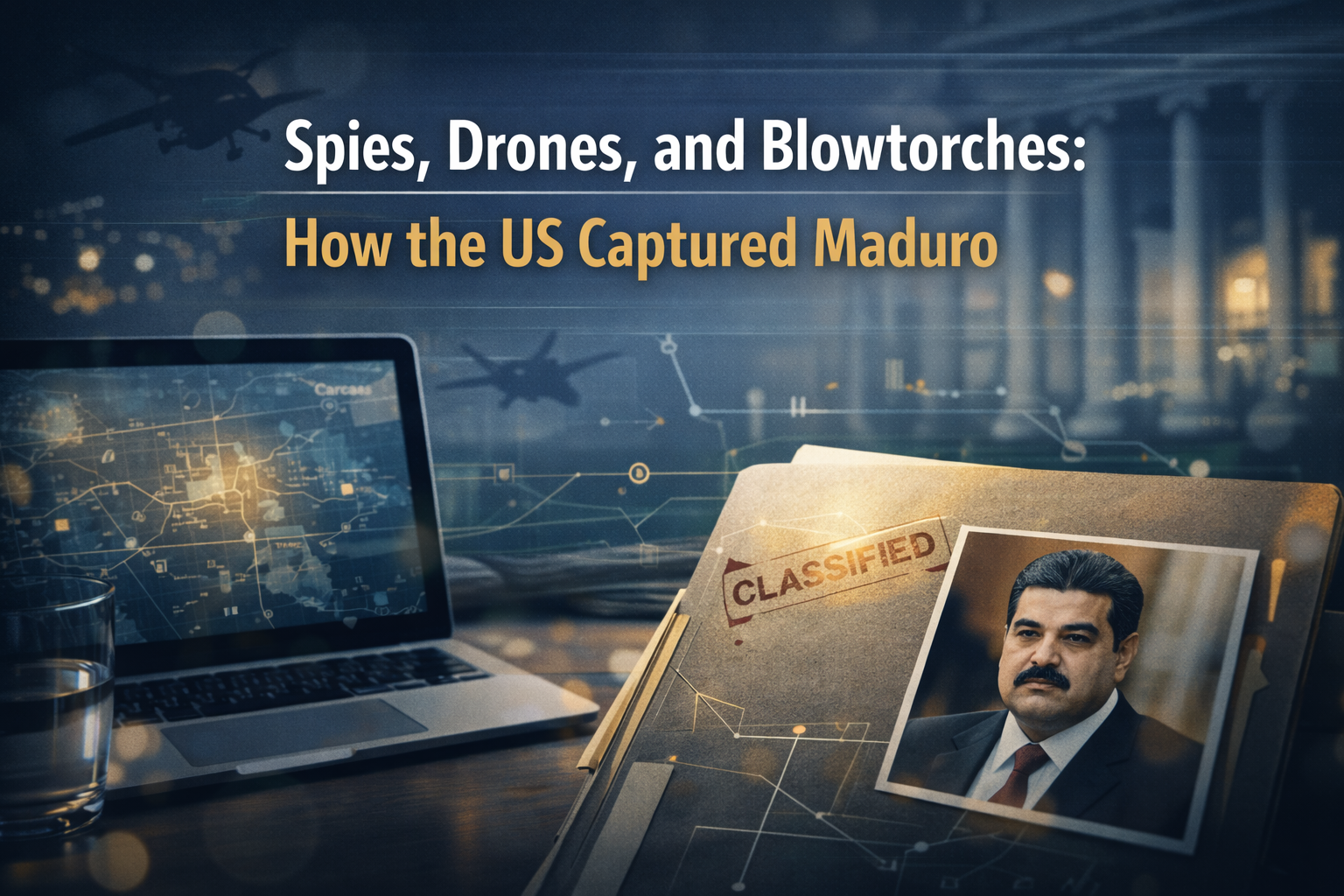
Spies, Drones, and Blowtorches: How the US Captured Maduro
Advanced | January 6, 2026
✨ Read the article aloud on your own or repeat each paragraph after your tutor.
Maduro Capture Operation: The Night Caracas Lit Up
In the early hours of January 3, 2026, residents in Caracas reported explosions and aircraft overhead—then came the headline: the U.S. said it had captured Venezuelan President Nicolás Maduro and his wife, Cilia Flores. (AP News)
Step One: “Pattern of Life” Intelligence
This Maduro capture operation didn’t begin that night. It began months earlier with intelligence work designed to answer one basic question: where will he be, and when? Reuters reported that a small CIA team tracked Maduro’s “pattern of life,” and that the agency had a human source close to Maduro who could help pinpoint his location as the operation unfolded. (Reuters)
Step Two: Airstrikes, Disruption, and Speed
Next came the opening moves: intense strikes aimed at blinding or disabling defenses around Caracas. Reuters reported the assault involved more than 150 aircraft launched from 20 bases, hitting targets tied to air defenses and military infrastructure before the ground assault began. (Reuters) AP separately reported at least seven blasts and said the attack lasted less than 30 minutes. (AP News)
Step Three: Blowtorches at the Door
Then came the part that sounds like a movie—because it kind of does. Reuters reported Special Forces stormed the fortified compound and used blowtorches to cut through steel doors, moving fast to prevent Maduro from reaching a safer internal room. (Reuters)
Step Four: Extraction and the Courtroom Timeline
After the capture, the story shifted from battlefield to courtroom. AP reported Maduro and Flores were taken to a U.S. warship and then flown to New York. (AP News) CBS News reported they were expected to appear in federal court in Manhattan at noon on Monday. (CBS News)
Business Angle: Oil, Risk, and Investor Nerves
Even if you don’t follow politics, this story matters for business. Big shocks like this can raise risk perception overnight—especially in oil markets and emerging-market investing. AP noted President Trump said the U.S. would “run” Venezuela temporarily during a transition, but what that means on the ground remains unclear. (AP News) Al Jazeera also reported regional concern and sharp criticism from Caracas as the situation escalated. (Al Jazeera)
Vocabulary
- Surveillance (noun) – careful watching, often by authorities.
Example: Surveillance reportedly tracked Maduro’s movements for months. - Asset (noun) – a person who provides valuable information or help.
Example: A human asset close to Maduro reportedly helped locate him. - Intel (noun) – information used for security or military planning.
Example: Real-time intel helped the operation move quickly. - Disrupt (verb) – to interrupt or weaken something.
Example: The strikes aimed to disrupt defenses around Caracas. - Breach (verb) – to force entry through a barrier.
Example: Troops breached a steel door to enter the compound. - Fortified (adjective) – strengthened to resist attack.
Example: Maduro’s residence was described as a fortified location. - Extraction (noun) – removing someone from a place by a planned operation.
Example: The extraction moved Maduro out of the country within hours. - Custody (noun) – being held by authorities.
Example: Maduro was placed in U.S. custody and flown to New York. - Sovereignty (noun) – a country’s right to govern itself.
Example: Venezuela argued the operation violated its sovereignty. - Risk perception (noun) – how risky people feel a situation is.
Example: Higher risk perception can slow investment decisions.
Discussion Questions (About the Article)
- Which step of the operation felt most important: intelligence, airstrikes, or the ground raid?
- Why is “pattern of life” intelligence valuable in missions like this?
- What details made this feel like a highly planned operation?
- What do you think is the biggest legal controversy after the capture?
- How does the story change once it moves from a raid to a courtroom?
Discussion Questions (About the Topic)
- Should leaders ever be captured by foreign militaries? Why or why not?
- How should countries balance security goals with international law?
- Why do major political shocks affect markets even if nothing changes immediately?
- What’s the long-term risk of normalizing “raids” to solve political problems?
- If you were advising a global company, what would you watch next in Venezuela?
Related Idiom
“The devil is in the details” – the small details are what really matter.
Example: With a Maduro capture operation, the devil is in the details—timing, intelligence, and speed.
📢 Want more short, practical English lessons like this? 👉 Sign up for the All About English Mastery Newsletter!
Join here: Join the newsletter
Want to finally master English but don’t have the time? Mastering English for Busy Professionals is built for you: Explore the course
Follow our YouTube Channel @All_About_English for more: Subscribe on YouTube
This article was inspired by:
- Reuters (operation details, blowtorches, scale)
- AP News (what we know + what comes next)
- CBS News (court timing + U.S. statements)
- Al Jazeera (regional reaction + escalation context)


 English
  한국어
한국어