

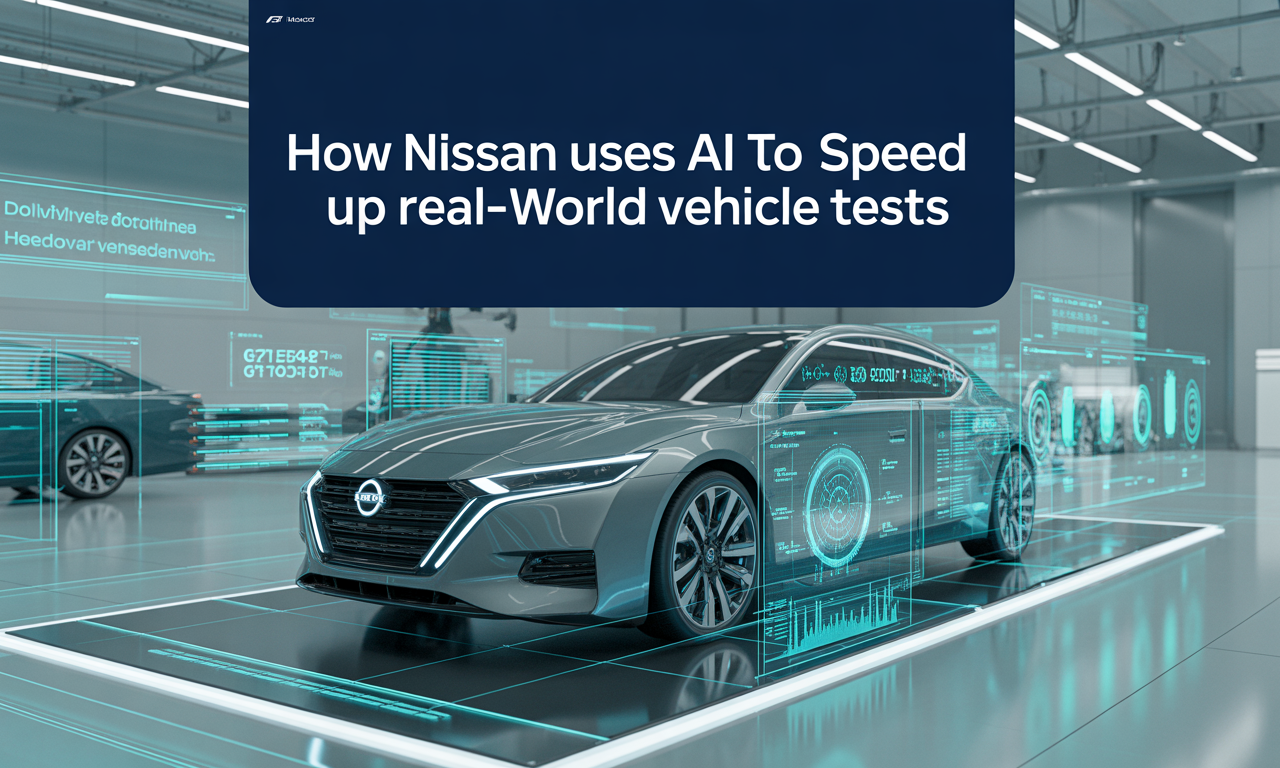
How Nissan Uses AI to Speed Up Real-World Vehicle Tests
Intermediate | December 8, 2025
✨ Read the article aloud on your own or repeat each paragraph after your tutor.
Nissan AI Testing: Speeding Up Development
A New Approach to Vehicle Testing
Nissan is changing how it develops new cars by using Nissan AI testing tools that predict physical test results and eliminate unnecessary steps. by bringing artificial intelligence (AI) directly into the vehicle testing process. The company has extended a strategic partnership with UK-based AI firm Monolith for three more years, using AI models to predict the results of physical tests before they happen. This move is designed to reduce the number of real-world tests and bring new vehicles to customers faster, as described in Nissan’s recent announcements and press releases. (Nissan Europe)
How AI Chooses the Most Important Tests
At the heart of this change is Nissan AI testing, which lets engineers quickly identify essential tests and skip repetitive procedures. is a simple idea: instead of testing every part again and again in the real world, engineers feed decades of historical test data into AI systems. The AI then suggests which tests are truly necessary and predicts how the car will behave, helping engineers focus on the most important checks. (Metrology News)
Turning 90 Years of Test Data into Smart Decisions
Training AI on Massive Test Databases
Nissan’s engineers at the Nissan Technical Centre Europe are training AI models on more than 90 years of vehicle test data, including information from older models such as the Micra. By learning from this huge history, the AI can accurately predict the outcome of many physical tests. (Metrology News; Automotive Testing Technology International)
Cutting Long Test Cycles More Efficiently
In one example highlighted by Reuters, AI was used to optimize chassis bolt-tightening tests for a new electric Nissan model. These tests were traditionally long and repetitive. By using AI, Nissan shortened the test schedule from around six months to about five months, and the company aims to cut this further to roughly three months. Overall, Nissan hopes to reduce physical testing time by around 20% by applying AI to more areas like tyre and battery testing. (Reuters)
Competing in a Faster Global Market
Meeting Pressure From Global Competitors
The push for AI is not just a technical upgrade; it is part of Nissan’s broader RE:Nissan recovery plan, which focuses on getting vehicles to market faster while keeping quality high. Competitors, especially some Chinese automakers, can launch new models in as little as 18 months, compared to the traditional five-year development cycle. Nissan uses AI to speed up testing so it can close that gap and stay competitive. (Vision Mobility; Reuters)
A Smarter Workflow for Faster Decisions
By cutting down on unnecessary tests and focusing on the most critical ones, Nissan can make decisions more quickly, manage costs better, and react faster to market trends. For busy professionals in the auto industry, this is a strong example of how data and AI can turn long, manual processes into smarter, shorter workflows.
What This Means for Drivers and the Industry
Benefits for Drivers
For everyday drivers, the change may not be visible, but the effects are real. Faster development cycles can mean quicker updates, more frequent new models, and improved features reaching the market earlier. At the same time, using AI does not mean skipping safety; it helps engineers spend more time on high‑risk areas instead of repeating similar tests.
A Model Other Automakers May Follow
For the wider industry, Nissan uses AI to speed up testing in a way that could become a standard model: combine deep historical data with modern AI, reduce physical prototypes, and let engineers focus on creativity and hands-on problem solving instead of routine checks. Other automakers are already watching and experimenting with similar tools.
Vocabulary
- Prototype (noun) – the first version of a product used for testing.
Example: “Engineers tested the prototype before starting mass production.” - Test cycle (noun) – a complete round of tests in a development process.
Example: “The new AI tools helped shorten the test cycle by several weeks.” - Historical data (noun) – past records and information used for analysis.
Example: “Nissan’s AI learns from historical data going back decades.” - Optimize (verb) – to make something as effective or efficient as possible.
Example: “AI helped optimize the bolt‑tightening process.” - Validation (noun) – the process of checking if something meets required standards.
Example: “The team used AI to support final validation of the design.” - Cycle time (noun) – the total time it takes to complete a process.
Example: “Reducing cycle time is key to staying competitive.” - Recovery plan (noun) – a strategy to improve performance after a difficult period.
Example: “The partnership with Monolith is part of Nissan’s recovery plan.” - Predictive model (noun) – a mathematical or AI model that forecasts future outcomes.
Example: “The predictive model estimates how a car will perform under stress.” - Test scenario (noun) – a specific situation or condition used during testing.
Example: “Engineers designed new test scenarios for wet‑road braking.” - Operational efficiency (noun) – the ability to deliver results with less time, cost, or waste.
Example: “AI tools improved operational efficiency in Nissan’s test labs.”
Discussion Questions (About the Article)
- How does Nissan use AI to speed up testing and reduce development time?
- Why is historical test data so important for Nissan’s new AI tools?
- What examples does the article give of specific tests improved by AI?
- How does this AI strategy fit into Nissan’s larger RE:Nissan recovery plan?
- What are some possible risks or limits of relying on AI for physical testing?
Discussion Questions (Broader Topic: AI and Engineering)
- In what other industries could AI reduce physical testing or repetitive work?
- Do you think companies should fully trust AI predictions, or always confirm with physical tests? Why?
- How might faster development cycles affect customers, workers, and suppliers?
- What skills will engineers need in the future if AI handles more of the data analysis?
- How can companies balance innovation with safety when using AI in product development?
Related Idiom
“Work smarter, not harder” — focus on efficient methods instead of just doing more work.
Example: “By using AI to predict test results, Nissan is trying to work smarter, not harder in vehicle development.”
📢 Want more tips like this? 👉 Sign up for the All About English Mastery Newsletter! Click here to join us!
Want to finally master English but don’t have the time? Mastering English for Busy Professionals is the course for you!
Follow our YouTube Channel @All_About_English for more great insights and tips.
This article was inspired by reporting and releases from Metrology News, Nissan, Reuters, and related industry coverage.


 English
  한국어
한국어