

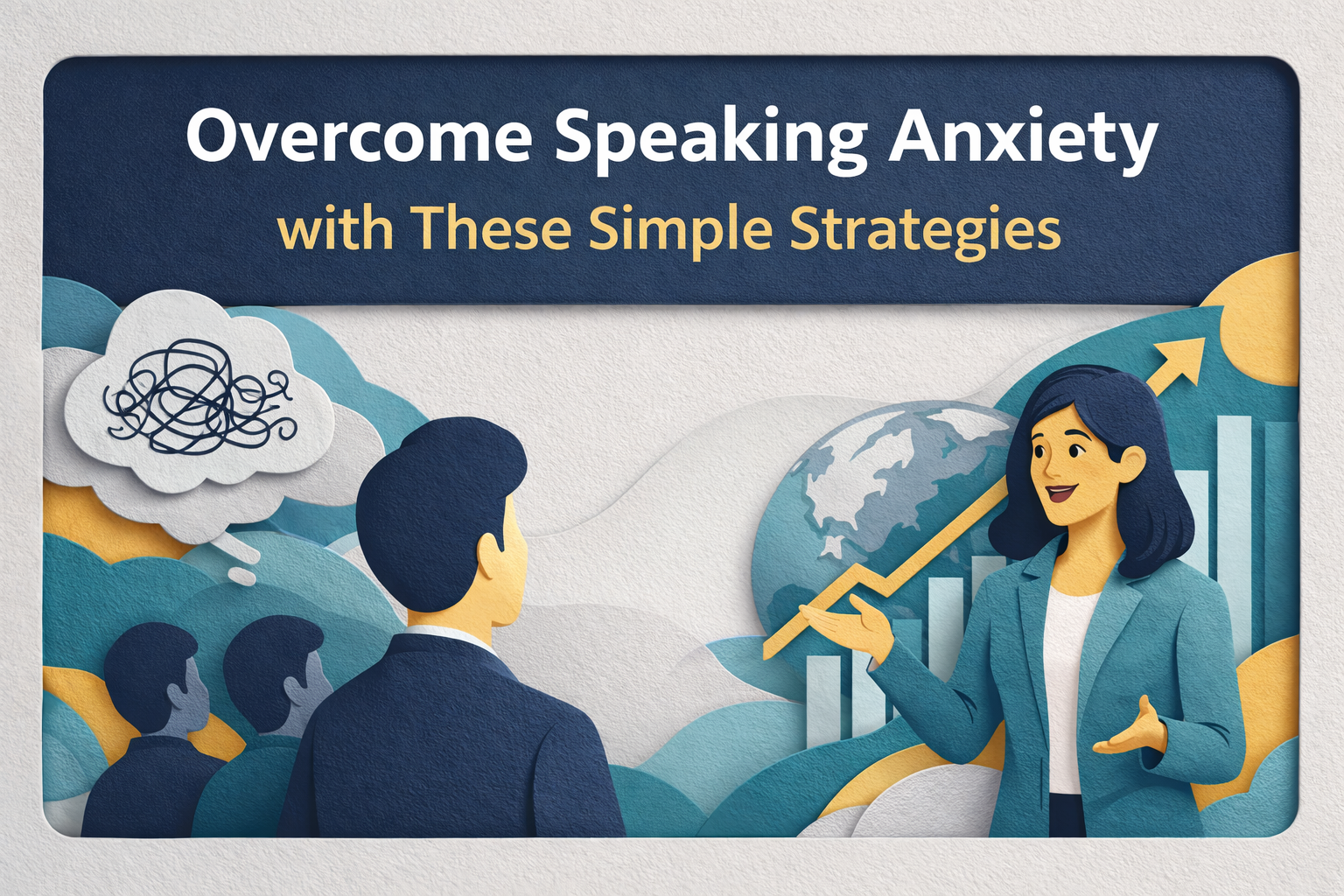
Overcome Speaking Anxiety with These Simple Strategies 🎤
Intermediate Level | February 8, 2026
Read the article aloud on your own or repeat each paragraph after your tutor.
If you’ve ever opened your mouth to speak English and felt your brain slam on the brakes, welcome to the club. Your heart speeds up, your mind goes blank, and suddenly even “schedule” feels like a 12-syllable monster. The frustrating part is you do know English—you just can’t access it fast enough in the moment.
Speaking anxiety is common for busy professionals because real workplace conversations feel high-stakes. If your goal is to Overcome Speaking Anxiety, you need repeatable habits—not perfect English. It’s not just English—it’s reputation, confidence, and the fear of looking “unprofessional.” But here’s the good news: anxiety can be trained down, and fluency can be trained up. You don’t need perfect grammar—you need a plan.
How to Overcome Speaking Anxiety
Anxiety usually shows up when your brain believes the situation is dangerous: a meeting, a client call, a new coworker, or even a casual hallway chat. Under stress, you may speak faster, breathe shallowly, or try to “sound smart” with complicated words. Ironically, that pressure often makes you freeze.
Strategy 1: Lower the Pressure in the First 10 Seconds
Before you speak, take one slow breath and let your shoulders drop. Then start with a simple sentence. A lot of professionals try to jump straight into a perfect explanation, but the better move is to start small and build momentum. Think of it like warming up before a workout—your first sentence is your warm-up.
Strategy 2: Use the “Simple + Clear” Rule
When you’re nervous, your best friend is simple English. Short sentences feel safer, and they’re easier for your listener to follow. Instead of trying to impress, focus on clarity. For example, in a meeting you can say, “Here’s my main point,” and then give one idea. If you need more detail, add it after.
Strategy 3: Prepare 3 “Go-To” Conversation Lines
You don’t need a full script, but having three prepared lines reduces stress immediately. Try these:
- “Can I confirm one thing before we move on?”
- “Let me think for a second.”
- “Here’s how I see it.”
These phrases buy you time and make you sound calm and professional—even when your brain is doing cartwheels.
Strategy 4: Practice Out Loud for Just 10 Minutes
Silent study doesn’t fix speaking anxiety. Speaking practice does. Choose a short article and read it out loud for 10 minutes a day. This builds mouth-muscle memory and helps your brain retrieve words faster. If you want to level up, record yourself for 30 seconds and listen back once—no self-roasting allowed.
Strategy 5: Use the AAA Method to Keep Conversations Flowing
When you don’t know what to say next, use a structure: Answer, Add, Ask (AAA). Answer the question, add one small detail, then ask a question back. This takes the “performance” feeling out of conversation and turns it into a simple exchange. It also helps you avoid awkward silence without needing fancy vocabulary.
Speaking anxiety doesn’t disappear overnight, but it does shrink quickly when you practice the right way. And the more often you practice starting simple, the faster you’ll Overcome Speaking Anxiety in real meetings and everyday workplace conversations. If you can train your body to stay calm and train your brain to start simple, you’ll feel a real difference—often in a week.
Vocabulary List
- Anxiety (noun) — A strong feeling of nervousness or worry.
Example: Her anxiety increased before the client call. - High-stakes (adjective) — Important and risky, with serious results.
Example: The presentation felt like a high-stakes moment. - Freeze (verb) — To suddenly stop or become unable to act.
Example: He froze when he had to answer a question in English. - Momentum (noun) — Forward movement that becomes stronger over time.
Example: Once she started talking, she built momentum quickly. - Clarity (noun) — The quality of being easy to understand.
Example: Clarity matters more than complex vocabulary in meetings. - Confirm (verb) — To check that something is true or correct.
Example: I want to confirm the deadline before we continue. - Retrieve (verb) — To get something back, especially from memory.
Example: Daily speaking practice helps you retrieve words faster. - Structure (noun) — A clear organization or system.
Example: The AAA method gives your conversation structure. - Exchange (noun) — A back-and-forth interaction or conversation.
Example: Their exchange felt natural and relaxed. - Shrink (verb) — To become smaller or less.
Example: With practice, the fear will shrink over time.
5 Questions About the Article
- Why do many professionals feel speaking anxiety at work?
- What should you do in the first 10 seconds before speaking?
- Why is simple English helpful when you’re nervous?
- What are the three “go-to” conversation lines mentioned?
- How does the AAA method help conversations?
5 Open-Ended Discussion Questions
- When do you feel most nervous speaking English (meetings, small talk, phone calls, etc.)?
- What is one simple sentence you can use to start speaking in a meeting?
- How could you practice out loud for 10 minutes in your daily routine?
- What topics make you feel more confident when you speak English?
- What is one small speaking goal you can set for this week?
📢 Want more tips like this? 👉 Sign up for the All About English Mastery Newsletter! Click here to join us!
Want to finally Master English but don’t have the time? Mastering English for Busy Professionals is the course for you! Check it out now!
Follow our YouTube Channel @All_About_English for more great insights and tips

 English
  한국어
한국어