

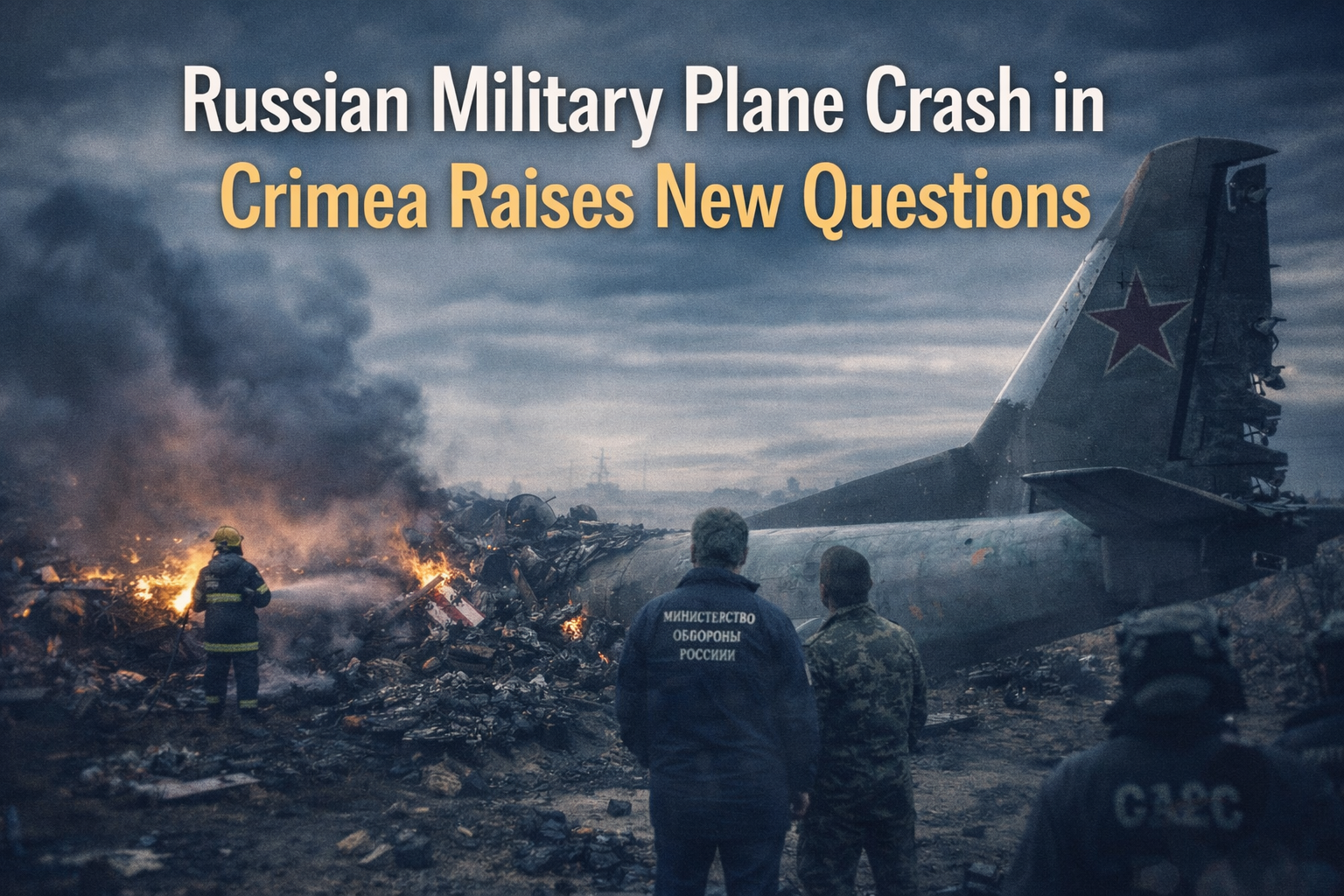
Russian Military Plane Crash in Crimea Raises New Questions
Advanced | April 6, 2026
✨ Read the article aloud on your own or repeat each paragraph after your tutor.
A Deadly Crash Over Occupied Crimea
Russia’s military suffered another serious aviation loss after a transport plane crashed in Crimea, killing everyone on board. According to Russia’s Defence Ministry, the aircraft was an An-26 military transport plane, and all 29 people aboard died in the crash. Reuters reported that the victims included 23 passengers and six crew members, and that rescuers later located the wreckage after the aircraft disappeared from radar (Reuters).
What Russian Officials Say Happened
Russian officials moved quickly to offer an early explanation. The Defence Ministry said the plane appears to have gone down because of a technical malfunction, not enemy fire. AP reported that the aircraft disappeared while flying over the Crimean Peninsula and was later confirmed to have crashed, with Russian agencies saying the plane may have struck a cliff (AP News). At this stage, however, the full investigation is still developing, so the exact cause has not yet been independently verified.
Why the Russian Military Plane Crash Matters
The Russian military plane crash matters for several reasons. First, Crimea remains one of the most politically sensitive places in the war. Russia seized the peninsula from Ukraine in 2014, but most of the international community still recognizes it as Ukrainian territory. That means any military incident there immediately attracts attention. Second, this was not just a routine flight. A military transport aircraft carries personnel and equipment, so a crash like this can affect operations as well as morale (Reuters).
Another Blow in a Long String of Losses
This crash did not happen in a vacuum. AP noted that Russia has suffered several fatal military aviation accidents since the full-scale war against Ukraine began. Those incidents have involved different aircraft, including bombers and fighter jets, and they have raised repeated questions about maintenance, training, and equipment reliability (AP News). In that sense, the Russian military plane crash is part of a broader pattern, not just a one-off tragedy.
A Story Wrapped in War and Information Control
As with many events involving Russia’s military, information remains tightly controlled. Official statements came mainly from the Defence Ministry and state-linked Russian agencies, which means outside observers still have limited access to independent evidence. That does not automatically mean the official account is false, but it does mean readers should be careful. In wartime, governments often move fast to shape the first version of the story, especially when military losses are involved. That is why wording like preliminary cause, according to officials, and not independently verified matters so much in serious reporting.
What English Learners Can Take From This Story
For English learners, this article is useful because it includes strong reporting language such as technical malfunction, went down, disappeared from radar, located the wreckage, and not independently verified. These expressions are common in hard-news reporting and are also useful in business English when discussing accidents, system failures, investigations, or uncertain early reports.
Vocabulary
- Malfunction (noun) – a failure in how a machine or system works.
Example: Officials said a technical malfunction may have caused the crash. - Wreckage (noun) – the broken parts left after a crash or destruction.
Example: Rescue teams later found the wreckage in Crimea. - Peninsula (noun) – a piece of land surrounded by water on most sides.
Example: The plane disappeared while flying over the Crimean Peninsula. - Disappear from radar (phrase) – to no longer be tracked by radar systems.
Example: The aircraft disappeared from radar shortly before the crash. - Technical malfunction (noun phrase) – a mechanical or system failure.
Example: Russia’s Defence Ministry blamed a technical malfunction. - Preliminary (adjective) – early, not final.
Example: The preliminary explanation may change after a fuller investigation. - Independently verified (phrase) – confirmed by outside sources, not just official claims.
Example: Some details of the crash have not yet been independently verified. - Morale (noun) – the confidence or spirit of a group.
Example: Repeated accidents can damage military morale. - Sensitive (adjective) – likely to cause strong reactions because it is important or controversial.
Example: Crimea remains a politically sensitive region. - One-off (adjective/noun) – something that happens only once and is not part of a pattern.
Example: Analysts may debate whether this was a one-off accident or part of a bigger problem.
Discussion Questions (About the Article)
- What facts did Russian officials release about the crash?
- Why are reports from Crimea often politically sensitive?
- Why does the article say the exact cause is still uncertain?
- How does this crash fit into a larger pattern of Russian military aviation losses?
- Why is careful wording important when reporting on war-related incidents?
Discussion Questions (About the Topic)
- How should readers judge official statements during wartime?
- Why do accidents involving military aircraft attract so much attention?
- What is the difference between an early report and a verified conclusion?
- How can repeated equipment failures affect an organization’s confidence and performance?
- What reporting phrases from this article could also be useful in business or technical settings?
Related Idiom
“Read between the lines” – to look for the deeper meaning or hidden message, not just the obvious words.
Example: When governments release early wartime statements, readers often need to read between the lines.
📢 Want more practical English practice with real-world stories? Sign up for the All About English Mastery Newsletter! Click here to join us.
Want to finally master English but don’t have the time? Mastering English for Busy Professionals is built for busy people like you.
Follow our YouTube Channel @All_About_English for more useful English tips and real-world practice.
This article was inspired by: Reuters, AP News


 English
  한국어
한국어