

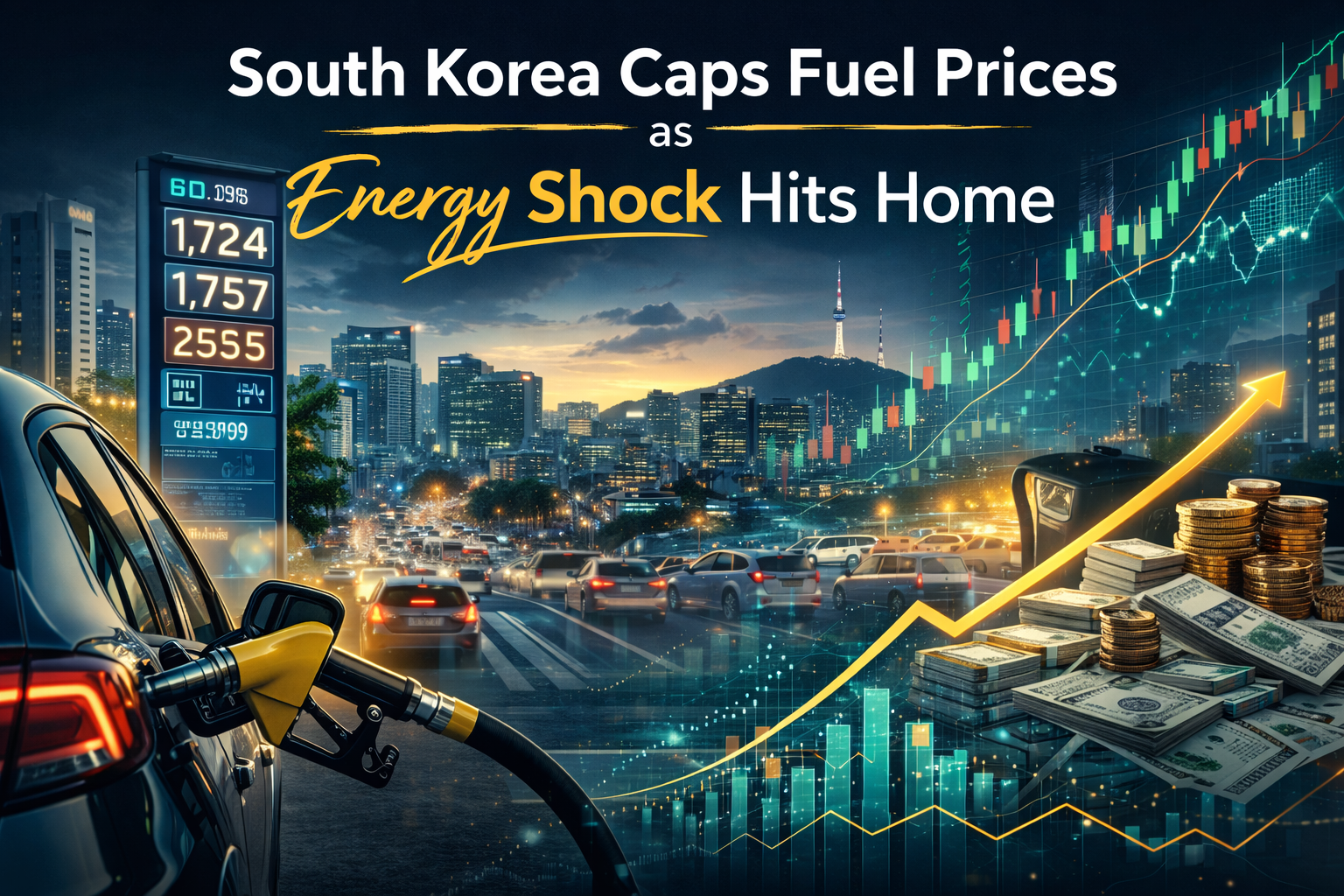
South Korea Caps Fuel Prices as Energy Shock Hits Home
Intermediate | March 16, 2026
✨ Read the article aloud on your own or repeat each paragraph after your tutor.
South Korea Takes an Unusual Step
South Korea has decided to cap domestic fuel prices to protect its economy from a sudden global energy shock. Reuters reported that this is the first time in nearly 30 years that the country has used this kind of fuel price control (Reuters). The move came after oil prices jumped because of the crisis in the Middle East, raising fears about inflation, consumer pain, and economic instability.
Why the Government Felt Pressure to Act
South Korea depends heavily on imported energy, so rising oil prices can hurt the country quickly. Reuters reported that South Korea gets about 70% of its oil and around 20% of its liquefied natural gas from the Middle East (Reuters). That means a disruption far away can create problems at gas stations, in shipping, and across the wider economy. For a trade-heavy country like South Korea, energy costs are not just a household issue. They are a national risk.
How the Fuel Price Cap Will Work
The government said the cap would begin on Friday, March 13, with a maximum wholesale gasoline price of 1,724 won per liter, down from 1,833 won before the measure (Reuters). Reuters also reported that the cap will be reviewed every two weeks based on global oil prices, taxes, and pre-crisis supply prices. To keep fuel flowing, refiners will be required to release at least 90% of the monthly volume they distributed during March and April of the previous year (Reuters).
Markets Showed Immediate Stress
The economic pressure was already visible before the cap officially started. Reuters reported that the KOSPI fell 6%, the won moved close to 1,500 per dollar, and government bond yields hit two-year highs as investors reacted to the shock (Reuters). President Lee Jae Myung said the country needed urgent action to protect an economy that is both trade-reliant and heavily dependent on imported energy (Reuters).
The Government Is Using More Than One Tool
Fuel caps are only one part of the response. Reuters reported that South Korea has enough oil reserves for about 208 days, and officials also discussed broader support measures such as a supplementary budget and possible expansion of a 100 trillion won market stabilization program (Reuters). Later reporting also said the government was considering energy vouchers for vulnerable households and even boosting coal and nuclear power generation if needed (Reuters).
South Korea Fuel Price Cap Becomes a Big Economic Test
This South Korea fuel price cap may help ease pressure on consumers in the short term, but it also raises bigger questions. Can price controls really calm a market when the global supply picture is still unstable? Will refiners and retailers absorb the pain, or will the government need to offer more support? For English learners, this story is a strong example of how business news mixes policy, markets, and everyday life. When energy prices move, almost everything else follows.
Vocabulary
- Cap (noun/verb) – a limit on how high something can go.
Example: The government placed a cap on fuel prices. - Wholesale (adjective) – sold in large amounts, usually to businesses.
Example: The wholesale gasoline price was set at 1,724 won per liter. - Refiner (noun) – a company that processes crude oil into fuel products.
Example: Refiners were told to keep fuel flowing into the market. - Stabilization (noun) – the act of making something more steady or less extreme.
Example: Officials discussed a market stabilization program. - Supplementary budget (noun) – extra government spending added after the main budget is set.
Example: A supplementary budget may help support the economy. - Disruption (noun) – a break or problem that interrupts normal activity.
Example: The government wanted to avoid disruption in fuel supply. - Inflation (noun) – a general rise in prices over time.
Example: Higher oil prices can increase inflation. - Reserve (noun) – stored supplies kept for emergencies.
Example: South Korea has strategic oil reserves for difficult times. - Burden (noun) – a heavy responsibility or cost.
Example: The cap was introduced to ease the burden on consumers. - Volatility (noun) – fast and unpredictable change.
Example: Global oil volatility pushed the government to act.
Discussion Questions (About the Article)
- Why did South Korea decide to cap fuel prices?
- Why is South Korea especially vulnerable to an energy shock?
- How will the fuel price cap be adjusted over time?
- What signs showed that markets were already under stress?
- What other measures is the government considering besides the cap?
Discussion Questions (About the Topic)
- Do you think fuel price caps are a good idea during a crisis? Why or why not?
- How do rising energy prices affect ordinary households?
- Should governments protect consumers even if it distorts the market?
- What are the risks of relying heavily on imported energy?
- How can countries build stronger energy security for the future?
Related Idiom
“Put out a fire” – to deal with a sudden urgent problem.
Example: South Korea used a fuel price cap to put out a fire before the energy shock spread further through the economy.*
📢 Want more practical English using real news? 👉 Sign up for the All About English Mastery Newsletter! Click here to join us!
Want to finally Master English but don’t have the time? Mastering English for Busy Professionals is the course for you! Check it out now!
Follow our YouTube Channel @All_About_English for more great insights and tips.
This article was inspired by: (Reuters), (Reuters), and (Reuters)


 English
  한국어
한국어