

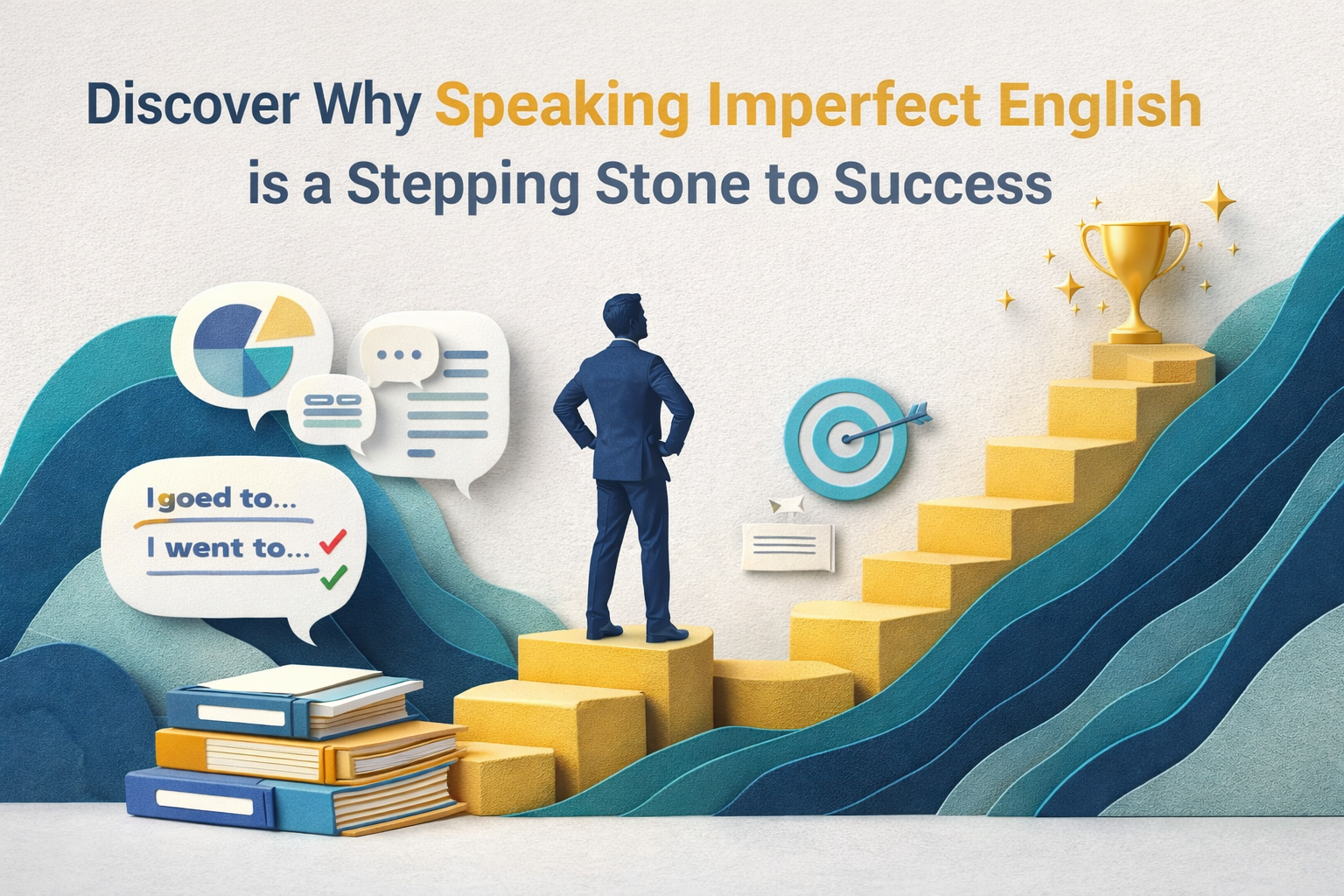
Discover Why Speaking Imperfect English is a Stepping Stone to Success 👣
Intermediate Level | February 12, 2026
Read the article aloud on your own or repeat each paragraph after your tutor.
Let’s be real: perfect English is a nice dream… but it’s also one of the biggest reasons smart professionals stay quiet. In meetings, they wait until they can say the sentence “the right way,” and by the time they’re ready, the moment is gone.
Here’s the truth: when you speak imperfect English, you’re not “failing.” You’re training.
And yes—speaking imperfect English on purpose is often the fastest way to build real confidence. Every time you speak, you build speed, confidence, and real-world skill—the kind that matters in actual business conversations.
Why Speaking Imperfect English Is the Right Goal
In school, many learners were taught to avoid mistakes like they were a crime. But in the real world, the goal is not perfection—it’s clarity. If your coworker understands your point, your English is doing its job.
Think about it like the gym. You don’t get stronger by thinking about lifting weights. You get stronger by lifting imperfectly at first, then adjusting. English works the same way.
The Hidden Grammar Win: You Learn Faster When You Speak
Here’s the grammar twist most people don’t notice: when you speak out loud, you “catch” patterns. You start noticing things like verb tense, word order, and missing articles (a/an/the) because your brain can hear the problem.
For example, you might say: “Yesterday I go to the client meeting.” Then later you notice, “Oh—past tense. It should be went.” That small correction is powerful because it’s connected to a real moment, not a worksheet.
Mistakes Create Feedback (And Feedback Creates Improvement)
If you never speak, you don’t get feedback. No feedback means no progress. But when you speak—even with mistakes—you give yourself something to improve.
Try this simple business-friendly mindset shift:
- Instead of: “I don’t want to sound stupid.”
- Say: “I’m testing my English in real time.”
That’s how professionals grow—by testing, adjusting, and moving forward.
A Simple 3-Step Method to Speak Imperfect English on Purpose
Step 1: Use “Simple First, Better Later”
Start with short, clear sentences. Don’t chase fancy vocabulary. If you can say it simply, you can say it confidently.
Example:
- Simple: “I disagree with that plan.”
- Better later: “I see the logic, but I’m not convinced this is the best approach.”
Step 2: Use “Repair Phrases” When You Get Stuck
These phrases save you in meetings (and they sound professional):
- “Let me say that another way.”
- “What I mean is…”
- “Give me a second—how do you say…?”
Instead of freezing, you keep the conversation moving. That’s a big win.
Step 3: Do a 60-Second “Grammar Replay” After You Speak
After a call or meeting, pick one sentence you said imperfectly. Fix it. Say the improved version out loud once.
That’s it.
This tiny habit helps you improve grammar naturally—without turning your life into a textbook prison. (You’re busy. I get it.)
What Success Looks Like for Busy Professionals
English success isn’t sounding like a news anchor. It’s being able to:
- share updates clearly,
- ask smart questions,
- disagree politely,
- and speak up without fear.
When you accept imperfect English as part of the process, you stop hiding. And when you stop hiding, people notice you.
Vocabulary List
- Stepping stone (noun) — A helpful stage or step that leads to something bigger.
Example: Speaking imperfect English is a stepping stone to stronger communication. - Clarity (noun) — The quality of being clear and easy to understand.
Example: In meetings, clarity matters more than perfect grammar. - Adjust (verb) — To change something slightly to improve it.
Example: I adjusted my sentence after I noticed the tense mistake. - Pattern (noun) — A repeated way something happens or is structured.
Example: I started noticing a pattern in how native speakers use articles. - Feedback (noun) — Information that helps you improve.
Example: Honest feedback helped me fix the same mistake faster. - Freeze (verb) — To stop suddenly because you feel nervous or unsure.
Example: I used to freeze when someone asked an unexpected question. - Polite disagreement (noun phrase) — A respectful way to say you don’t agree.
Example: Polite disagreement keeps relationships strong at work. - Convince (verb) — To make someone believe or agree.
Example: I wasn’t convinced the plan would work under the current timeline. - Replay (noun/verb) — To review something again, often to learn from it.
Example: I did a quick replay of my meeting notes to fix one sentence. - Speak up (phrasal verb) — To share your opinion or talk when it matters.
Example: I decided to speak up instead of staying silent.
5 Questions About the Article
- Why do many professionals stay quiet in meetings?
- What is the problem with making “perfect English” the goal?
- How does speaking out loud help you improve grammar?
- What are two “repair phrases” you can use when you get stuck?
- What is the 60-second “Grammar Replay,” and why is it useful?
5 Open-Ended Discussion Questions
- When do you feel the most nervous speaking English at work, and why?
- What mistake do you make often—and how could you correct it after a conversation?
- What is one short sentence you want to say more confidently in meetings?
- How could “simple first, better later” help you in your job?
- What would change in your career if you spoke up 20% more in English?
📢 Want more tips like this? 👉 Sign up for the All About English Mastery Newsletter! Click here to join us!
Want to finally Master English but don’t have the time? Mastering English for Busy Professionals is the course for you! Check it out now!
Follow our YouTube Channel @All_About_English for more great insights and tips


 English
  한국어
한국어