

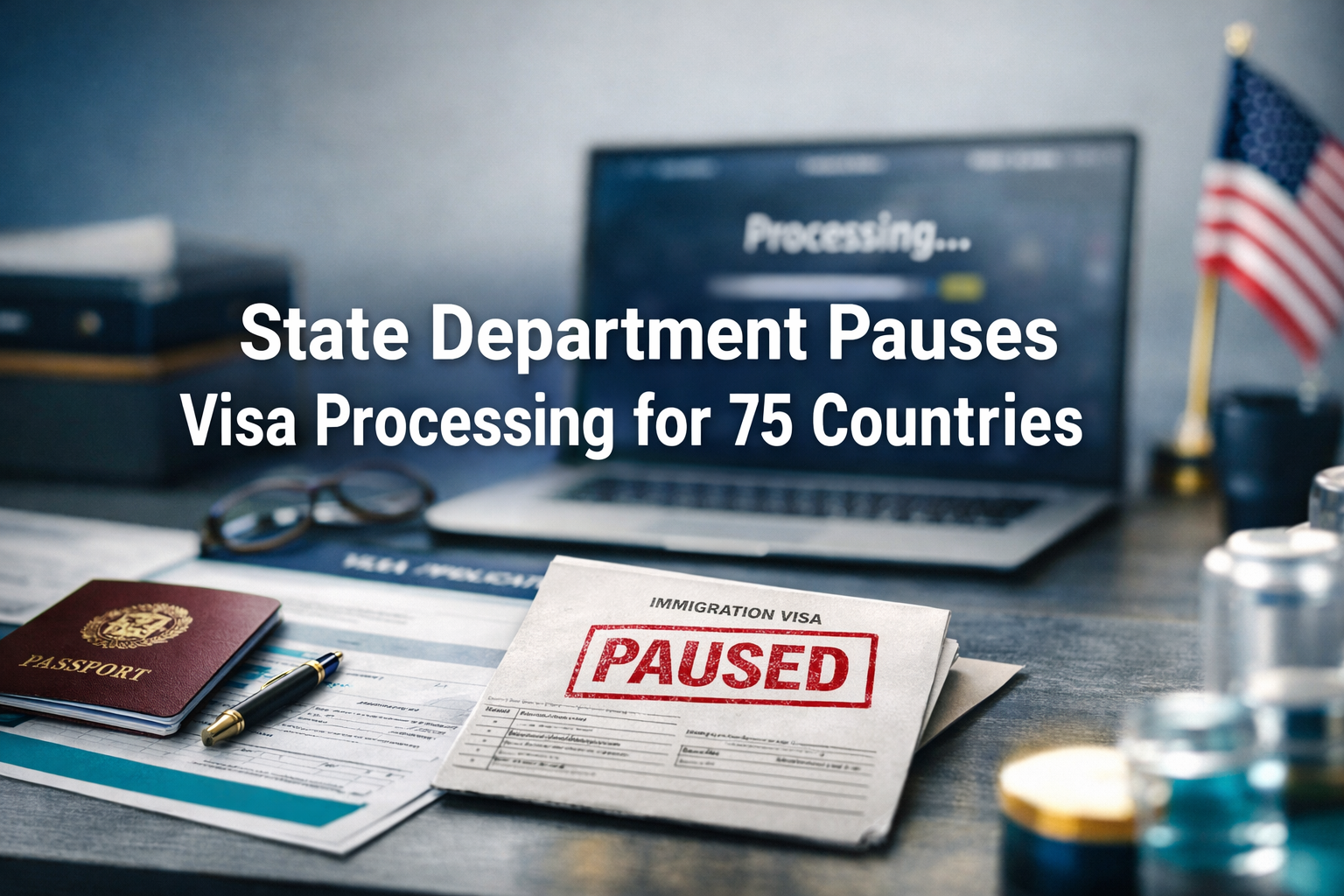
State Department Pauses Visa Processing for 75 Countries
Advanced | January 22, 2026
✨ Read the article aloud on your own or repeat each paragraph after your tutor.
A Big Policy Shift: Visa Processing Pause for 75 Countries
If you’re a company trying to hire global talent—or a family waiting to reunite—here’s a major update. This visa processing pause affects nationals of 75 countries, meaning many people who were on track for U.S. permanent residency may now face delays.
According to the State Department’s official notice, starting January 21, 2026, consulates may still accept applications and hold interviews, but they will not issue immigrant visas to nationals of the 75 listed countries during the pause (State Department). The policy is described as indefinite, tied to a broader review of “public charge” screening—basically, whether an immigrant might rely on U.S. public benefits.
What “Public Charge” Means (And Why It’s Back in the Spotlight)
In plain English, the government is saying: “We want to make sure new immigrants can support themselves.” The State Department framed the pause as part of a “full review” to prevent immigrants from becoming a public charge—a legal term connected to receiving certain government assistance.
Fox News reported that internal guidance tells consular officers to apply existing law more aggressively while screening rules are reassessed (Fox News). Reuters also described a State Department cable saying applicants from the listed countries were considered at higher risk of using public resources (Reuters).
Who Is Affected (And Who Isn’t)
This policy focuses on immigrant visas—the kind tied to permanent residency. That can include:
- Family-based immigration (spouses, children, and relatives waiting abroad)
- Employment-based immigration (professionals recruited by U.S. companies)
But the pause does not apply to visitor visas, according to Reuters, and AP reported that temporary categories like tourists and students were not the main target (Reuters | AP News).
The State Department also lists at least one clear exception: dual nationals can be exempt if they apply using a passport from a country not on the list.
The “75 Countries” List (Yes, It’s Broad)
The State Department posted the full list publicly. It includes countries across multiple regions—Africa, the Middle East, South Asia, Latin America, the Caribbean, and parts of Europe.
A few examples mentioned in major coverage include Afghanistan, Iran, Russia, Somalia, Brazil, Nigeria, Pakistan, Colombia, Uruguay, Bosnia and Albania.
If you want to see the full list, the most reliable source is the State Department notice here:
Why This Matters for Business (And Real People)
From a business perspective, this creates uncertainty. Companies planning to relocate talent may need backup options, longer timelines, or alternative visa strategies.
On the human side, AP described the emotional impact on applicants—including skilled professionals pursuing visas like EB-2 NIW (National Interest Waiver) (AP News). Even when applicants follow the legal process carefully, a sudden pause can feel like someone hit the brakes mid-journey.
Whether you agree with the policy or not, one thing is clear: this visa processing pause isn’t just “government stuff.” It affects hiring plans, long-term career moves, and family decisions.
Vocabulary
- Pause (noun/verb) – a temporary stop.
Example: The government announced a pause in immigrant visa issuance. - Processing (noun) – the steps used to handle an official request.
Example: Visa processing can include documents, interviews, and background checks. - Immigrant visa (noun) – a visa that allows someone to move permanently to a country.
Example: An immigrant visa can lead to permanent residency. - Indefinite (adjective) – with no clear end date.
Example: The pause was described as indefinite. - Applicant (noun) – someone who applies for something.
Example: Each applicant must submit forms and attend an interview. - Consular officer (noun) – a government official who works at an embassy or consulate.
Example: A consular officer reviews visa documents and interviews applicants. - Public charge (noun) – a legal term about someone likely relying on public benefits.
Example: Officials cited “public charge” concerns to justify the policy. - Vetting (noun) – careful checking or screening.
Example: The State Department said it is reviewing vetting procedures. - Exempt (adjective) – not affected by a rule.
Example: Some dual nationals may be exempt if they use a different passport. - Uncertainty (noun) – the feeling of not knowing what will happen next.
Example: The announcement created uncertainty for families and employers.
Discussion Questions (About the Article)
- What exactly is being paused—applications, interviews, or visa issuance?
- What reason did the State Department give for pausing immigrant visa issuance?
- What kinds of visas are mainly affected by this change?
- What exception does the State Department mention for dual nationals?
- How could this policy affect companies that recruit international talent?
Discussion Questions (About the Topic)
- Should governments require immigrants to prove financial self-sufficiency? Why or why not?
- What counts as “public assistance,” and should it matter for immigration decisions?
- How can immigration policy affect business hiring and economic growth?
- What are fair ways to reduce fraud without blocking legal applicants?
- How should countries balance national security, economics, and human rights in immigration policy?
Related Idiom
“Hit the brakes” — to slow down or stop suddenly.
Example: For many applicants, the visa pause feels like the government hit the brakes right before the finish line.
📢 Want more English like this—short, useful, and easy to practice? 👉 Sign up for the All About English Mastery Newsletter! Click here to join us!
Want to finally Master English but don’t have the time? Mastering English for Busy Professionals is the course for you! Check it out now!
Follow our YouTube Channel @All_About_English for more great insights and tips.


 English
  한국어
한국어