

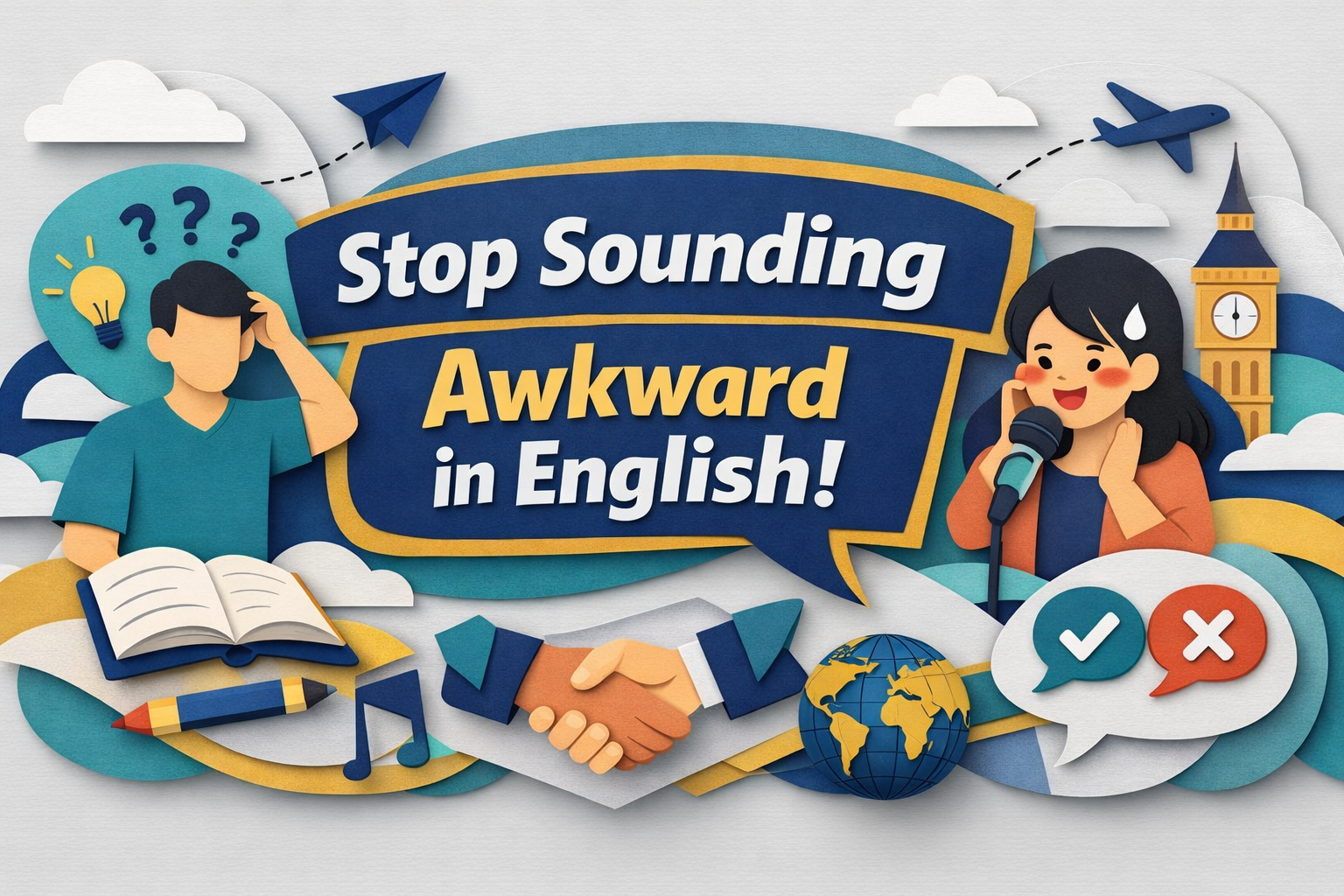
Stop Sounding Awkward: Common Mistakes Explained 🙊
Beginner Level | January 8, 2026
Read the article aloud on your own or repeat each paragraph after your tutor.
Have you ever started speaking English and suddenly felt… awkward? Your grammar might be okay, your vocabulary might be fine, but something just feels off. You pause too long. You overthink your words. The conversation feels stiff. The good news? This happens to almost everyone learning English—especially busy professionals.
Awkward English usually isn’t about big mistakes. It’s about small habits that quietly block natural conversation. Once you notice them, they’re surprisingly easy to fix. Let’s break down the most common ones.
Mistake 1: Trying to Sound Too Smart
Many learners believe that longer words and complex sentences sound more professional. In reality, they often do the opposite. When you try too hard to sound advanced, your message becomes unclear—and that creates awkwardness. Simple English is confident English.
Clear, short sentences help people relax. They understand you faster. And when people understand you, conversations flow.
Mistake 2: Saying Almost Nothing
Short answers like “Yes,” “No,” or “I’m fine” stop conversations. They don’t give the other person anything to respond to. This often leads to silence, which feels uncomfortable for everyone.
Adding just one small detail can completely change the feeling. One sentence is enough to keep things moving.
Mistake 3: Overthinking While Speaking
Many professionals try to plan the perfect sentence while someone else is talking. By the time they’re ready, the moment is gone. Natural conversation doesn’t wait for perfection—it rewards presence.
It’s okay to be simple. It’s okay to pause. Speaking a little imperfectly is far better than not speaking at all.
Mistake 4: Avoiding Small Talk (Stop Sounding Awkward in English)
Small talk isn’t useless—it’s the bridge to real conversation. Skipping it can make you seem distant or uninterested, even when you’re not. Simple comments about work, the day, or shared situations help people feel comfortable.
Small talk builds trust. Trust opens doors.
Mistake 5: Forgetting to Ask Questions
Conversation isn’t a performance—it’s a two-way exchange. When you only answer questions and never ask them, the interaction feels unbalanced. Asking simple questions shows interest and keeps the conversation alive.
You don’t need clever questions. You just need honest curiosity.
Bringing It All Together: How to Stop Sounding Awkward in English
If English feels awkward, remember this: it’s rarely about your level—it’s about your habits. When your goal is to stop sounding awkward in English, focus on connection instead of perfection. Speak simply, add one small detail, stay present, allow small talk, and ask honest questions. These small shifts remove pressure and help you stop sounding awkward in English in real conversations. Over time, your English will feel more natural, relaxed, and confident.
Vocabulary List
- Awkward (adjective) — Feeling uncomfortable or unnatural.
Example: The conversation felt awkward after a long silence. - Habit (noun) — Something you do regularly, often without thinking.
Example: Speaking too fast can become a bad habit. - Clear (adjective) — Easy to understand.
Example: Clear language helps meetings run smoothly. - Pause (noun/verb) — A short stop before continuing.
Example: He paused before answering the question. - Natural (adjective) — Relaxed and normal, not forced.
Example: Her English sounded natural and confident. - Overthink (verb) — To think too much about something.
Example: Try not to overthink every sentence. - Flow (noun) — Smooth and continuous movement.
Example: Good questions help conversations flow. - Detail (noun) — A small piece of information.
Example: Adding one detail makes your answer more interesting. - Comfortable (adjective) — Feeling relaxed and confident.
Example: He felt more comfortable speaking English at work. - Exchange (noun) — A conversation where people share ideas.
Example: The meeting was a productive exchange of ideas.
5 Questions About the Article
- Why does trying to sound smart sometimes create awkwardness?
- How can short answers stop a conversation?
- What happens when you overthink while speaking?
- Why is small talk important?
- How do questions improve conversation flow?
5 Open-Ended Discussion Questions
- When do you feel most awkward speaking English?
- Which mistake do you think you make most often?
- How can simple language help at work?
- What small talk topics feel easiest for you?
- What is one habit you want to change after reading this?
📢 Want more real news made simple for English practice? 👉 Sign up for the All About English Mastery Newsletter! Join here: Join the newsletter
Want to finally master English but don’t have the time? Mastering English for Busy Professionals is built for you: Explore the course
Follow our YouTube Channel @All_About_English for more: Subscribe on YouTube

 English
  한국어
한국어