

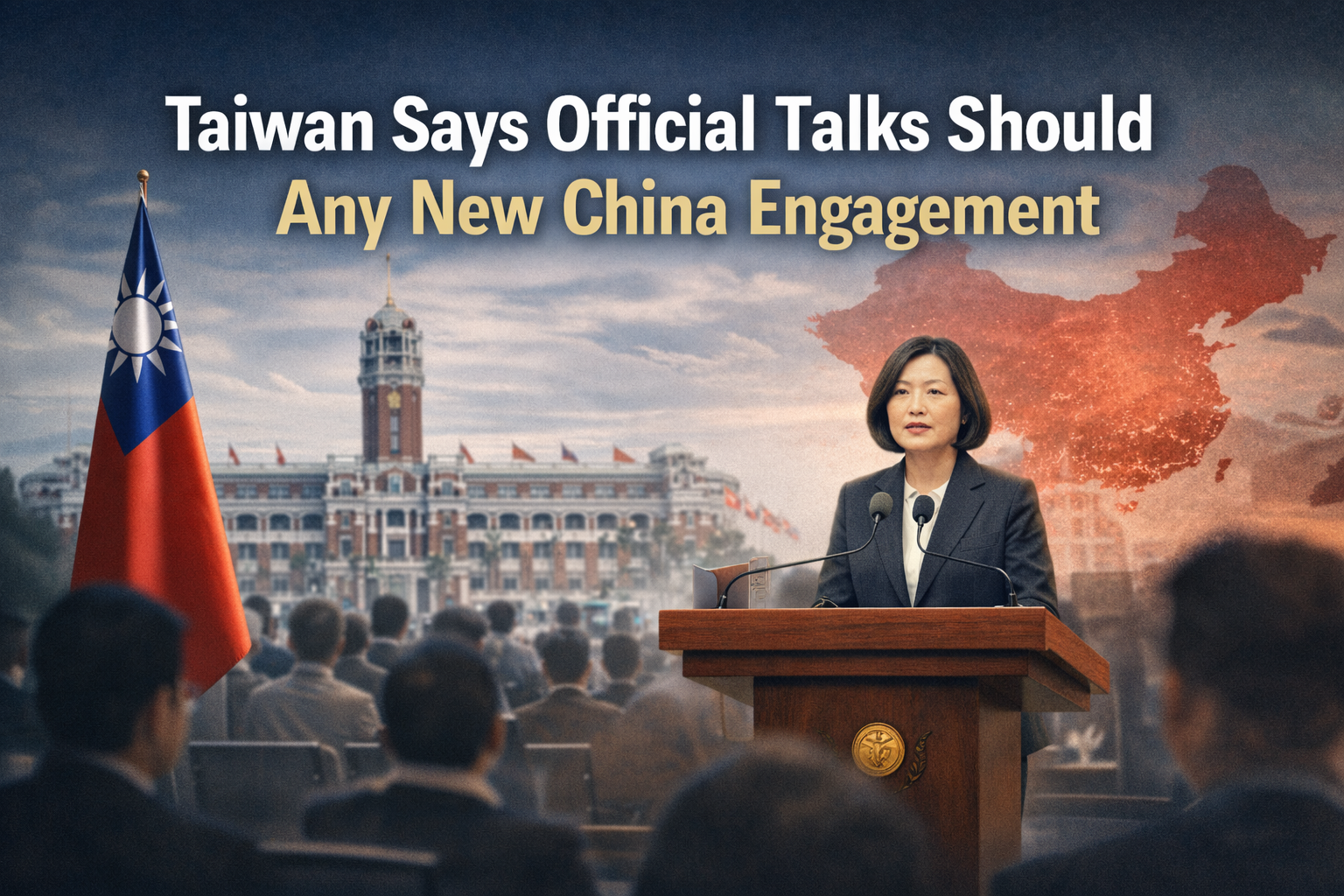
Taiwan Says Official Talks Should Lead Any New China Engagement
Intermediate | April 13, 2026
✨ Read the article aloud on your own or repeat each paragraph after your tutor.
Taiwan China Engagement Should Be Government-Led
Taiwan said on April 13, 2026 that any new talks with China about trade and tourism should be led by the government, not by private political contacts. The message came from Tsai Ming-yen, the head of Taiwan’s National Security Bureau, after China announced 10 new incentive measures for Taiwan. According to (Reuters), Tsai said only the government should be assessing, planning, and driving these exchanges.
China Offered New Measures After an Opposition Visit
China unveiled the new measures on April 12, just after Cheng Li-wun, chairwoman of Taiwan’s main opposition party, the Kuomintang (KMT), visited China and met Xi Jinping. Reuters reported that the measures include easing tourist restrictions, allowing in “healthy” Taiwanese television dramas, helping food and fishery sales, and exploring a regular communication mechanism between the KMT and China’s Communist Party. (Reuters)
Why Taipei Is Being Careful
Taiwan’s government is not rejecting contact itself. In fact, President Lai Ching-te has repeatedly called for talks. But Beijing refuses to speak with Lai’s administration, calling him a “separatist.” That is why Tsai Ming-yen said official planning matters. He argued that letting the government take charge can help Taiwan avoid unnecessary risks and long-term consequences. (Reuters)
The Election Interference Concern
Tsai also warned that Chinese “goodwill measures” often appear ahead of elections. Reuters said he pointed to a pattern in which Beijing focuses on particular cities, industries, companies, or individuals at politically sensitive times. Taiwan will hold important local elections in November 2026, and officials are worried China could again try to influence public opinion, just as Taiwan complained before the 2024 presidential election. (Reuters)
The Opposition Party Has a Different Tone
The KMT welcomed the new measures and said they could create peace and economic opportunities. Reuters also reported that Hou Yu-ih, the KMT’s 2024 presidential candidate and current mayor of New Taipei, said exchanges should begin on the basis of equality, dignity, and mutual respect, starting with less sensitive areas such as culture. That shows the debate inside Taiwan is not about whether communication matters, but about who should lead it and under what conditions. (Reuters)
Why This Story Matters
This story matters because cross-strait relations affect not only Taiwan and China, but also global business, security, and regional politics. Future Taiwan China engagement could influence trade, diplomacy, and security across the region. It also shows how diplomacy, trade, elections, and national identity can become tightly connected. For English learners, this article gives useful real-world terms like engagement, incentive measures, sovereignty, mutual respect, and interference. In politics, the messenger can be just as important as the message.
Vocabulary
- Engagement (noun) – communication or contact between governments, groups, or countries.
Example: Taiwan said new engagement with China should be government-led. - Incentive (noun) – something offered to encourage action.
Example: China announced new incentives for Taiwan on trade and tourism. - Opposition party (noun) – a political party that is not currently leading the government.
Example: Taiwan’s opposition party welcomed the new measures. - Separatist (noun/adjective) – a person or idea connected with breaking away from a larger political unit.
Example: Beijing calls President Lai a separatist. - Sovereignty (noun) – a country’s right to govern itself.
Example: Taiwan rejects Beijing’s claims over its sovereignty. - Interference (noun) – unwanted involvement in another group’s affairs.
Example: Officials warned the measures could be used for election interference. - Mutual respect (noun) – respect shared by both sides.
Example: Hou said exchanges should begin with mutual respect. - Rebuff (verb) – to reject or refuse something.
Example: China has rebuffed several offers of talks from Taiwan’s president. - Goodwill (noun) – friendly intentions or helpful actions.
Example: Tsai said such goodwill measures often appear before elections. - Cross-strait (adjective) – relating to Taiwan and China across the Taiwan Strait.
Example: Cross-strait relations remain tense and politically sensitive.
Discussion Questions (About the Article)
- What did Taiwan say about who should lead new engagement with China?
- What kinds of incentives did China announce for Taiwan?
- Why is Taipei cautious about these new measures?
- How did Taiwan’s opposition party respond to China’s offer?
- Why are Taiwan’s November 2026 local elections part of this story?
Discussion Questions (About the Topic)
- Why do governments worry about foreign influence during elections?
- Should official talks always come before party-to-party communication? Why or why not?
- How can trade and tourism become political tools?
- What are the benefits and risks of accepting incentives from a political rival?
- How should leaders balance peace efforts with national security concerns?
Related Idiom or Phrase
“Read between the lines” – to understand a deeper meaning that is not said directly.
Example: When China offers new incentives before an election, many officials try to read between the lines.
📢 Want more useful English practice with real-world international news? Sign up for the All About English Mastery Newsletter! Click here to join us.
Want to finally Master English but don’t have the time? Mastering English for Busy Professionals is built for busy learners. Check it out now.
Follow our YouTube Channel @All_About_English for more English tips and real-world practice.
This article was inspired by: Reuters, Reuters, and Reuters


 English
  한국어
한국어