

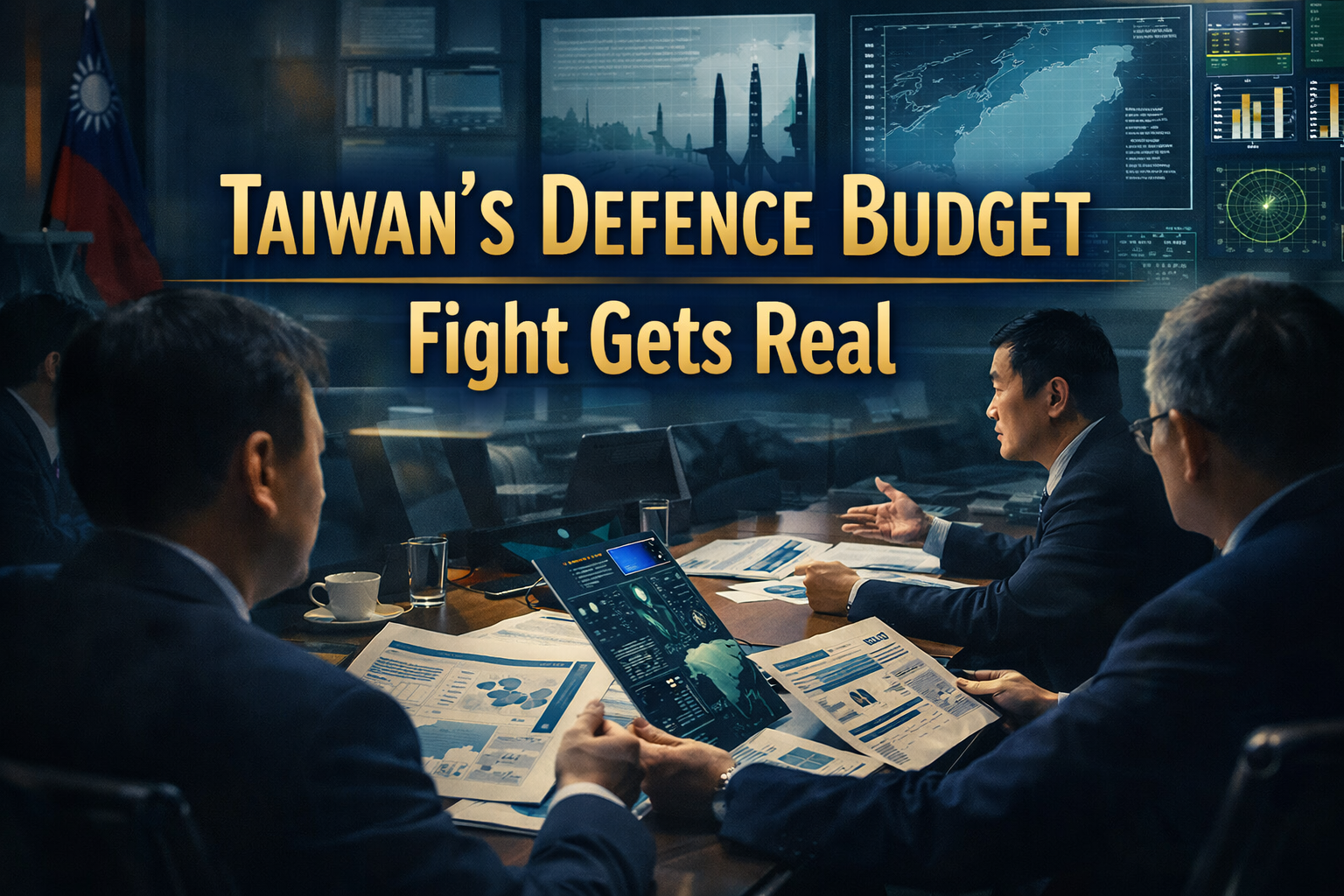
Taiwan’s Defence Budget Fight Gets Real
Intermediate | March 18, 2026
✨ Read the article aloud on your own or repeat each paragraph after your tutor.
A Political Fight Over Security
Taiwan’s defence minister, Wellington Koo, publicly rejected a much smaller military spending proposal from the main opposition party, the Kuomintang (KMT). According to Reuters, the government wants a special defence budget of about $40 billion, while the KMT suggested spending only about 30% of that amount. That gap turned the debate into more than a budget argument. It became a fight over how seriously Taiwan should respond to rising military pressure from China.
Why the Deadline Caused Problems
The opposition also proposed that Taiwan should finish its U.S. weapons purchases by the end of 2028. Koo said that deadline was simply not realistic (Reuters). He warned that key defence projects, including precision artillery and anti-armour unmanned aerial vehicle systems, would become impossible to complete under that rule. In other words, he was saying the deadline might sound disciplined on paper, but in practice it could weaken Taiwan’s ability to prepare.
The U.S. Angle Makes This More Urgent
This story matters beyond Taiwan because the United States is Taiwan’s main arms supplier. A few days later, Reuters reported that Taiwan’s political parties agreed to let the government sign agreements for four U.S. arms packages so it would not miss critical deadlines (Reuters). Those packages included TOW anti-tank missiles, M109A7 self-propelled howitzers, Javelin missiles, and HIMARS rocket systems. Reuters also reported that one HIMARS letter was set to expire on March 26, which helps explain why officials were sounding the alarm.
Why the Opposition Pushed Back
The KMT did not say defence was unnecessary. Instead, it argued that the government’s proposal was too large and lacked enough transparency. Reuters reported that the party also wanted weapons deals to happen through government-to-government channels rather than commercial arrangements, saying that would provide better oversight (Reuters). Koo rejected that idea too, warning that limiting procurement channels would make Taiwan’s defence weaker, not stronger.
Taiwan Defence Budget Debate Is About More Than Money
The Taiwan defence budget debate is not only about numbers on a spreadsheet. It is about speed, trust, and strategy. President Lai Ching-te has argued that Taiwan can afford to spend more because of its strong economy, especially with support from semiconductors and AI-related growth (Reuters). Critics, however, want clearer details before approving such a large package. That tension is familiar in politics and business alike: one side says, “Move faster,” while the other says, “Show me the plan first.”
A Good Lesson in Real-World English
For English learners, this article is useful because it includes the language of budgets, deadlines, negotiation, oversight, and strategy. The Taiwan defence budget debate also shows how one issue can be described in very different ways depending on who is speaking. One group focuses on urgency and national security. The other focuses on cost and accountability. That kind of framing appears all the time in meetings, public debate, and business discussions.
Vocabulary
- defence (noun) – protection against attack or danger.
Example: Taiwan wants to strengthen its defence as pressure from China grows. - proposal (noun) – a plan or suggestion for action.
Example: The opposition offered a much smaller budget proposal. - deadline (noun) – the latest time by which something must be finished.
Example: Koo said the 2028 deadline was unrealistic. - realistic (adjective) – practical and possible in real life.
Example: The minister argued that the proposed timeline was not realistic. - oversight (noun) – careful supervision or checking.
Example: Lawmakers asked for more oversight of the defence budget. - procurement (noun) – the process of buying something, especially for government or large organizations.
Example: Military procurement often takes years to complete. - transparency (noun) – openness and clear sharing of information.
Example: The opposition said the budget needed more transparency. - strategy (noun) – a plan for achieving a goal.
Example: Defence strategy involves more than just buying weapons. - accountability (noun) – responsibility for explaining actions and decisions.
Example: Critics said accountability matters before approving more spending. - urgency (noun) – the need for quick action.
Example: Government officials spoke with urgency because of the contract deadlines.
Discussion Questions (About the Article)
- Why did Wellington Koo reject the opposition’s defence proposal?
- What made the 2028 deadline such a problem?
- Which U.S. weapons packages were at risk of delay?
- Why did the KMT want stronger oversight of the budget?
- Why is this debate about more than just money?
Discussion Questions (About the Topic)
- How should governments balance national security and budget concerns?
- When is it reasonable for lawmakers to slow down a major spending package?
- Do strict deadlines help government projects, or do they sometimes create bigger problems?
- How important is transparency when governments spend large amounts of money?
- What similarities do you see between political negotiation and business negotiation?
Related Idiom
“A double-edged sword” – something that has both benefits and risks.
Example: A strict weapons deadline can be a double-edged sword because it creates urgency but may also block important projects.
📢 Want more tips like this? 👉 Sign up for the All About English Mastery Newsletter! Click here to join us.
Want to finally master English but don’t have the time? Mastering English for Busy Professionals is the course for you! Check it out now!
Follow our YouTube Channel @All_About_English for more great insights and tips.
This article was inspired by: Reuters, Reuters, and Reuters.


 English
  한국어
한국어