

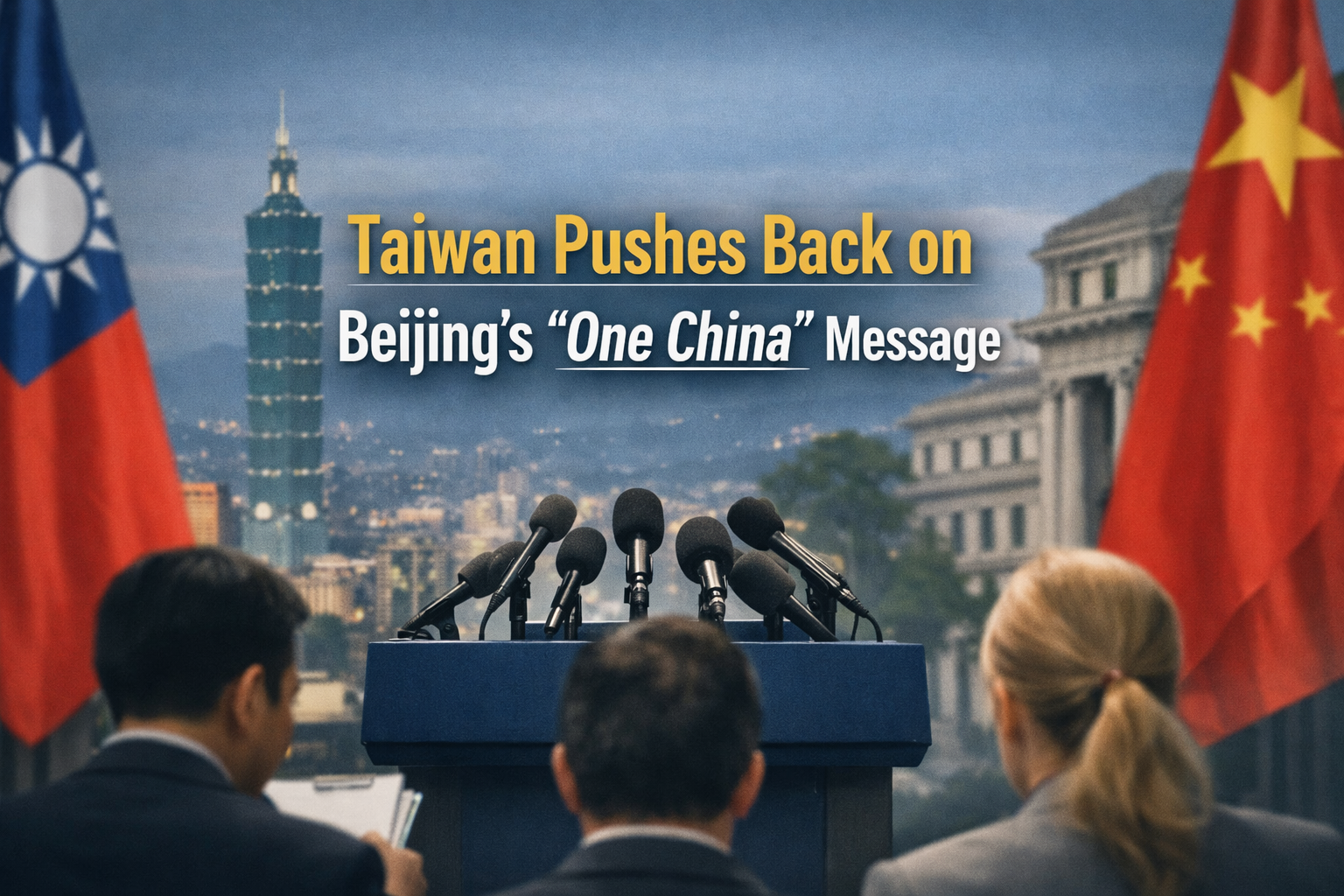
Taiwan Pushes Back on Beijing’s “One China” Message
Intermediate | March 22, 2026
✨ Read the article aloud on your own or repeat each paragraph after your tutor.
Taiwan Answers Back After Beijing’s Sharp Comments
On March 8, 2026, China’s foreign minister Wang Yi used very strong language about Taiwan during a press conference in Beijing. He said Taiwan “never was, is not, and never will be a country.” Taiwan quickly pushed back. According to TaiwanPlus, Taiwan’s foreign ministry strongly condemned Wang’s remarks and rejected Beijing’s claim over the island. (TaiwanPlus) The dispute reminded many people that the Taiwan issue is not just about history. It is also about identity, democracy, and who gets to decide Taiwan’s future.
Why Taiwan Rejects One China So Strongly
Beijing says Taiwan is part of China and treats the issue as a core national interest. But Taiwan’s government says the island is already self-governed and that only the people of Taiwan can decide their future. In that sense, Taiwan rejects one China as a political conclusion imposed by Beijing. This difference is huge. It is not a small disagreement over wording. It affects diplomacy, security, trade, and how other countries deal with both Beijing and Taipei.
The Bigger Political Background
The timing also mattered. Reuters reported that Wang Yi made the comments while warning that a failure of U.S.-China engagement could lead to misunderstandings and confrontation. (Reuters) At the same time, China has increased pressure in the region through military activity around Taiwan and angry reactions to moves by Taiwan and Japan. In other words, Wang’s comments were not made in a vacuum. They came during a tense period when every public statement carries extra weight.
Taiwan Says Its Future Is Not Beijing’s Decision
Taiwan’s position has stayed consistent: Beijing does not get the final word. Reuters reported again the very next day that Taiwan rejects China’s sovereignty claims and says only Taiwan’s people can decide the island’s future. (Reuters) That message is simple, but powerful. For many observers, Taiwan rejects one China because it believes its future should be decided democratically by the people living there. For many people in Taiwan, this is really the heart of the issue. They see their future as something to be chosen by voters in Taiwan, not announced by officials in Beijing.
Why English Learners Should Care About This Story
This story is useful for English learners because it mixes politics, diplomacy, and persuasive language. You can learn words like condemn, sovereignty, and provocation, but you can also notice how governments frame a message. Beijing used absolute language. Taiwan answered with firm, defensive language. That makes this a great article for learners who want to understand how serious international disagreement sounds in real English.
What May Happen Next
This issue is not going away anytime soon. China continues to pressure Taiwan politically and militarily, while Taiwan keeps insisting on its democratic right to choose its own path. Other countries will keep watching closely, especially the United States and Japan. So, while this was one set of comments on one day, it is really part of a much bigger long-term struggle.
Vocabulary
- Condemn (verb) – to strongly criticize something.
Example: “Taiwan condemned Beijing’s comments after Wang Yi’s speech.” - Sovereignty (noun) – the right of a country to rule itself.
Example: “Taiwan says its sovereignty should be decided by its own people.” - Provocation (noun) – an action or statement that is meant to cause anger or a strong reaction.
Example: “Some people saw the statement as a political provocation.” - Diplomacy (noun) – the management of relations between countries.
Example: “Diplomacy becomes harder when both sides use very sharp language.” - Tension (noun) – a nervous or difficult situation between people or countries.
Example: “Tension in the region has remained high.” - Rejection (noun) – a refusal to accept something.
Example: “Taiwan’s rejection of Beijing’s claim was immediate.” - Claim (noun) – a statement that something belongs to someone or is true.
Example: “China repeated its claim that Taiwan is part of its territory.” - Self-governed (adjective) – controlling its own government and decisions.
Example: “Taiwan sees itself as a self-governed democracy.” - Confrontation (noun) – a tense or direct conflict.
Example: “Leaders warned that misunderstanding could lead to confrontation.” - Identity (noun) – the character or sense of who a person or group is.
Example: “The debate is also about Taiwan’s political identity.”
Discussion Questions (About the Article)
- What exactly did Wang Yi say, and why did Taiwan react so strongly?
- How did Taiwan describe its own position in response to Beijing’s comments?
- Why does this disagreement affect more than just politics?
- How does strong language shape international news stories like this one?
- Why do you think this issue remains so sensitive after so many years?
Discussion Questions (About the Topic)
- Should people in a place like Taiwan decide their own future? Why or why not?
- How much power should history have in today’s political arguments?
- What is the difference between a government’s claim and a people’s choice?
- How can words from political leaders increase tension between countries?
- Why is it important for English learners to understand diplomatic language?
Related Idiom
“Draw a line in the sand” – to set a clear limit or position that you will defend.
Example: “Taiwan drew a line in the sand by rejecting Beijing’s comments and repeating that its future must be decided by its own people.”
📢 Want more practical English using real news? 👉 Sign up for the All About English Mastery Newsletter! Click here to join us!
Want to finally Master English but don’t have the time? Mastering English for Busy Professionals is the course for you! Check it out now!
Follow our YouTube Channel @All_About_English for more great insights and tips.
This article was inspired by: TaiwanPlus, Reuters, and Reuters.


 English
  한국어
한국어