

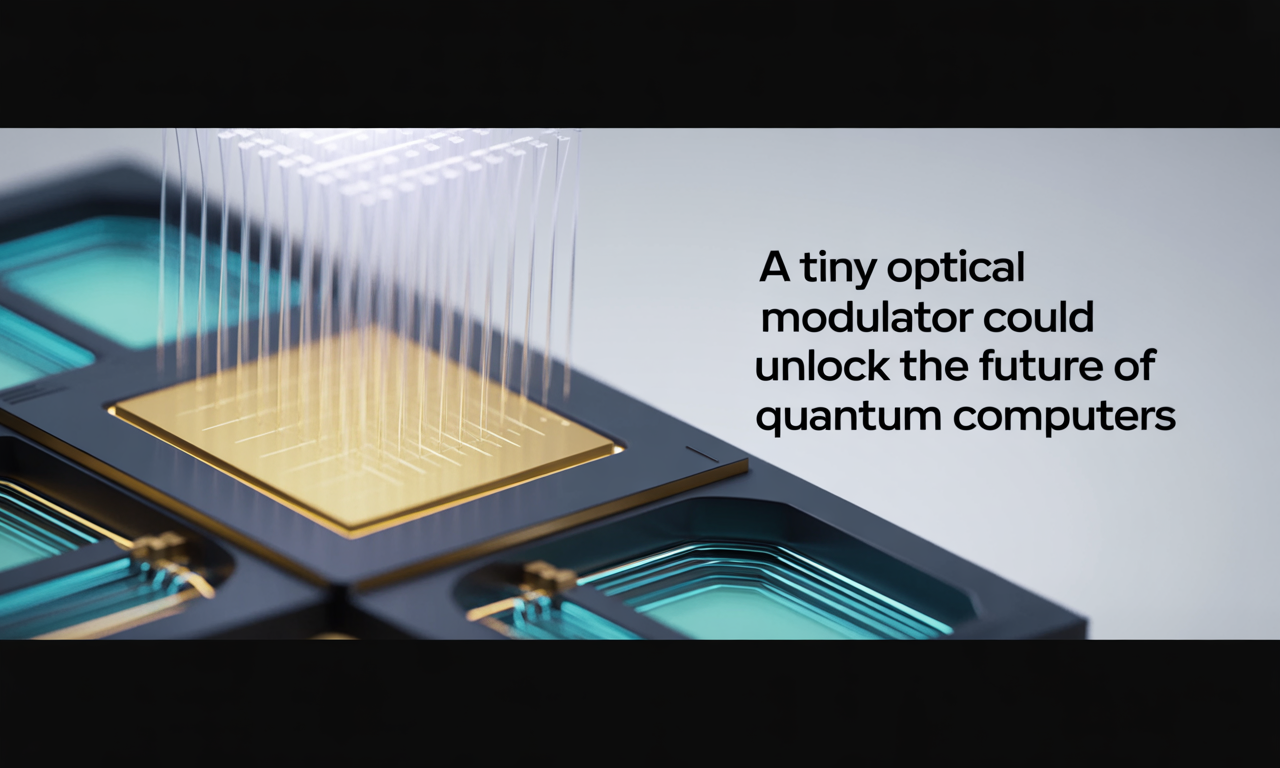
A Tiny Optical Modulator Could Unlock the Future of Quantum Computers
Intermediate | December 18, 2025
✨ Read the article aloud on your own or repeat each paragraph after your tutor.
Tiny Optical Modulator: Why a Small Breakthrough Matters in a Big Way
At first glance, a tiny optical modulator doesn’t sound very exciting. But according to new research, this small device could play a huge role in the future of quantum computers—machines that promise to solve problems today’s computers simply can’t handle. Scientists say the breakthrough could help scale quantum systems without making them bigger, more expensive, or more fragile, as reported by Phys.org (December 12, 2025).
What Is an Optical Modulator (In Simple Terms)?
An optical modulator is a device that controls light—turning it on and off or changing its strength. In classical computing and telecommunications, modulators already help send data through fiber‑optic cables. The difference here is that this new modulator is designed to work at the quantum level, where information can be carried by single particles of light, called photons. (Background: Phys.org)
Why Quantum Computers Need Better Light Control
Many quantum computers rely on extremely delicate signals. Even small amounts of noise, heat, or delay can destroy the information being processed. Researchers explained that traditional modulators are often too large, too slow, or too power‑hungry for practical quantum systems. The newly developed tiny optical modulator addresses that problem by being faster, more efficient, and small enough to integrate directly onto a quantum chip, according to the research summary on Phys.org.
The Key Breakthrough: Smaller, Faster, and More Scalable
What makes this development stand out is scale. Instead of using bulky external equipment, the modulator can be fabricated directly into photonic circuits. That opens the door to mass‑producing quantum components, rather than building custom machines one piece at a time. Scientists involved in the project say this could remove one of the biggest bottlenecks slowing down real‑world quantum computing. (Research coverage: Phys.org)
Why This Matters Beyond the Lab
Quantum computing often sounds abstract, but its applications are very real. Experts say advances like this could eventually improve drug discovery, materials science, financial modeling, and encryption. From a business perspective, the takeaway is clear: breakthroughs don’t always look dramatic. Sometimes, a small component quietly makes large systems finally practical. That’s exactly why engineers are paying close attention to this tiny optical modulator. (Phys.org)
What Comes Next
Researchers caution that this doesn’t mean consumer‑ready quantum computers are arriving next year. However, it does represent steady progress toward machines that are easier to build, maintain, and scale. As one researcher put it, quantum computing won’t advance because of a single big invention—but because of many small ones like this. (Phys.org)
Vocabulary
- Optical modulator (noun) – a device that controls light signals.
Example: “The optical modulator adjusts how light carries information.” - Quantum computer (noun) – a computer that uses quantum physics to process information.
Example: “Quantum computers can solve certain problems much faster.” - Photon (noun) – a particle of light.
Example: “Information can be stored in a single photon.” - Scale (verb) – to grow or expand efficiently.
Example: “The technology makes it easier to scale quantum systems.” - Efficient (adjective) – working well without wasting energy or time.
Example: “The new design is more energy‑efficient.” - Fabricated (verb) – built or manufactured.
Example: “The chip was fabricated using standard techniques.” - Bottleneck (noun) – something that slows progress.
Example: “Hardware limitations are a major bottleneck.” - Fragile (adjective) – easily damaged or disrupted.
Example: “Quantum signals are extremely fragile.” - Integrate (verb) – to combine into a system.
Example: “The modulator can integrate directly into the chip.” - Application (noun) – a practical use of something.
Example: “Quantum computing has many future applications.”
Discussion Questions (About the Article)
- Why can small hardware improvements matter so much in advanced technology?
- What problems do quantum computers face today?
- Why is controlling light important in quantum systems?
- What does “scaling” mean in technology development?
- Which part of this breakthrough did you find most interesting?
Discussion Questions (About the Topic)
- Do you think quantum computers will affect everyday life? How?
- Why do you think progress in new technologies often feels slow?
- What industries might benefit most from quantum computing?
- Should governments invest more in basic scientific research? Why or why not?
- How can small inventions lead to big economic changes?
Related Idiom / Phrase
“The missing piece of the puzzle” – something needed to make a system work.
Example: “Better light control could be the missing piece of the puzzle for scalable quantum computers.”
📢 Want more news‑based English practice like this? 👉 Sign up for the All About English Mastery Newsletter!
https://allaboutenglishmastery.com/newsletter
Want to finally master English but don’t have the time? Mastering English for Busy Professionals is the course for you! Check it out now!
Follow our YouTube Channel @All_About_English for more great insights and tips.
This article was inspired by: Phys.org (December 12, 2025), reporting on research into compact optical modulators for quantum computing.


 English
  한국어
한국어