

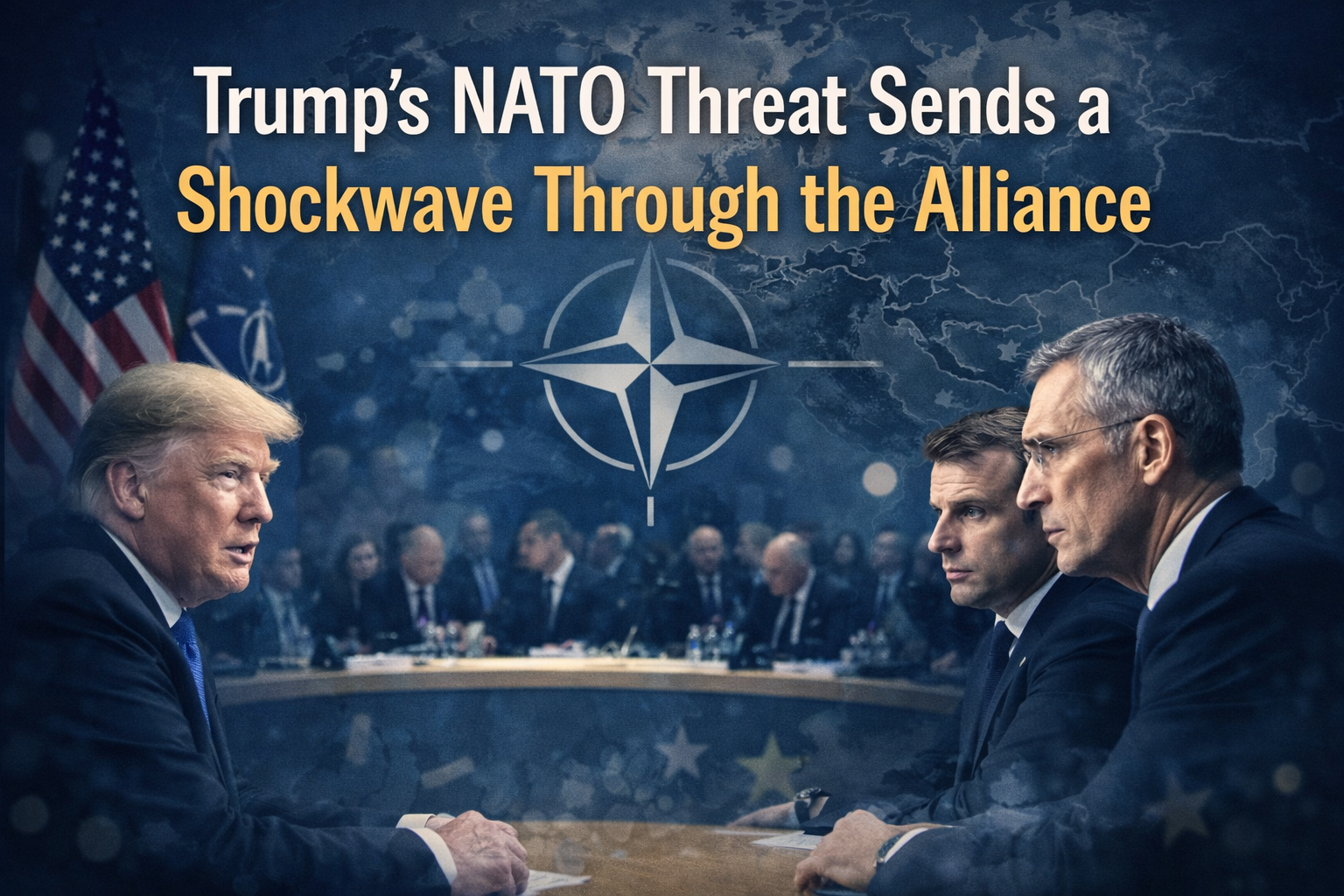
Trump’s NATO Threat Sends a Shockwave Through the Alliance
Advanced | April 6, 2026
✨ Read the article aloud on your own or repeat each paragraph after your tutor.
A New Fight Over an Old Alliance
Tensions between the United States and its European allies rose sharply after President Donald Trump said he was considering pulling the U.S. out of NATO. He made the threat while criticizing European members for refusing to send ships to help unblock the Strait of Hormuz during the Iran war. In remarks to Reuters, Trump said he was “absolutely” considering withdrawal and planned to speak openly about his frustration with the alliance (Reuters).
Why Trump Says NATO Failed Him
The immediate trigger for this latest conflict was not a long-running debate about defense spending. This time, Trump’s anger focused on the refusal of European allies to support a U.S. push to secure shipping in the Strait of Hormuz, one of the world’s most important oil routes. Reuters reported that Trump said European countries had refused to send ships, and he sharply questioned why Washington should remain committed to an alliance that, in his view, was not backing the United States in a moment of crisis (Reuters).
Why the Trump NATO Exit Threat Matters So Much
The Trump NATO exit threat matters because NATO is not just another diplomatic club. The alliance was created in 1949 and has long been the foundation of Western security. Its most important idea is collective defense: if one member is attacked, the others are expected to respond. That is why Trump’s threat hit such a nerve. Reuters also noted that Defense Secretary Pete Hegseth declined to reaffirm the U.S. commitment to collective defense on the same day, which added even more pressure to an already tense situation (Reuters).
Europe Tries to Keep Calm
European leaders did not exactly roll over. Poland called for calm, Germany said it remained committed to NATO, and British Prime Minister Keir Starmer said Britain should strengthen ties with Europe while still protecting its own national interests (Reuters). NATO Secretary-General Mark Rutte is also due to visit Washington for what Reuters described as a long-planned trip, but the timing now feels much more serious because it comes right after Trump’s threat and public criticism of France, the U.K., and other allies (Reuters).
Can a President Actually Leave NATO Alone?
That question is now front and center. Reuters reported that Congress passed a law in 2023 saying no U.S. president can withdraw from NATO unless the move is approved by two-thirds of the Senate or by an act of Congress. The law also says no federal money can be spent on a withdrawal without that approval. However, legal experts say the Constitution does not clearly explain who controls treaty withdrawal, so a real court fight could still happen if a president tried to test the limits (Reuters).
A Bigger Crack in the Trans-Atlantic Relationship
This story is about more than one angry comment. Reuters later reported that many European officials now fear the United States may not fully stand by its allies in a future crisis, even without a formal withdrawal. Analysts told Reuters that the alliance is in one of its weakest positions in decades, with some calling it the worst moment in NATO’s history since its founding. In other words, the Trump NATO exit threat has already damaged trust, whether the U.S. actually leaves or not (Reuters).
What English Learners Can Take From This Story
For English learners, this article is useful because it includes strong political and business expressions such as threaten to pull out, ratchet up tensions, stand by allies, reaffirm commitment, and hit a nerve. These phrases are not only common in global affairs reporting. They also work in business English when companies, teams, or leaders face conflict, pressure, and high-stakes decisions.
Vocabulary
- Alliance (noun) – a formal partnership between countries or groups.
Example: NATO is a military alliance between North American and European countries. - Withdraw (verb) – to leave an agreement, place, or organization.
Example: Trump said he was considering whether to withdraw the U.S. from NATO. - Collective defense (noun) – the principle that members of a group defend one another.
Example: NATO is built on the idea of collective defense. - Commitment (noun) – a promise or serious responsibility.
Example: European leaders said they remained committed to the alliance. - Trigger (noun/verb) – the event that causes something to begin.
Example: The dispute over Hormuz triggered a new political crisis inside NATO. - Rift (noun) – a serious break or division in a relationship.
Example: Trump’s comments deepened the rift between Washington and its allies. - Denounce (verb) – to criticize publicly and strongly.
Example: Trump continued to denounce the alliance in public remarks. - Reaffirm (verb) – to state something again in a clear and firm way.
Example: Some officials wanted the Pentagon to reaffirm support for NATO’s core mission. - Ratchet up (phrasal verb) – to increase pressure, tension, or intensity.
Example: The president’s remarks ratcheted up tensions with Europe. - Cornerstone (noun) – a central and important part of something.
Example: NATO has long been the cornerstone of Western security.
Discussion Questions (About the Article)
- Why did Trump say he was considering withdrawing from NATO?
- Why is the Strait of Hormuz such an important issue in this story?
- How did European leaders respond to Trump’s comments?
- What legal barriers could make a U.S. withdrawal from NATO difficult?
- Do you think the political damage can be repaired easily? Why or why not?
Discussion Questions (About the Topic)
- Should military alliances require equal support in every international conflict?
- How important is trust in long-term international partnerships?
- What happens when a leader makes a threat even if they may not carry it out?
- Can an alliance survive if members begin to doubt each other’s commitment?
- What similarities do you see between political alliances and business partnerships?
Related Idiom
“Hit a nerve” – to cause a strong emotional reaction because the issue is sensitive or important.
Example: Trump’s NATO comments hit a nerve because they raised doubts about the future of Western security.
📢 Want more practical English practice with real-world stories? Sign up for the All About English Mastery Newsletter! Click here to join us.
Want to finally master English but don’t have the time? Mastering English for Busy Professionals is built for busy people like you.
Follow our YouTube Channel @All_About_English for more useful English tips and real-world practice.
This article was inspired by: Reuters – April 1 main report, Reuters – legal explainer, Reuters – Rutte visit, Reuters – April 3 follow-up


 English
  한국어
한국어