

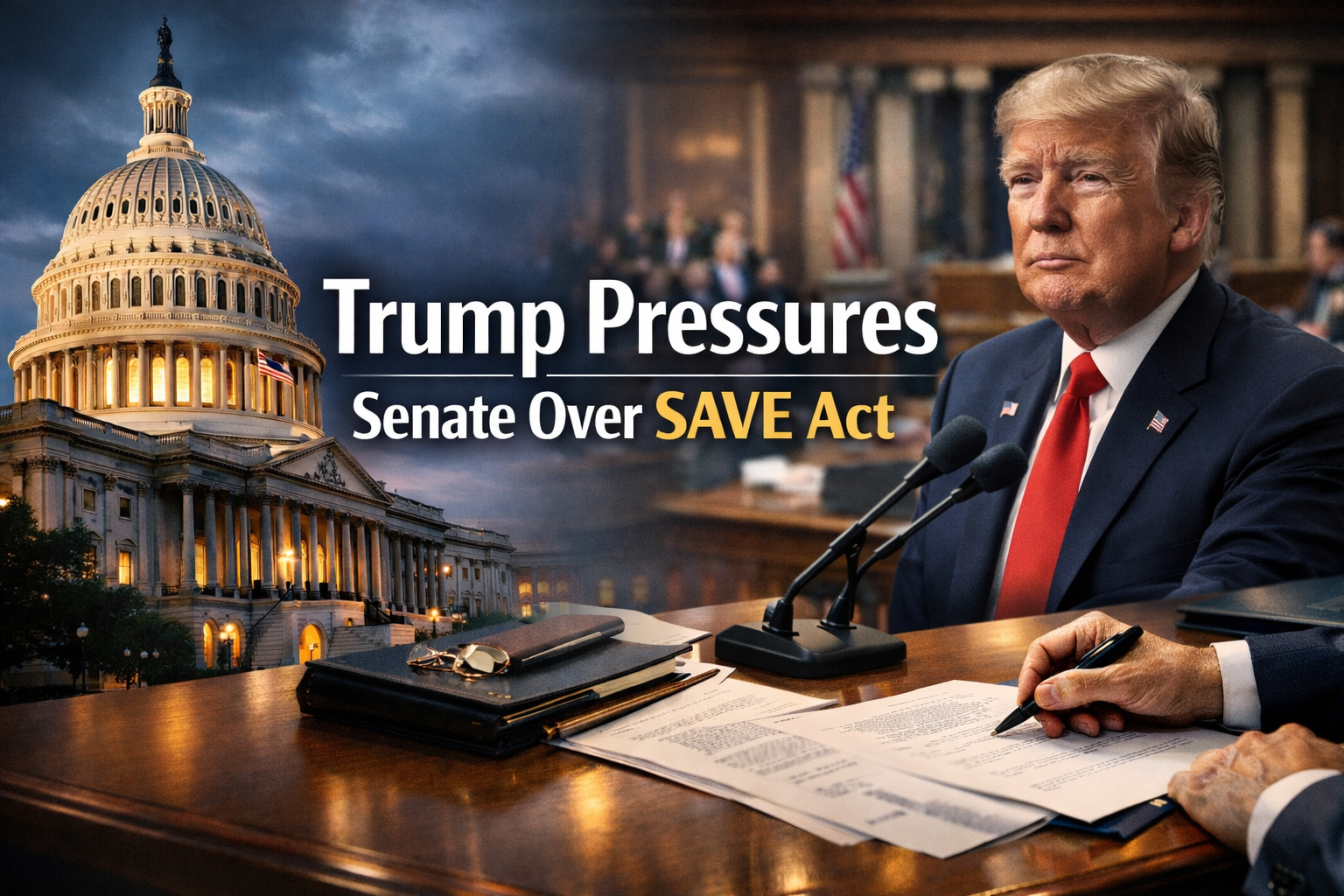
Trump Pressures Senate Over SAVE Act
Advanced | March 15, 2026
✨ Read the article aloud on your own or repeat each paragraph after your tutor.
A New Political Pressure Campaign
President Donald Trump has turned up the pressure on the U.S. Senate over the SAVE America Act, a Republican-backed voting bill. On March 8, 2026, Trump said he would not sign other legislation until Congress passes the bill (Reuters). That public warning raised the temperature in Washington and made the SAVE Act a much bigger political fight. In other words, Trump SAVE Act pressure quickly became a central issue in the broader debate over election law.
What the SAVE Act Would Do
The bill would require people to show proof of U.S. citizenship when registering to vote in federal elections. It would also create criminal penalties for election officials who register someone without the required documents. Reuters reported that the Republican-controlled House passed the bill in February by a 218-213 vote (Reuters). Supporters say the law would strengthen election security and make sure only citizens vote in federal elections.
Why the Senate Is the Real Battleground
Even though Republicans control the Senate, passing the bill will not be easy. The SAVE Act would likely need 60 votes to overcome a filibuster, which means Republican leaders would need some Democratic support (Reuters). Right now, that looks very unlikely. Senate Democratic leader Chuck Schumer has strongly opposed the bill and warned that it could create major legislative gridlock if Trump refuses to sign other bills until this one passes.
Critics Say the Bill Could Create Real Problems
Critics argue that the bill is trying to solve a problem that is already rare. Noncitizen voting in federal elections is already illegal, and reports from election officials and outside groups say such cases are uncommon. The bigger concern, according to critics, is that many eligible American citizens may struggle to get the documents needed to register under the proposed rules (AP News).
The Document Problem Could Be Bigger Than It Looks
An Associated Press report explained that the list of accepted documents sounds broad at first, but many of the options come with fine print. For example, not all REAL ID-compliant driver’s licenses show that the holder is a U.S. citizen. AP also noted that only five states currently offer enhanced REAL IDs that clearly indicate citizenship. A current passport would work, but only about half of American adults have one, and getting a new passport can take four to six weeks and cost well over $100. A 2025 University of Maryland study estimated that 21.3 million eligible Americans do not have or cannot easily access the documents needed to prove citizenship (AP News).
Who Could Feel the Impact Most?
The proposed rules could especially affect people whose documents do not match their current names, including many married women, as well as rural voters and people who live far from government offices. AP also pointed out that birth certificates can take weeks or even months to obtain in some places (AP News). So while supporters describe the law as common sense, opponents say it could create a paperwork headache for millions of legal voters right before the midterm elections.
Why Trump SAVE Act Pressure Matters
This issue is not just about one bill. It is about the balance between election security and voter access. Trump’s message to the Senate shows how strongly he wants action before the 2026 midterms. Trump SAVE Act pressure has now become one of the clearest signs of how aggressively he wants Congress to act on voting rules. But the fight over the SAVE Act also highlights a deeper question: how far should the government go to prevent rare abuse if the new rules may make voting harder for millions of legitimate voters? That debate is likely to stay front and center in the months ahead.
Vocabulary
- Pressure (noun) – strong effort to make someone do something.
Example: “Trump increased pressure on the Senate to pass the bill.” - Legislation (noun) – a law or a proposed law.
Example: “The president said he would not sign other legislation first.” - Citizenship (noun) – the legal status of being a citizen of a country.
Example: “The bill would require proof of citizenship for voter registration.” - Penalty (noun) – a punishment for breaking a rule or law.
Example: “The proposal includes penalties for election officials who break the rules.” - Filibuster (noun) – a Senate procedure that can block a vote unless enough senators agree to move forward.
Example: “The SAVE Act may need 60 votes to overcome a filibuster.” - Gridlock (noun) – a situation where no progress can be made because people cannot agree.
Example: “Schumer warned that the dispute could lead to gridlock.” - Rare (adjective) – not common or not happening often.
Example: “Reports say noncitizen voting in federal elections is rare.” - Qualifier (noun) – an extra condition or limitation.
Example: “Some accepted documents come with qualifiers hidden in the fine print.” - Eligible (adjective) – allowed by law or rule to do something.
Example: “Millions of eligible voters may lack the right documents.” - Midterm elections (noun) – U.S. elections held in the middle of a president’s term.
Example: “Both parties are already focused on the midterm elections.”
Discussion Questions (About the Article)
- What did Trump say he would do if the SAVE Act does not pass?
- What are the main requirements in the SAVE Act?
- Why is the Senate a difficult place for this bill to pass?
- What document-related problems did critics point out?
- Why do opponents think the bill could affect legal voters?
Discussion Questions (About the Topic)
- Should governments require proof of citizenship for voter registration? Why or why not?
- How can a country protect election security without making voting too difficult?
- What kinds of documents should count as proof of citizenship?
- Do you think convenience should matter when governments design voting rules?
- How should lawmakers balance fraud prevention and public access?
Related Idiom
“Draw a line in the sand” – to make a firm public position that shows you will not back down easily.
Example: “Trump drew a line in the sand by saying he would not sign other bills until the SAVE Act passed.”
📢 Want more practical English using real news? 👉 Sign up for the All About English Mastery Newsletter! Click here to join us!
Want to finally Master English but don’t have the time? Mastering English for Busy Professionals is the course for you! Check it out now!
Follow our YouTube Channel @All_About_English for more great insights and tips.
This article took inspiration from Reuters, Reuters, and AP News.


 English
  한국어
한국어