

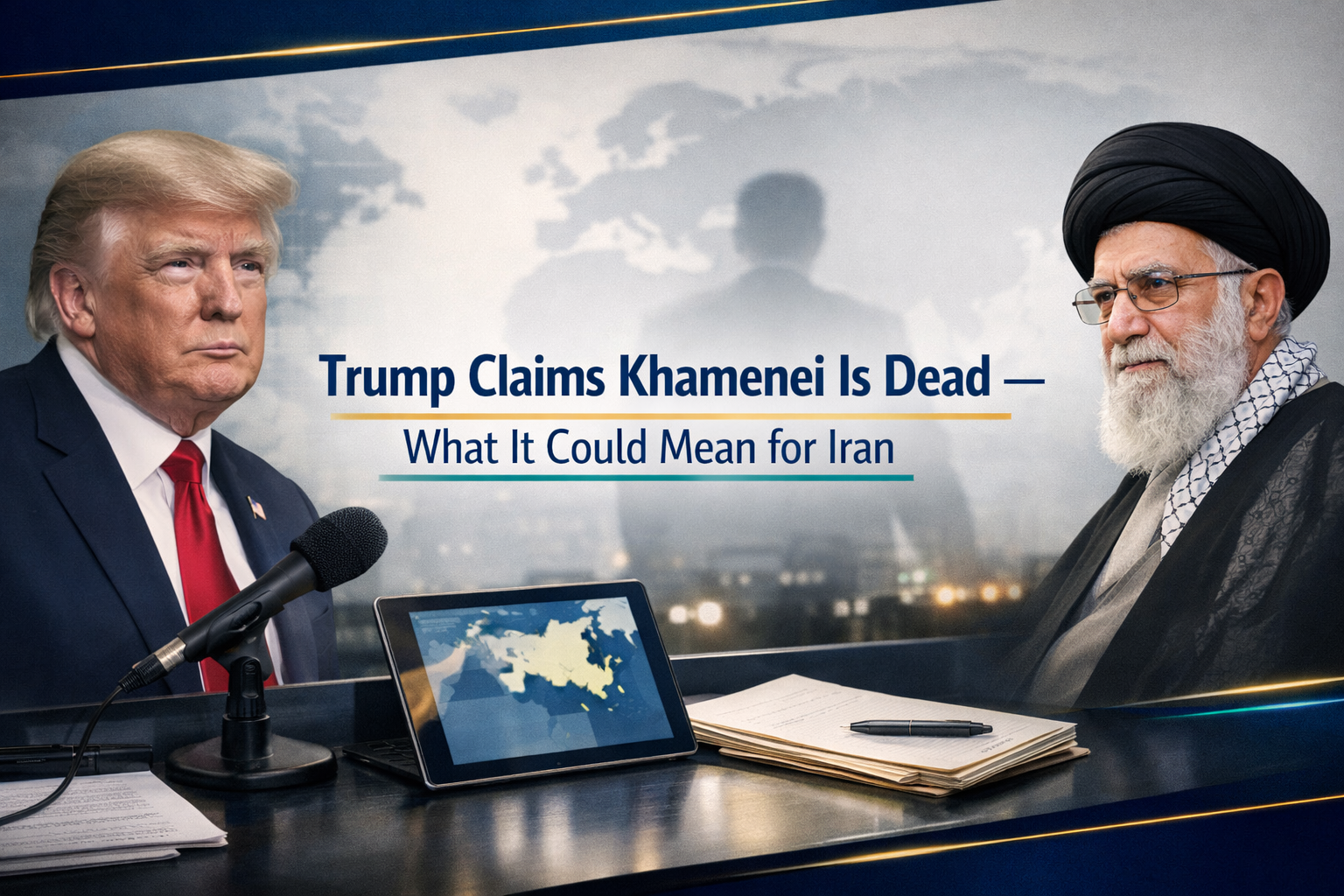
Trump Claims Khamenei Is Dead — What It Could Mean for Iran
Advanced | March 3, 2026
✨ Read the article aloud on your own or repeat each paragraph after your tutor.
Trump says Khamenei is dead: A High-Stakes Claim From Washington
Over the weekend, U.S. President Donald Trump posted on social media that Iran’s Supreme Leader, Ayatollah Ali Khamenei (86), was dead and framed it as a turning point for Iran. He called Khamenei “one of the most evil people in history” and said this was a major chance for Iranians to “take back” their country. (AP)
What Happened, According to Early Reporting
Trump’s statement came amid fast-moving reporting about military activity involving Iran and Israel, plus heavy diplomatic pressure behind the scenes. Early coverage focused on the risk of the situation widening if either side escalates further. (AP) (The Guardian)
Iran’s Response and the Risk of Escalation
After the initial claims and headlines, attention quickly shifted to what Iran would do next — and how neighbors in the region would react. Analysts often point to energy routes like the Strait of Hormuz as a key pressure point, because disruption there can ripple into global prices and business confidence. (Reuters)
The Big Question: What Comes After a Supreme Leader?
If Khamenei’s death is confirmed and accepted inside Iran, the next step could involve Iran’s political and religious institutions selecting a new supreme leader. That transition matters because the supreme leader influences security policy, foreign relations, and the direction of the economy — all of which affect regional stability and market expectations. (Reuters)
Why This Matters for Professionals (Even Far From the Middle East)
When geopolitical risk jumps, global businesses usually watch three things: energy prices, shipping stability, and currency volatility. Even if you don’t trade oil or run a logistics company, higher fuel costs can ripple into airline tickets, shipping fees, and consumer prices. In business terms, this is where companies start running “what-if” scenarios and tightening risk plans. (Reuters)
What to Watch This Week
In the coming days, pay attention to three updates (especially as the phrase “Trump says Khamenei is dead” continues to spread across headlines): (1) official confirmation and details from credible reporting, (2) whether retaliation continues or cools down, and (3) how global leaders and international organizations push for diplomacy or de-escalation. In moments like this, rumors travel fast — but verified statements and on-the-record reporting matter most. (AP)
Vocabulary
- Supreme leader (noun) – the highest political and religious authority in a country.
Example: “In Iran, the supreme leader has final say on major national decisions.” - Confirmed (adjective) – verified as true by reliable sources.
Example: “The news wasn’t confirmed until official statements were released.” - Escalation (noun) – a situation becoming more serious or intense.
Example: “Diplomats worked quickly to prevent escalation.” - Retaliation (noun) – a response attack after being attacked.
Example: “Leaders warned that retaliation could escalate the conflict.” - Stability (noun) – a steady situation without major change or conflict.
Example: “Markets prefer stability because it reduces uncertainty.” - Volatility (noun) – rapid and unpredictable change, especially in prices.
Example: “Oil price volatility rose as headlines spread.” - Diplomacy (noun) – negotiation between governments to solve problems peacefully.
Example: “Diplomacy is often the fastest path to de-escalation.” - Supply chain (noun) – the system that moves products from production to customers.
Example: “Conflict can disrupt the supply chain through shipping delays.” - Pressure point (noun) – a place where tension can quickly increase.
Example: “Energy routes can become a pressure point during regional conflict.” - De-escalation (noun) – actions that reduce conflict or tension.
Example: “Both sides signaled they were open to de-escalation talks.”
Discussion Questions (About the Article)
- Why do you think Trump framed this news as a “chance” for Iranian people?
- What details sound confirmed, and what still sounds uncertain?
- Why can leadership change create business and market uncertainty?
- Which ripple effect seems most likely: energy prices, shipping disruption, or investor fear?
- If you were advising a company, what “what-if” plan would you recommend?
Discussion Questions (About the Topic)
- Should leaders use public statements to encourage change inside another country? Why or why not?
- How can rumors and fast headlines affect diplomacy?
- Why does the Strait of Hormuz matter to the global economy?
- What should news readers do to avoid being misled during a crisis?
- How do you think global companies should prepare for geopolitical shocks?
Related Idiom
“Throw gasoline on the fire” — to make a bad situation even worse.
Example: “Aggressive statements can throw gasoline on the fire when tensions are already high.”
📢 Want more advanced English practice with real news? 👉 Sign up for the All About English Mastery Newsletter! Click here to join us!
Want to finally Master English but don’t have the time? Mastering English for Busy Professionals is the course for you! Check it out now!
Follow our YouTube Channel @All_About_English for more great insights and tips.
This article took inspiration from: AP, Reuters, The Guardian, and Ground News.


 English
  한국어
한국어