

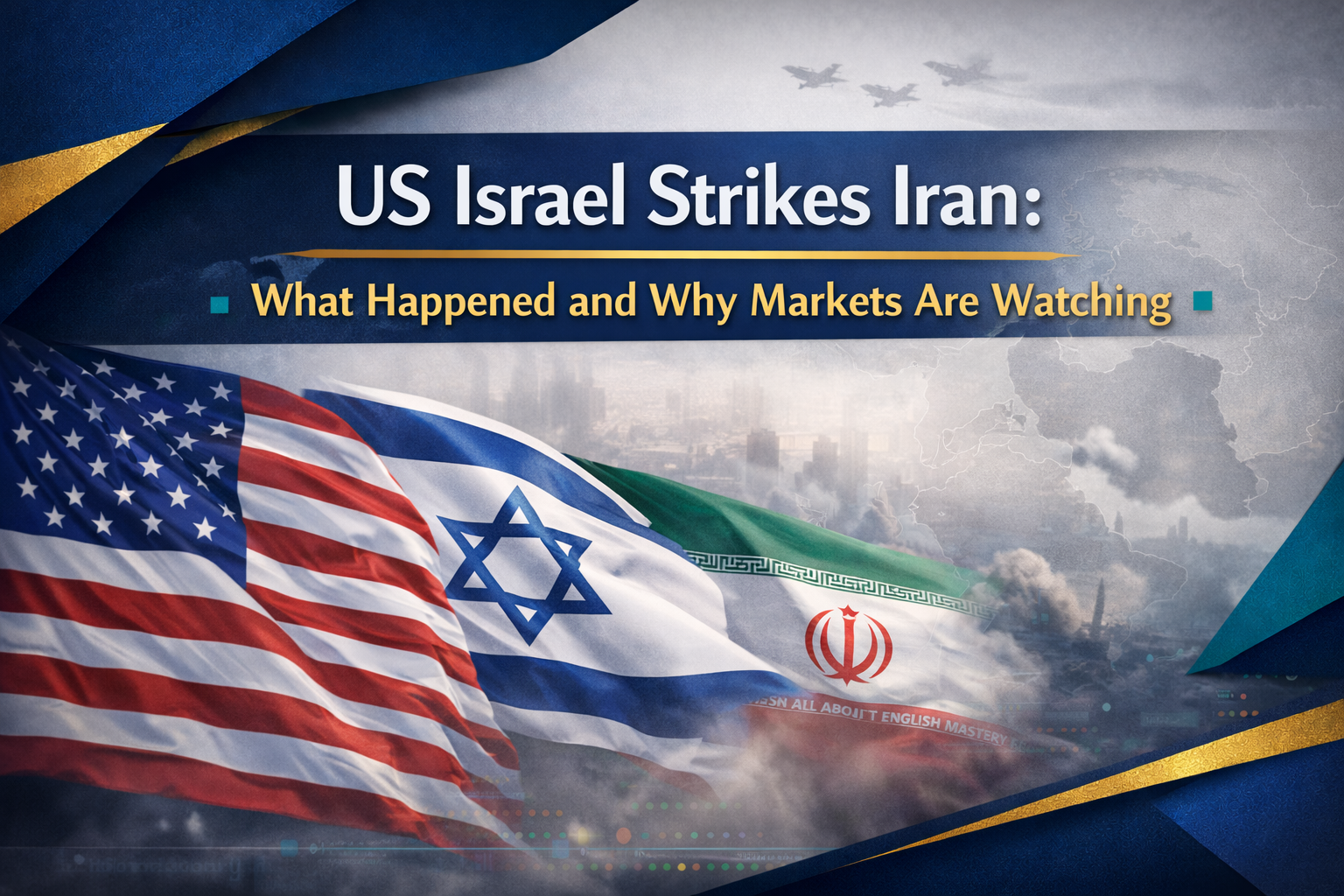
US Israel Strikes Iran: What Happened and Why Markets Are Watching
Advanced | March 1, 2026
✨ Read the article aloud on your own or repeat each paragraph after your tutor.
US Israel strikes Iran: A Sudden Escalation Overnight
On March 1, 2026, the United States and Israel launched coordinated strikes on Iran—the US Israel strikes Iran story—triggering immediate fears of a wider regional conflict. Reuters reported the U.S. operation (described by U.S. officials as Operation Epic Fury) included Tomahawk cruise missiles, F-18 and F-35 aircraft, and the first combat use of a new low-cost, one-way drone system modeled after Iranian Shahed drones. (Reuters)
The Targeting Logic: Leadership and Strategic Sites
According to Reuters, the strikes were tied to real-time intelligence suggesting Iran’s top leadership was gathered with senior security aides—prompting an accelerated decision to hit early. Reuters said the operation was designed to strike Supreme Leader Ayatollah Ali Khamenei and other top figures, though the full picture of outcomes and verification remains contested and politically charged. (Reuters)
Iran’s Response: Retaliation Across the Region
Retaliation came quickly. Reuters reported Iranian missiles struck or targeted multiple locations in the Gulf, with explosions or air defenses activated in several cities, and at least one death reported in the UAE in earlier waves of retaliation (Reuters). They also reported loud blasts over Dubai and Doha as the second day of escalation unfolded (Reuters).
The Diplomacy Track: An Emergency UN Meeting
As strikes and counter-strikes widened, the U.N. Security Council convened an emergency meeting. AP reported U.N. Secretary-General António Guterres condemned the attacks and urged an end to hostilities, while U.S., Israeli, and Iranian diplomats argued sharply over legality, civilian harm, and responsibility. (AP News) A separate briefing note summarized the emergency meeting dynamics and divisions among major powers. (Security Council Report)
Why Business Leaders Care: Risk, Shipping, and Energy
Even if you don’t follow geopolitics, this story matters for business because it touches three sensitive systems: energy prices, shipping routes, and investor confidence. Markets tend to price in “worst-case” risks first—especially if the Strait of Hormuz becomes threatened or tanker insurance costs spike. Reuters published market reactions noting that analysts expected higher energy prices if the conflict expanded. (Reuters / market reactions)
The Advanced English Takeaway
Notice the language used by governments: words like “proportional,” “self-defense,” “de-escalation,” and “sovereignty.” In high-stakes communication, leaders try to sound controlled—even when the situation is volatile. If you want to sound more authoritative in business English, practice stating firm positions with calm phrasing—especially during conflict or crisis.
Vocabulary
- coordinated (adjective) – planned and carried out together.
Example: The coordinated strikes involved both U.S. and Israeli forces. - escalation (noun) – a serious increase in conflict or tension.
Example: The escalation raised fears of a wider war. - retaliation (noun) – a response attack after being attacked.
Example: Iran’s retaliation included missile strikes across the region. - real-time intelligence (noun phrase) – information gathered and used immediately.
Example: Officials said real-time intelligence influenced the timing of the strike. - strategic (adjective) – important for long-term goals and advantage.
Example: Strategic sites include air defenses and command centers. - verification (noun) – confirmation that something is true.
Example: Verification is difficult during fast-moving conflicts. - sovereignty (noun) – a country’s right to govern itself.
Example: Several countries warned that sovereignty must be respected. - proportional (adjective) – not excessive; matched to the situation.
Example: Leaders argued over what counts as a proportional response. - disruption (noun) – an interruption that causes problems.
Example: Shipping disruption can affect global supply chains. - risk premium (noun) – extra cost or price added because of uncertainty.
Example: Oil markets add a risk premium during conflict.
Discussion Questions (About the Article)
- What details show the strikes were planned for speed and surprise?
- Why do you think both sides pay so much attention to wording and messaging?
- How does retaliation change the risk for neighboring countries?
- What role does the UN Security Council play in situations like this?
- Which vocabulary words from the article feel most useful for business English?
Discussion Questions (About the Topic)
- Should governments prioritize deterrence or diplomacy in crises? Why?
- How can geopolitical risk affect hiring, investment, and consumer confidence?
- Why are energy and shipping routes so central to global stability?
- What are the pros and cons of relying on government statements during conflict?
- If you were advising a global company, what risk plan would you recommend right now?
Related Idiom
“On a knife edge” – in a very dangerous or uncertain situation.
Example: After the US Israel strikes Iran operation, the region felt like it was on a knife edge.
📢 Want more advanced English practice with real news? 👉 Sign up for the All About English Mastery Newsletter! Click here to join us!
Want to finally Master English but don’t have the time? Mastering English for Busy Professionals is the course for you! Check it out now!
Follow our YouTube Channel @All_About_English for more great insights and tips.
This article took inspiration from: (Reuters), (Reuters (sources report)), (AP News), and (Security Council Report).


 English
  한국어
한국어