

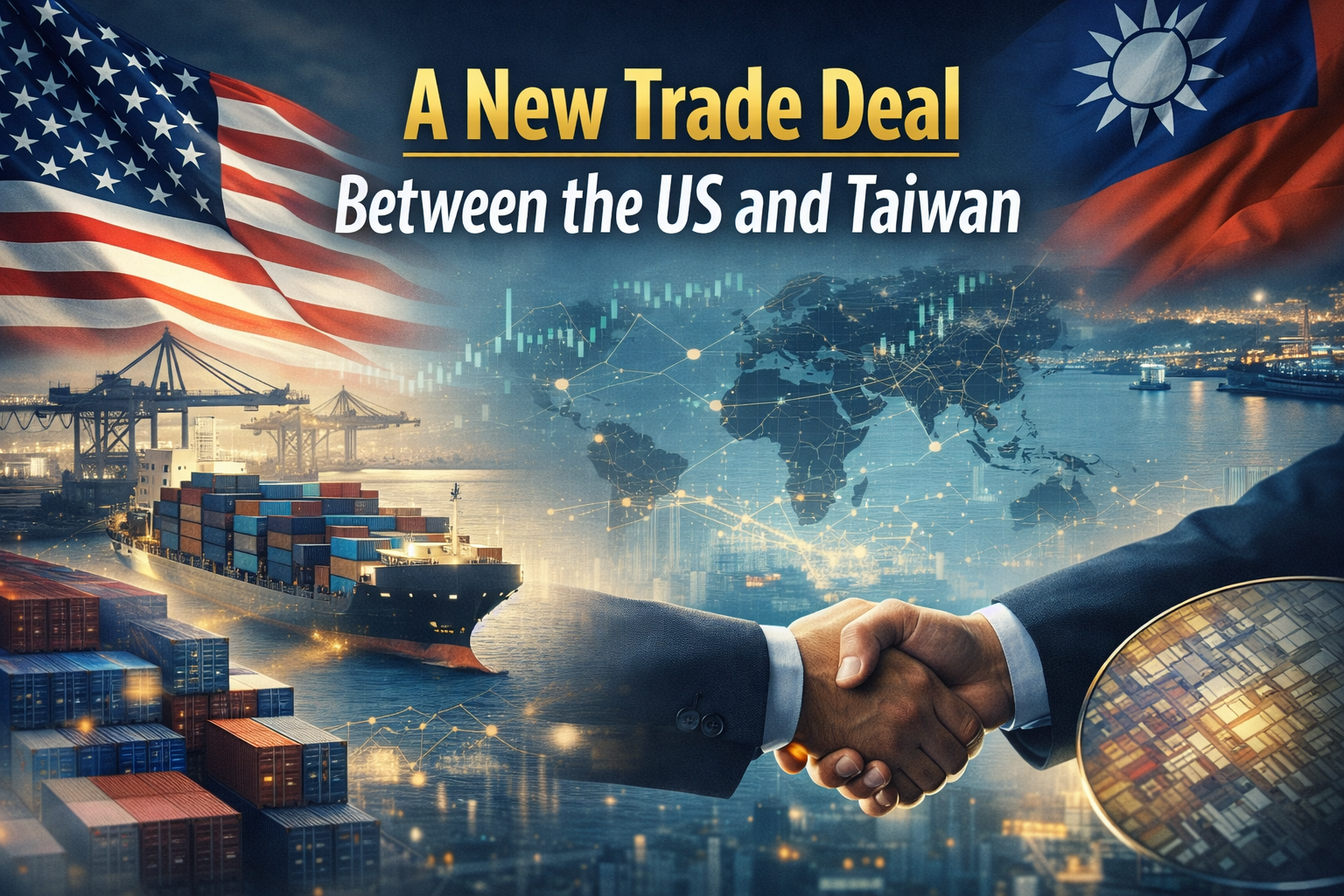
A New Trade Deal Between the US and Taiwan
Intermediate | March 8, 2026
✨ Read the article aloud on your own or repeat each paragraph after your tutor.
A Deal to Cut Tariffs
The United States and Taiwan recently finalized a trade deal that could change business between the two sides in a big way (Reuters). Under the agreement, the U.S. will keep a 15% tariff on imports from Taiwan, while Taiwan will reduce or remove tariffs on nearly all U.S. goods. Taiwan also agreed to increase purchases of American products such as energy, aircraft, and industrial equipment (Reuters).
What Is a Tariff, Anyway?
A tariff is basically a tax on imported goods. Governments use tariffs to protect local industries or to put pressure on trading partners. In this case, both sides were trying to reach a better balance. For Taiwan, the US-Taiwan tariff deal helps keep access to the U.S. market. For the U.S., the deal opens more doors for farmers, manufacturers, and energy exporters. From a business point of view, both sides are trying to strengthen the relationship without blowing up the supply chain.
Why the US-Taiwan Tariff Deal Matters to Taiwan
Taiwan is a major exporter, especially in high-tech products like semiconductors. A lower tariff level helps Taiwanese companies stay competitive in the American market. Taiwan’s leaders also said the deal could strengthen supply chains and support long-term cooperation with the U.S. (Reuters). That is especially important in an era when technology, energy, and manufacturing are all tied closely to politics.
Why This Matters to the United States
For the U.S., the US-Taiwan tariff deal is not just about trade numbers. It is also about strategic partnership. Taiwan agreed to buy tens of billions of dollars’ worth of U.S. goods over several years, including large purchases of energy and aircraft (Reuters). That could create opportunities for American companies and workers. In plain English, Washington wants more exports, stronger supply chains, and closer ties with a key partner in Asia.
Not Everyone Is Ready to Celebrate Yet
Even so, there are still questions. Taiwan’s parliament must approve the deal, and trade policy can always shift when politics shift. Taiwanese officials later sought reassurance that the favorable terms would stay in place (Reuters). So while the deal looks important, it is not the end of the story. It is more like a major checkpoint in a longer negotiation.
A Useful Story for English Learners
This is a great news topic for English learners because trade vocabulary shows up all the time in business conversations. Words like tariff, exports, imports, and supply chain are useful whether you work in tech, manufacturing, shipping, or sales. This story gives you real-world English that you can actually use in meetings and discussions.
Vocabulary
- Tariff (noun) – a tax placed on imported goods.
Example: Taiwan and the U.S. agreed to lower some tariffs under the new trade deal. - Import (noun/verb) – a product brought into a country from another country.
Example: The U.S. applies tariffs to some imported goods. - Export (noun/verb) – a product sold to another country.
Example: Taiwan exports many high-tech products to global markets. - Competitive (adjective) – able to succeed well against others.
Example: Lower tariffs can help Taiwanese products stay competitive in the U.S. - Supply chain (noun) – the system used to produce and move goods.
Example: Both sides said the deal could strengthen the supply chain. - Agreement (noun) – a formal decision made by two or more sides.
Example: The trade agreement includes new rules on tariffs and purchases. - Partnership (noun) – a relationship built for working together.
Example: The U.S. and Taiwan want to deepen their economic partnership. - Approval (noun) – official permission or acceptance.
Example: Taiwan’s parliament still needs to give approval to the deal. - Strategic (adjective) – related to long-term plans and important goals.
Example: Many experts see Taiwan as a strategic partner for the United States. - Negotiation (noun) – formal discussion to reach an agreement.
Example: The final deal came after months of negotiation.
Discussion Questions (About the Article)
- What are the main points of the new U.S.-Taiwan trade deal?
- Why does Taiwan want lower tariffs on its exports to the U.S.?
- Why is this deal important for U.S. companies and workers?
- What concerns still remain even after the agreement was finalized?
- Which industries are most likely to be affected by this deal?
Discussion Questions (About the Topic)
- Do tariffs help or hurt the economy in most cases?
- Why are supply chains so important in today’s global economy?
- Should countries use trade deals for political goals as well as economic ones?
- How can a trade deal affect ordinary workers and consumers?
- Which is more important: free trade or protecting domestic industries?
Related Idiom
“A double-edged sword” – something that has both benefits and risks.
Example: Tariffs can be a double-edged sword because they may protect some industries while hurting others.
📢 Want more practical English using real news? 👉 Sign up for the All About English Mastery Newsletter! Click here to join us!
Want to finally Master English but don’t have the time? Mastering English for Busy Professionals is the course for you! Check it out now!
Follow our YouTube Channel @All_About_English for more great insights and tips.
This article was inspired by Reuters reporting on the U.S.-Taiwan trade agreement.


 English
  한국어
한국어