

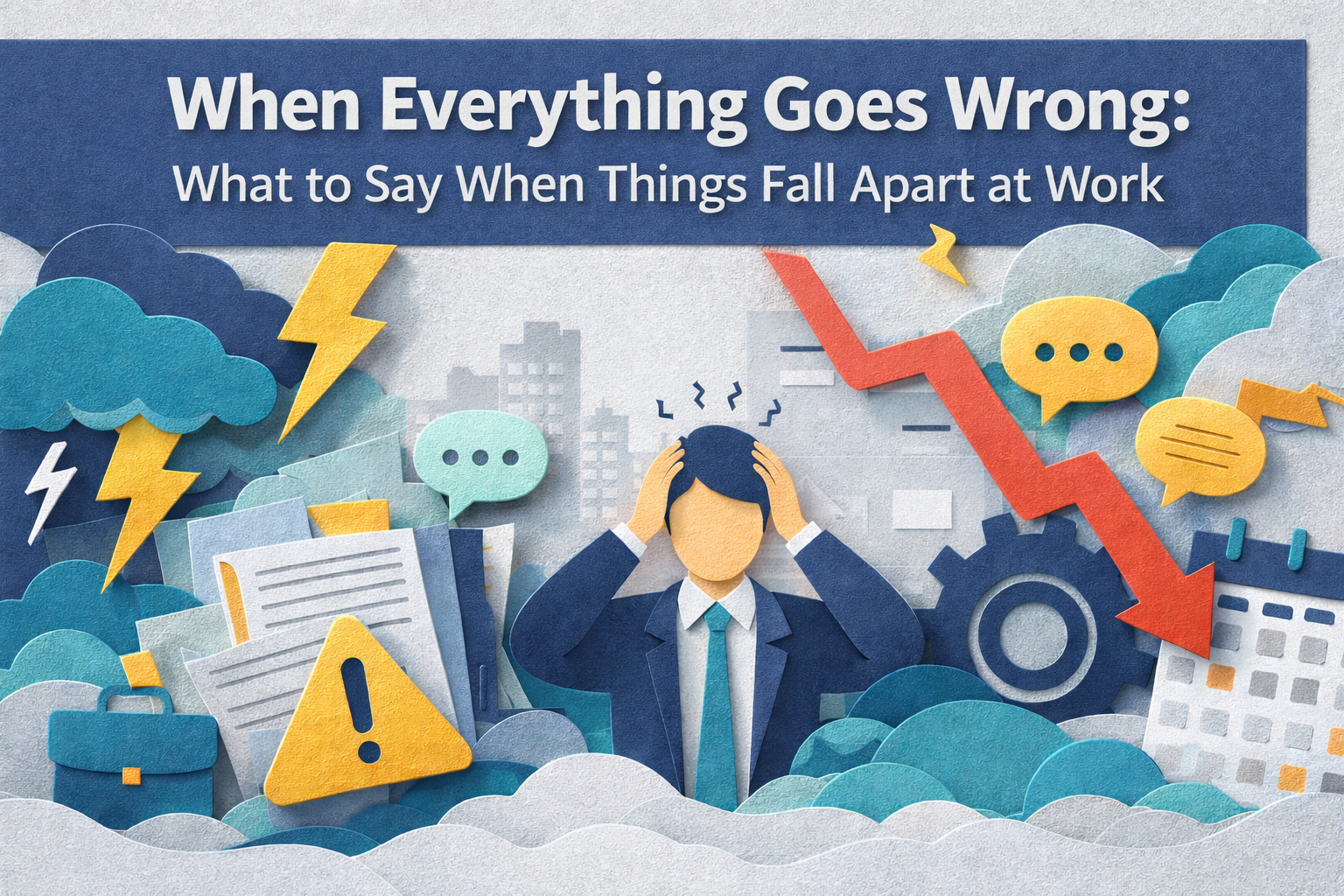
When Everything Goes Wrong: What to Say When Things Fall Apart at Work
Advanced Level | April 2, 2026
Read the article aloud on your own or repeat each paragraph after your tutor.
Some days at work feel smooth and productive. Other days feel like a train jumping off the tracks while your inbox catches fire. A client changes the deadline, your manager wants updates, a teammate misses an important detail, and now everyone is looking at you like you have a magic button hidden under your desk. When everything goes wrong, many English learners know what they want to say, but they struggle to say it calmly and clearly in the moment.
The truth is, hard moments at work are not just a test of skill. They are also a test of communication. People notice how you speak when things are messy. Do you panic? Do you go silent? Or do you sound steady, practical, and solution-focused? If you can learn to speak clearly during stressful moments, you will sound more professional, more trustworthy, and more confident.
Why Speaking Well Matters When Everything Goes Wrong
In calm situations, almost anyone can sound prepared. However, pressure reveals your real habits. When everything goes wrong, people want clarity more than fancy language. They want to know what happened, what the problem is, what the next step will be, and whether they can trust you to handle it. That means your job is not to sound perfect. Your job is to sound useful.
Imagine this situation: the presentation file will not open, the meeting starts in three minutes, and your boss asks, “What’s happening?” A weak answer sounds like this: “Uh… there is a little problem, and I’m checking many things now.” A stronger answer sounds like this: “The file is not opening properly, so I’m switching to the backup version now. I’ll have it ready in two minutes.” One answer spreads stress. The other creates confidence.
Stop Explaining Everything
When people feel nervous, they often talk too much. They add too many details, repeat themselves, and make the situation sound even worse. This is one of the biggest speaking mistakes professionals make when everything goes wrong. In high-pressure moments, long explanations usually create more confusion, not more trust.
A better approach is to give short updates with clear structure. First, state the problem. Second, explain the action. Third, give the next step. For example: “The shipment is delayed at customs. We’ve already contacted the broker. I’ll update the client by 3 p.m.” That kind of structure helps you sound calm, even if your internal engine room is taking on water.
Useful Phrases for When Everything Goes Wrong
You do not need dramatic language when something goes wrong. In fact, simple language is usually stronger. Phrases like “Here’s the issue,” “This is what we know so far,” “We’re working on it now,” “The next step is…,” and “I’ll keep you updated” are practical and professional. These expressions help you guide the conversation instead of getting lost inside it.
Another helpful habit is to avoid blame in the first few moments. If you immediately start pointing fingers, people may see you as emotional or defensive. Focus on the facts first. Later, when things calm down, you can discuss responsibility and process. In the moment, your goal is to move the situation forward.
Sound Calm, Not Passive
There is a big difference between sounding calm and sounding weak. Calm language is direct and grounded. Passive language sounds unsure. Compare these two examples: “Maybe we might need to check it again” versus “We need to check it again before sending it.” The second sentence is clearer and stronger. It shows leadership without sounding aggressive.
When everything goes wrong, your voice matters too. Slow down a little. Use shorter sentences. Pause before answering. These habits make you sound more in control. Ironically, the calmer you sound, the more people will believe you can help fix the problem.
How to Practice Before the Next Crisis
The best time to prepare for stressful English is before the stressful moment arrives. Think about three common problems in your job. Maybe a deadline slips, a customer complains, or a technical issue blocks progress. Write one or two clear responses for each situation and practice saying them aloud. This builds speaking muscle memory, so your words come faster when pressure hits.
You can also practice with a tutor, coworker, or even by yourself. Say the situation out loud and answer it like it is happening now. For example: “The client is upset about the delay. What do you say?” Then respond: “I understand the concern. We found the issue this morning, and we’re fixing it now. I’ll send you a full update by noon.” This kind of rehearsal helps turn panic into control.
When everything goes wrong, strong English is not about using bigger words. It is about giving people confidence in a difficult moment. If you can describe the issue, explain the action, and lead the next step with calm language, you will stand out in the best possible way. Trouble will come sooner or later. When it does, let your English look like leadership.
Vocabulary List
- Pressure (noun) — the stress or demand you feel in a difficult situation.
Example: He communicates clearly under pressure. - Clarity (noun) — the quality of being clear and easy to understand.
Example: Her clarity helped the team stay focused during the problem. - Trustworthy (adjective) — able to be trusted.
Example: He sounded trustworthy when he explained the problem calmly. - Backup (noun) — a copy or extra option used if the main one fails.
Example: We used the backup file when the original presentation crashed. - Structure (noun) — an organized way of arranging ideas.
Example: A clear structure makes stressful updates easier to understand. - Delay (noun/verb) — a situation in which something happens later than planned.
Example: The shipping delay forced the team to change the schedule. - Passive (adjective) — not direct or active in expression or behavior.
Example: His passive answer made the problem sound even more confusing. - Grounded (adjective) — calm, stable, and sensible.
Example: She stayed grounded even when everything went wrong. - Rehearsal (noun) — practice done before the real event or situation.
Example: A quick rehearsal helped him answer the client with confidence. - Crisis (noun) — a serious problem or dangerous moment.
Example: Good communication matters most during a crisis.
5 Questions About the Article
- Why is communication especially important when everything goes wrong?
- What three parts should a short problem update include?
- Why is it better to avoid blame at the beginning of a crisis?
- What is the difference between calm language and passive language?
- How can someone practice for stressful speaking situations before they happen?
5 Open-Ended Discussion Questions
- What kinds of problems usually create the most pressure in your job?
- How do people in your workplace usually speak when things go wrong?
- What phrases would help you sound calmer in a tense meeting?
- Can you remember a time when clear communication solved a difficult situation?
- How would you like to sound the next time something goes wrong at work?
📢 Want more tips like this? 👉 Sign up for the All About English Mastery Newsletter! Click here to join us!
Want to finally Master English but don’t have the time? Mastering English for Busy Professionals is the course for you! Check it out now!
Follow our YouTube Channel @All_About_English for more great insights and tips.

 English
  한국어
한국어