

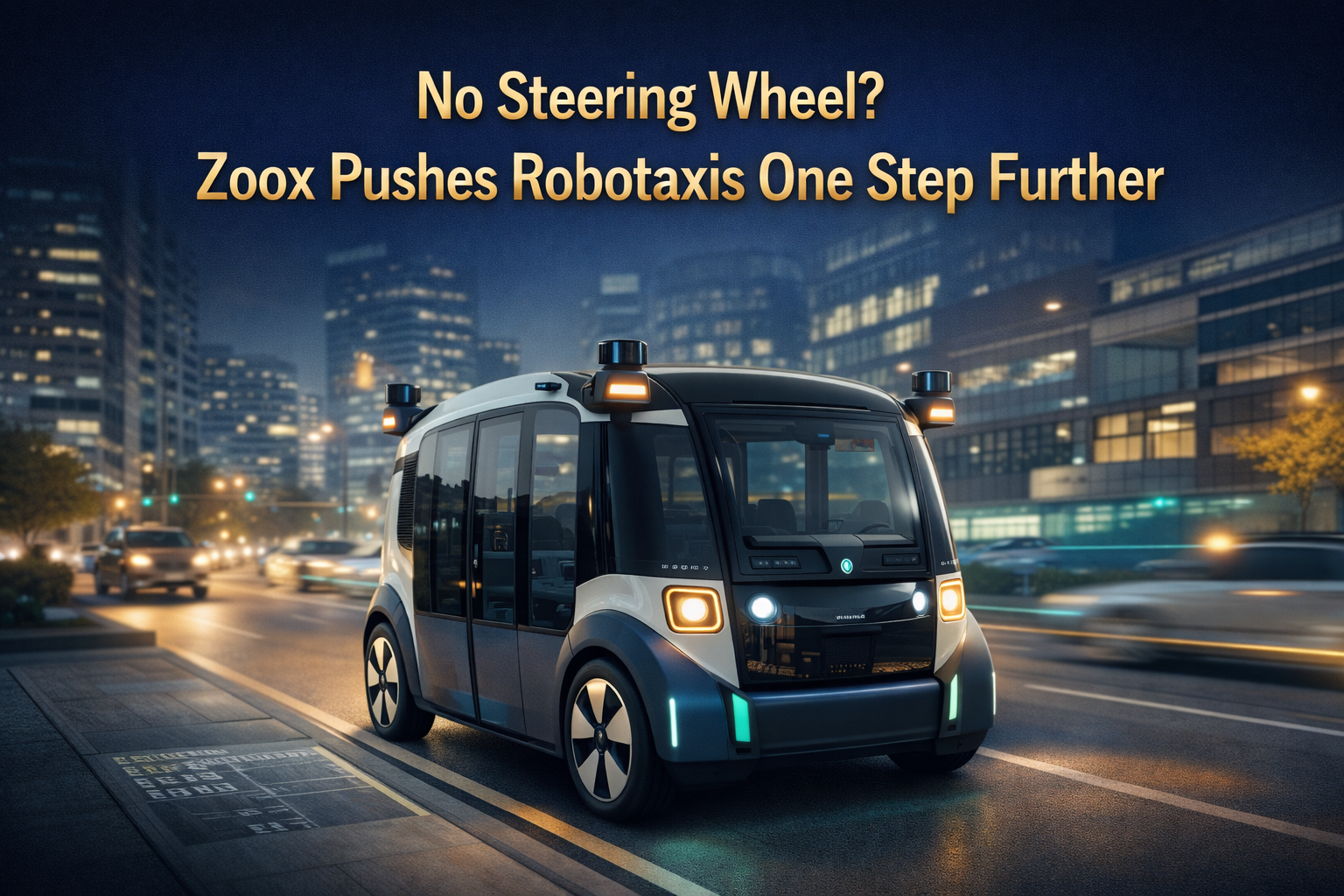
No Steering Wheel? Zoox Pushes Robotaxis One Step Further
Intermediate | March 12, 2026
✨ Read the article aloud on your own or repeat each paragraph after your tutor.
A Strange-Looking Taxi With No Driver Controls
Self-driving cars already sound futuristic, but Zoox is pushing things even further. The Amazon-owned company wants to deploy robotaxis that do not have a steering wheel, brake pedal, or other traditional human controls. According to Reuters, the U.S. National Highway Traffic Safety Administration, or NHTSA, is now asking the public to comment on Zoox’s petition. If approved, Zoox could deploy up to 2,500 of these purpose-built robotaxis on U.S. roads.
Why Zoox Robotaxis Without Steering Wheels Are a Big Deal
This matters because most self-driving vehicles on the road today still keep ordinary controls like a steering wheel and pedals, even if a computer does the driving. Reuters reported that companies can deploy fully autonomous vehicles with normal human controls without special approval, but vehicles without those controls need exemptions from federal safety rules. Zoox is asking for exemptions from eight federal safety standards that were originally written for human-driven cars. That is why Zoox robotaxis without steering wheels have become such an important test case.
What Makes the Zoox Vehicle Different
Zoox’s vehicle is not just a regular car with new software. The company says its robotaxi is purpose-built for riders, not for drivers (Zoox). A Zoox vehicle brochure says it can travel up to 75 miles per hour in either direction, and its cabin is designed around passengers rather than a front seat driver (Zoox brochure). Reuters also described the seating as carriage-style, which helps explain why the vehicle looks so unusual compared with a normal taxi or car.
The Safety Question Is Still Front and Center
Of course, the big question is safety. Reuters said Zoox told NHTSA that its robotaxi would provide a level of safety at least equal to ordinary vehicles, even without human controls. NHTSA has moved slowly in the past on these kinds of requests, and Reuters noted that earlier petitions from General Motors to deploy vehicles without steering wheels were eventually withdrawn between 2018 and 2024 (Reuters). At the same time, NHTSA has already been adapting some safety rules for automated vehicles, including earlier changes to occupant protection standards for vehicles without traditional driver positions (Federal Register).
A Bigger Push for Robotaxis
This petition is also part of a larger push to make robotaxis more common in American cities. Just one day after that Reuters report, Reuters also reported that Uber and Zoox had signed a multi-year partnership to deploy Zoox robotaxis on Uber’s network, beginning in Las Vegas in summer 2026, with a wider rollout to Los Angeles planned by mid-2027 (Reuters). In other words, the company is not just testing a concept. It is trying to build a real business around it.
Why This Story Matters Beyond Cars
For English learners, this story is useful because it mixes technology, regulation, business, and public trust. A steering-wheel-free vehicle sounds exciting, but it also raises simple, practical questions: Who is responsible if something goes wrong? What should regulators require before the public gets in? And how much innovation is too much, too fast? In business language, this is a story about whether bold design can survive real-world rules.
Vocabulary
- Petition (noun) – an official request to a government agency or authority.
Example: “Zoox filed a petition asking for permission to deploy its robotaxis.” - Deploy (verb) – to put something into use or operation.
Example: “The company wants to deploy up to 2,500 robotaxis.” - Exemption (noun) – special permission not to follow a usual rule.
Example: “Zoox needs an exemption from several safety standards.” - Purpose-built (adjective) – designed for one specific use.
Example: “Zoox says its robotaxi is purpose-built for riders.” - Autonomous (adjective) – able to operate without direct human control.
Example: “Autonomous vehicles use software and sensors to drive themselves.” - Regulator (noun) – a government body that creates or enforces rules.
Example: “The regulator is now asking the public for comment.” - Standard (noun) – an official level or rule that something must meet.
Example: “Federal safety standards were written for human-driven cars.” - Carriage-style (adjective) – arranged like a carriage, with seats facing inward.
Example: “The robotaxi has carriage-style seating instead of a driver-focused layout.” - Occupant protection (noun) – safety systems designed to protect people inside a vehicle.
Example: “Occupant protection rules still matter even without a steering wheel.” - Rollout (noun) – the launch or introduction of a product or service.
Example: “Zoox plans a wider rollout after its first launch in Las Vegas.”
Discussion Questions (About the Article)
- What is Zoox asking NHTSA to approve?
- Why does Zoox need special permission for these robotaxis?
- What makes the Zoox vehicle different from a normal car?
- Why is safety still the biggest issue in this story?
- How does the Uber partnership change the importance of Zoox’s plan?
Discussion Questions (About the Topic)
- Would you ride in a robotaxi with no steering wheel? Why or why not?
- Should governments move quickly or slowly when approving new autonomous vehicles?
- What matters more in transport innovation: speed, convenience, or safety?
- How can companies build public trust in new technology?
- What jobs or industries could change if robotaxis become common?
Related Idiom
“Take the wheel” – to take control of a situation.
Example: “In this case, no human can take the wheel, so people have to trust the software.”
📢 Want more practical English using real news? 👉 Sign up for the All About English Mastery Newsletter! Click here to join us!
Want to finally Master English but don’t have the time? Mastering English for Busy Professionals is the course for you! Check it out now!
Follow our YouTube Channel @All_About_English for more great insights and tips.
This article was inspired by Reuters, Reuters follow-up, Zoox, Zoox brochure, and the Federal Register.


 English
  한국어
한국어