

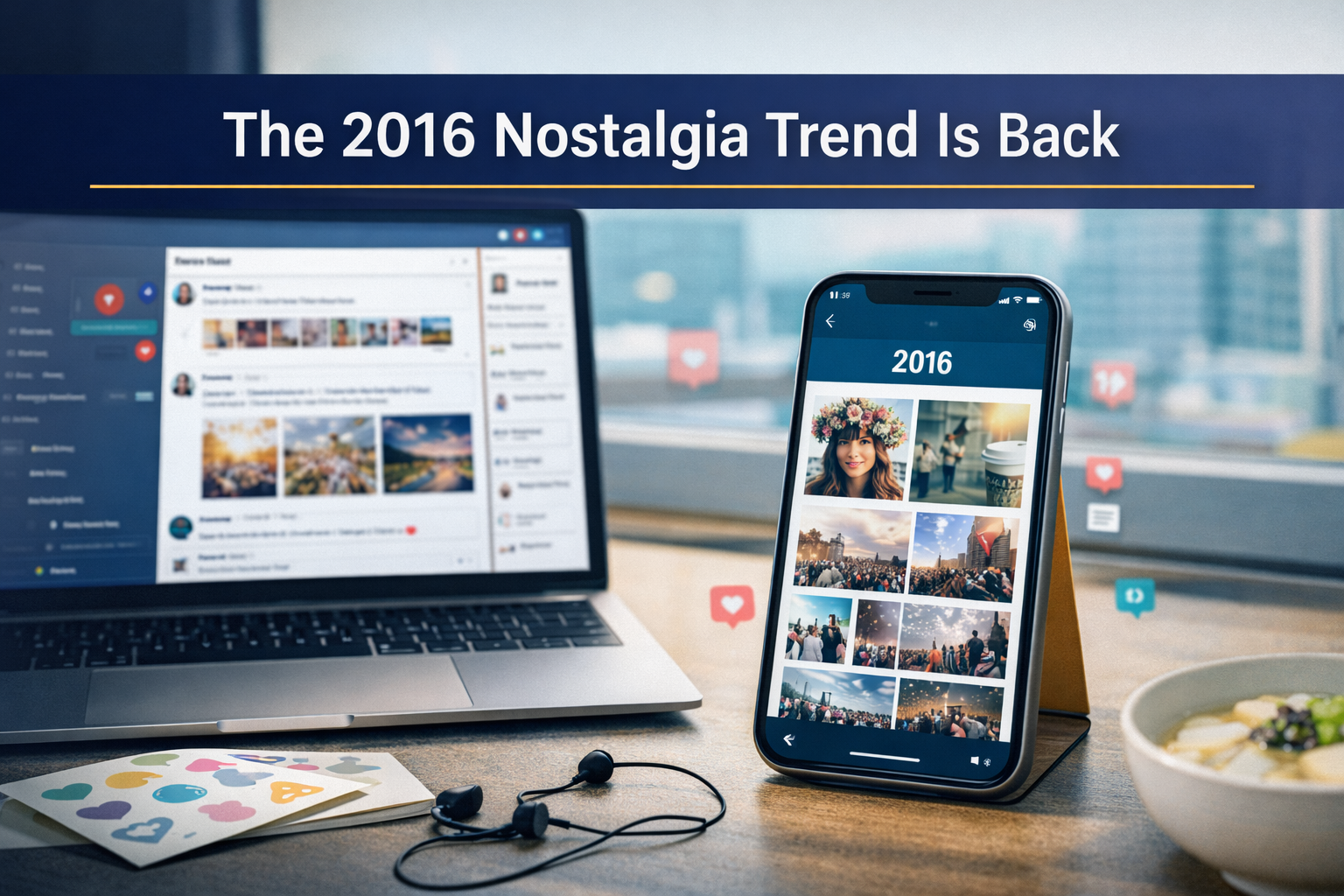
The 2016 Nostalgia Trend Is Back
Beginner | February 13, 2026
✨ Read the article aloud on your own or repeat each paragraph after your tutor.
The 2016 Nostalgia Trend Is Everywhere
Open your phone in 2026 and you might feel like you time-traveled. The 2016 nostalgia trend is suddenly everywhere. People are suddenly posting throwback photos from 2016, sharing old memes, and bringing back trends like Snapchat filters, bold makeup, and even “2016 party” playlists. In the U.S., this wave of nostalgia has gotten so big that major media outlets are calling it a real cultural moment—not just a small internet joke. (The Wall Street Journal)
What People Miss About 2016
So what’s the big deal about that year? Many people remember 2016 as a time when the internet felt more fun and less stressful. Today, social media can feel more performative—like everyone is “building a brand.” But in 2016, posting was often messier, sillier, and more relaxed. Some writers say it felt like one of the last moments when culture felt more shared, before algorithms divided everyone into tiny corners of the internet. (Vogue)
Music, Makeup, and “2016 Parties”
The comeback isn’t just talk—the 2016 nostalgia trend is changing what people listen to and buy. According to reporting referenced by the WSJ, Spotify saw a huge jump (reported as 800%) in user-made “2016 playlists.” People are also replaying songs from artists like Drake and Rihanna, and some clubs have hosted 2016-themed nights that sell out. If you’re in business, this is a big signal: nostalgia can be a powerful marketing tool when it hits the right moment. (The Wall Street Journal)
Brands Are Cashing In (Especially Beauty)
Companies are paying attention because consumers are changing their style again. A separate business report notes that Gen Z’s “2016 nostalgia” is helping drive renewed interest in bold looks, which can lift sales for cosmetics and retailers. In other words, brands see this trend gaining traction—and they’re trying to ride the wave while it’s hot. (MarketWatch)
Why Now? The “Ten-Year Rule” and a Tough Decade
There’s also a simple timing reason: 2016 is about 10 years ago, and people often feel nostalgic in “decade cycles.” But it’s not only about time. Many people look back at 2016 as “before everything got heavy”—before the pandemic years, and before daily online life felt so intense. Another analysis points out the irony: 2016 had serious problems too, but memory often keeps the fun parts and blurs the stress. (The Washington Post)
What This Means for You (English + Real Life)
If you hear people say “Bring back 2016,” they’re usually not making a political statement. They’re saying, “I miss when things felt simpler.” In English, this is a great chance to practice talking about trends, nostalgia, and how culture changes. And if you work in marketing, sales, or content, it’s a reminder that emotions—not logic—often drive what people click, buy, and share.
Vocabulary
- Nostalgia (noun) – a warm feeling when you remember the past.
Example: “2016 nostalgia is trending online.” - Throwback (noun) – something that reminds people of the past.
Example: “She posted a throwback photo from 2016.” - Trend (noun) – something popular for a period of time.
Example: “The 2016 trend is spreading fast.” - Viral (adjective) – shared very quickly online.
Example: “The video went viral in one day.” - Algorithm (noun) – a system that decides what content you see online.
Example: “The algorithm showed me more 2016 videos.” - Performative (adjective) – done to look good to others, not because it’s real.
Example: “Some people say social media feels more performative now.” - Resurgence (noun) – a return to popularity.
Example: “There’s a resurgence of 2016 music and fashion.” - Cash in (phrasal verb) – to benefit or make money from something.
Example: “Some brands are trying to cash in on the nostalgia wave.” - Theme night (noun) – an event focused on one topic or time period.
Example: “The club hosted a 2016 theme night.” - Cycle (noun) – a pattern that repeats over time.
Example: “Fashion trends often return in a cycle.”
Discussion Questions (About the Article)
- What kinds of 2016 things are people bringing back in 2026?
- Why do some people think 2016 felt “simpler” online?
- What examples of music or parties are mentioned in the story?
- How are businesses and brands responding to this trend?
- Do you think nostalgia shows the truth about the past, or only the fun parts?
Discussion Questions (About the Topic)
- What year do people in your country feel nostalgic about? Why?
- What trend from the past would you like to bring back?
- Do you think social media was better “before”? Why or why not?
- How can companies use nostalgia in marketing without being annoying?
- What’s a good memory you have from 10 years ago?
Related Idiom
“Ride the wave” – to take advantage of a trend while it’s popular.
Example: “Beauty brands are trying to ride the wave of 2016 nostalgia.”
📢 Want more English practice like this? 👉 Sign up for the All About English Mastery Newsletter! Click here to join us!
Want to finally Master English but don’t have the time? Mastering English for Busy Professionals is the course for you! Check it out now!
Follow our YouTube Channel @All_About_English for more great insights and tips.
This article was inspired by: The Wall Street Journal, plus supporting reporting from Vogue, The Washington Post, and MarketWatch.
 English
  한국어
한국어