

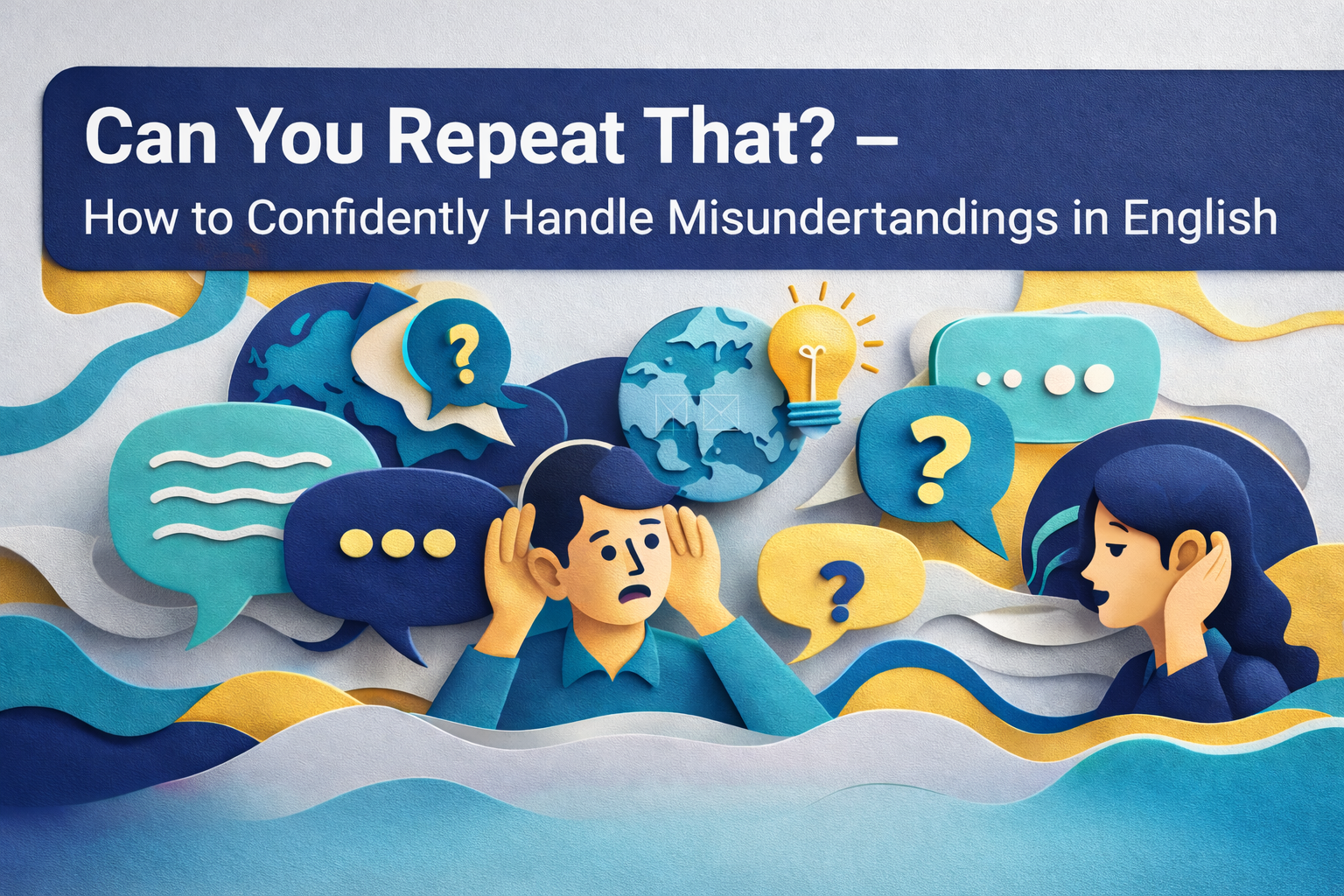
Can You Repeat That? Simple Ways to Handle Misunderstandings in English ☎️
Beginner Level | March 9, 2026
Read the article aloud on your own or repeat each paragraph after your tutor.
Why Misunderstandings Happen at Work
Misunderstandings happen—even for native speakers. In a busy workplace, people speak fast, use new words, or talk while walking to the next meeting. When you don’t understand, the worst move is to smile and pretend. That can create bigger problems later.
The good news? You don’t need perfect English to handle misunderstandings. You just need a few “safe phrases” that keep the conversation friendly and moving forward.
Safe Phrase 1: Can You Repeat That?
First, use a polite restart. Say: “Sorry, can you repeat that?” This is simple, professional, and very common. If you want to sound a little softer, try: “Sorry, I didn’t catch that.” (This means: I didn’t hear/understand it.)
Safe Phrase 2: Ask for Slower Speech
Next, ask for slower speech. Many people can slow down if you ask clearly. Try: “Could you say that a little more slowly?” In meetings, you can add a business-friendly reason: “I want to make sure I understand.”
Safe Phrase 3: Confirm What You Heard
If you understood some of the message, confirm what you heard. This is a strong connection skill because it shows you are listening carefully. Say: “So you mean we should change the deadline to Friday—right?” If you’re not sure, use: “Let me check I understood…” Then repeat your understanding in one short sentence.
Safe Phrase 4: Ask About One Word
Sometimes the problem is one word. Ask directly: “What does ‘deadline’ mean?” or “What does that word mean?” In a professional setting, you can also say: “Can you explain that in a simpler way?” Clear communication is more important than “sounding advanced.”
Safe Phrase 5: Handle Tech Problems on Calls
If you are on a call or Zoom, technical issues can cause misunderstandings. Use a quick tech check phrase like: “Your audio is cutting out. Can you say that again?” That keeps things calm and avoids blame.
The Big Idea: Clarifying Is Professional
Finally, remember this: asking for clarification is not rude. It’s responsible. When you speak up, you protect your work, reduce mistakes, and build trust. People usually respect you more when you communicate clearly.
Vocabulary List
- misunderstanding (noun) — a situation where people do not understand each other correctly
Example: A misunderstanding can happen when people speak too fast. - repeat (verb) — to say something again
Example: Could you repeat that, please? - catch (verb) — to hear or understand (informal)
Example: Sorry, I didn’t catch that. - clarify (verb) — to make something clear and easy to understand
Example: Can you clarify what you want me to do? - confirm (verb) — to check that something is correct
Example: Let me confirm the meeting time with you. - deadline (noun) — the last date or time to finish something
Example: The deadline for the report is Friday. - detail (noun) — a small piece of information
Example: Can you share one more detail about the plan? - explain (verb) — to say what something means in a clear way
Example: Can you explain that in a simpler way? - audio (noun) — sound from a call, video, or recording
Example: The audio is not clear on this call. - responsible (adjective) — careful and reliable; doing the right thing
Example: It’s responsible to ask questions when you are unsure.
5 Questions About the Article
- Why is it risky to smile and pretend you understand?
- What is one polite phrase to ask someone to repeat?
- How can you ask someone to speak more slowly?
- What phrase can you use to confirm what you heard?
- What can you say if the problem is one word?
5 Open-Ended Discussion Questions
- When was the last time you had a misunderstanding in English?
- Which “safe phrase” feels easiest for you to use? Why?
- In your job, what situations make misunderstandings more likely?
- How can you stay calm when you don’t understand?
- What is one phrase you want to practice this week?
📢 Want more simple, real-life English like this? 👉 Sign up for the All About English Mastery Newsletter! Click here to join us!
Want to finally Master English but don’t have the time? Mastering English for Busy Professionals is the course for you! Check it out now!
Follow our YouTube Channel @All_About_English for more great insights and tips

 English
  한국어
한국어